
Every therapist relies on memory that they rarely measure: the coping skill taught in session three has to be retrievable during a panic attack in week nine, and the psychoeducation about the cognitive model has to survive past the parking lot. LLM Yet the most common ways clients (and clinicians) try to make information stick—re-reading a handout, re-watching a video, highlighting—are among the least effective ways to build durable memory. 2 Retrieval practice, the cognitive phenomenon known as the testing effect, inverts that intuition: the act of pulling information out of memory does more to consolidate it than putting it in again. 1 This article translates a mature experimental literature into something usable at the level of a treatment plan. LLM
Type & Discipline
Retrieval practice is a learning technique, not a standalone therapy; it is a specific, manipulable procedure for strengthening memory that can be embedded inside many treatment and educational contexts. 4 It comes from cognitive psychology, specifically the science of human memory and learning, and belongs to the broader family of memory and learning research. 4 The underlying empirical finding is the testing effect (also called test-enhanced learning or the retrieval-practice effect): long-term retention is better after retrieving information than after restudying it for an equivalent amount of time. 14 Because it is a technique rather than a manualized therapy, clinicians deliver retrieval practice within established modalities—as a way of making the content of psychoeducation, skills training, or cognitive rehabilitation actually durable—rather than as a treatment in its own right. LLM
Creators & Lineage
The phenomenon has roots stretching back over a century, but its modern resurgence and theoretical sharpening are most associated with Henry Roediger and Jeffrey Karpicke, whose 2006 work reframed testing as a learning event rather than merely an assessment event. 1 Their landmark studies showed that students who took a memory test on studied material retained far more on a delayed final test than students who simply restudied the same material—even though restudying produced better performance in the short term. 1 Karpicke and Roediger then demonstrated that repeated retrieval during initial learning, rather than repeated study, is the key driver of long-term retention. 3
Andrew Butler, working with Roediger, helped consolidate the field with an influential synthesis arguing that retrieval practice plays a critical role in durable memory and detailing the conditions under which it works. 2 The technique sits within a lineage of memory-and-learning science and is closely allied with spaced repetition and distributed practice, since the benefits of retrieval compound when practice is spread over time. 25 It also connects to cognitive rehabilitation, where structured recall is used to support functioning in people with memory impairment. LLM More recently, neuroimaging work has begun to identify the neural correlates of retrieval-based memory enhancement, grounding the behavioral effect in measurable brain activity. 6
Core Principles
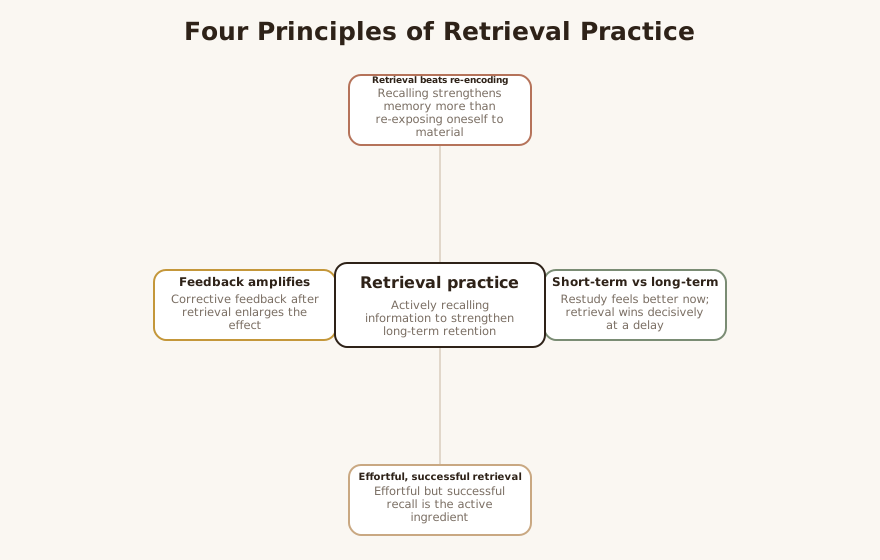
The first principle is the central asymmetry: retrieving information strengthens memory more than re-encoding it. 1 When learners spend study time reproducing material from memory—answering a question, recalling a definition, explaining a concept without looking—they retain markedly more over weeks and months than learners who spend the same time re-exposing themselves to the material. 13
The second principle is the short-term/long-term dissociation: restudying often feels better and produces stronger immediate performance, which is precisely why people prefer it, yet retrieval wins decisively at a delay. 1 This gap between subjective fluency and actual durability is a recurring trap; the easier strategy feels like it is working while it is quietly producing worse retention. 15
The third principle is that effortful, successful retrieval is the active ingredient. 2 Retrieval that is too easy adds little, while retrieval that is effortful but ultimately successful produces the largest gains—a phenomenon related to the idea of “desirable difficulty.” 5 The fourth principle is that feedback amplifies the effect: when retrieval is followed by corrective feedback, errors are corrected and the benefit increases, which is especially important for material the learner has not yet fully mastered. 2 Finally, repeated and spaced retrieval is better than massed or single retrieval, linking the technique to distributed practice. 32 At the mechanistic level, retrieval is thought to reconsolidate and reorganize the memory trace, and neural evidence suggests retrieval practice produces lasting changes in how memories are represented rather than a simple strengthening of the original encoding. 6
Interventions & Techniques
In applied settings the technique takes several concrete forms. LLM The most basic is the low-stakes recall prompt: a brief, ungraded question that asks the learner to reproduce material from memory rather than recognize it, since free recall and short-answer formats generally produce larger benefits than passive review. 1 A second is the brain dump or free recall: after reading or a session, the learner closes the material and writes down everything they can remember, then checks against the source—a direct application of retrieval followed by feedback. 2
A third is spaced retrieval: scheduling recall attempts at expanding intervals across days and weeks, which combines the testing effect with distributed practice. 35 A fourth is self-explanation and the “teach-back,” in which the learner explains a concept aloud from memory; the generative, retrieval-heavy nature of explaining is what makes it effective. LLM A fifth, central to clinical use, is feedback-coupled retrieval, ensuring that recall attempts are followed by accurate correction so that errors do not consolidate. 2
LLM-generated illustrative example (not a guideline): A therapist finishes teaching a client the cognitive triangle (thoughts–feelings–behaviors). Instead of handing over a worksheet to re-read, she asks the client to put it away and, at the start of the next three sessions, draw the triangle from memory and give one personal example. By the fourth session the client narrates the model fluently during a between-session activation, where a re-read handout would likely have stayed in the drawer. LLM
Evidence Base
The maturity of this evidence base is best described as established. LLM The testing effect is one of the most reliably replicated findings in cognitive psychology, demonstrated across hundreds of experiments, many materials, age ranges, and retention intervals. 24 Roediger and Karpicke’s experimental demonstrations are foundational and have been reproduced extensively. 1 Karpicke and Roediger’s work isolating repeated retrieval as the operative variable strengthened the causal claim that it is recall, not mere additional exposure, that drives retention. 3
Honest appraisal requires several qualifications. LLM First, most of the rigorous evidence comes from educational and laboratory learning paradigms, not from psychotherapy outcome trials; the transfer to clinical psychoeducation and skills retention is theoretically strong but less directly tested. LLM Second, the size of the effect depends on conditions: retrieval that fails repeatedly without feedback, or that is trivially easy, yields little benefit, so the technique is not automatically beneficial regardless of implementation. 2 Third, while neuroimaging is beginning to map the neural correlates of retrieval-induced enhancement, the mechanistic story is still being worked out. 6 What is not in doubt is the core behavioral claim—that effortful, successful, ideally spaced and feedback-supported retrieval produces better long-term retention than equivalent restudy. 12
Populations & Indications
Retrieval practice was developed and is best validated in students and learners, for whom the technique most directly improves retention of academic material. 1 It is indicated wherever durable learning is a treatment goal. LLM People with attention-deficit/hyperactivity disorder are a natural fit when study-skills coaching is part of care, because active retrieval is more engaging and less passively skippable than re-reading. LLM Older adults with memory concerns and individuals with mild cognitive impairment are populations in which structured, spaced retrieval is used within cognitive rehabilitation to support recall of functionally important information. LLM
Within general practice, two indications stand out: patients receiving psychoeducation, where the goal is for explanatory models to be remembered and used, and clients in skills-based therapy, where coping strategies must be retrievable under stress rather than merely understood in session. LLM In each case the relevant outcome is not in-session comprehension but later, real-world recall—precisely the variable retrieval practice improves. 1
Problems-for-Work
For psychoeducation retention, retrieval practice converts a one-time explanation into a durable mental model by having clients recall and re-derive the model across sessions rather than re-reading it. 1 For skill acquisition deficits, it strengthens the link between a triggering situation and the trained coping response, since rehearsing the skill from memory—not just recognizing it—predicts later access. 2
For learning and memory consolidation broadly, spaced, feedback-supported recall is a general-purpose strengthener that can be layered onto almost any educational content. 3 For attention-deficit/hyperactivity disorder (study skills) and academic underperformance, replacing re-reading and highlighting with self-testing and brain dumps directly targets the inefficient passive strategies that often drive poor outcomes. 5 For forgetting and poor retention and mild cognitive impairment, structured spaced-retrieval routines are used to keep functionally important information accessible. LLM
LLM-generated illustrative example (not a guideline): A college student with attention-deficit/hyperactivity disorder reports studying for hours yet “blanking” on exams. The clinician reframes the problem: the student has been re-reading, which feels productive but builds fragile memory. They replace it with closed-book self-quizzing and weekly spaced recall, with answer-key feedback. Over a term, exam recall improves not because the student studies more but because study time is now spent retrieving rather than re-reading. LLM
Contraindications, Cautions & Cultural Humility
There are no medical contraindications to a learning technique, but there are real cautions about implementation. LLM The first is retrieval without feedback on poorly learned material: if a client repeatedly fails to recall and receives no correction, errors can consolidate and frustration can mount, so feedback is essential when mastery is incomplete. 2 The second is misjudged difficulty: retrieval must be effortful enough to matter but achievable enough to succeed, and pushing recall on material a client never encoded will simply produce failure. 5
A third caution is emotional: in trauma-related or grief work, “retrieval” of distressing autobiographical content is a different and clinically loaded act than retrieving neutral skill content, and this technique refers to the latter; it should not be casually applied to emotionally charged memories without appropriate clinical framing. LLM Cultural humility matters because the format of testing carries different meanings across educational and cultural backgrounds—self-quizzing can evoke evaluation anxiety or shame for clients whose histories with testing are aversive—so the clinician should frame recall as low-stakes practice, not assessment, and adapt the format to the client’s comfort. LLM With memory-impaired and older adults, pacing, errorless-learning adaptations, and dignity-preserving framing should guide how aggressively retrieval is pushed. LLM
Treatment-Plan Suggestions & SMART Objectives
| Goal | SMART objective (example) | Mechanism |
|---|---|---|
| Make psychoeducation durable | Over 4 sessions, client will reproduce the core treatment model from memory at the start of each session, accurately on 3 of 4 occasions | Retrieval strengthens long-term retention more than restudy 1 |
| Replace passive study with active recall | Within 3 weeks, client will substitute closed-book self-quizzing for re-reading on at least 4 of 5 study sessions, logged weekly | Effortful retrieval outperforms re-exposure 2 |
| Build coping-skill accessibility under stress | Over 6 weeks, client will recall and demonstrate one taught coping skill from memory at the start of session, weekly, without prompts | Retrieval links cue to response for later access 2 |
| Add spacing to consolidate learning | Within 4 weeks, client will complete recall attempts on key material at 1-, 3-, and 7-day intervals, on 80% of scheduled prompts | Repeated, spaced retrieval maximizes retention 3 |
| Couple retrieval with feedback | Within 2 weeks, client will check each self-quiz answer against a key and correct errors, on 100% of attempts | Feedback corrects errors and amplifies the effect 2 |
| Reduce reliance on highlighting/re-reading | Over 6 weeks, client will use a weekly “brain dump” before reviewing notes, on 5 of 6 weeks | Generative recall beats recognition-based review 5 |
| Support functional recall (memory concerns) | Over 8 weeks, client will use spaced retrieval to recall 3 functionally important items daily, with caregiver feedback, on 6 of 7 days | Structured spaced retrieval supports impaired memory LLM |
Common Misconceptions
A first misconception is that testing only measures learning; in fact retrieval is itself a learning event that changes and strengthens memory. 1 A second is that re-reading is an efficient way to study—it produces a comforting sense of fluency but markedly weaker long-term retention than self-testing. 15 A third is that the immediate performance during study reflects what will be retained later; the short-term advantage of restudy reverses at a delay, so in-session ease is a poor guide to durability. 1 A fourth is that retrieval practice requires formal tests or technology; the simplest closed-book recall prompt or brain dump captures the core benefit. 5 A fifth is that the benefit comes from extra exposure; controlled work shows it is the act of retrieving, not additional study time, that drives retention. 3 Finally, retrieval practice is sometimes mistaken for a therapy unto itself; it is a memory technique that strengthens whatever content a clinician embeds it in. LLM
Training & Certification
There is no certification in retrieval practice, because it is a cognitive technique rather than a credentialed clinical method. LLM Clinicians develop competence by reading the primary literature—Roediger and Karpicke’s foundational demonstrations, Karpicke and Roediger’s isolation of repeated retrieval, and Roediger and Butler’s synthesis of the conditions for effective practice. 132 Accessible secondary explainers translate these findings into classroom-style implementation that maps readily onto psychoeducation and coaching. 5 Practical skill comes from building recall prompts, spacing schedules, and feedback loops into modalities the clinician is already trained in—such as cognitive behavioral therapy, skills training, or cognitive rehabilitation—rather than from any retrieval-practice-specific credential. LLM
Key Terms
- Testing effect (retrieval-practice effect): The finding that retrieving information from memory improves long-term retention more than restudying it. 1
- Test-enhanced learning: Framing tests as learning events that strengthen memory, not merely as assessments of it. 1
- Retrieval practice: The technique of deliberately recalling information from memory as a study or rehearsal method. 4
- Short-term/long-term dissociation: Restudy can produce better immediate performance yet worse retention at a delay than retrieval. 1
- Desirable difficulty: Conditions that make learning feel harder in the moment but improve durable retention, including effortful retrieval. 5
- Spaced retrieval: Distributing recall attempts over time to compound the testing effect with distributed practice. 3
- Feedback: Corrective information following a retrieval attempt, which fixes errors and amplifies the benefit. 2
Resources & Further Reading
▶ Watch — a video introduction to this concept:
- Roediger, H. L., & Karpicke, J. D. (2006). Test-enhanced learning: Taking memory tests improves long-term retention (PDF)
- Roediger, H. L., & Butler, A. C. (2011). The critical role of retrieval practice in long-term retention (Trends in Cognitive Sciences)
- Karpicke, J. D., & Roediger, H. L. (2007). Repeated retrieval during learning is the key to long-term retention (PDF)
- Testing effect (Wikipedia)
- The testing effect: Why retrieval practice works (Structural Learning)
- Neural correlates of long-term memory enhancement following retrieval practice (PMC)
Reflective / Supervision Questions
- For this client, am I assuming that in-session understanding means the material will be retrievable later, or am I building in actual recall practice? 1
- Where in my work am I (or my client) defaulting to re-reading and review because it feels productive, when self-testing would build more durable memory? 1
- Have I paired retrieval attempts with feedback, so that errors get corrected rather than consolidated? 2
- Is the difficulty of my recall prompts calibrated—effortful enough to matter, achievable enough to succeed? 5
- Could the testing format evoke evaluation anxiety or shame for this client given their history, and how am I framing recall as low-stakes practice? LLM
- Which modality am I delivering this within, and does my documentation reflect the clinical intervention and the concrete problem-for-work rather than the technique in the abstract? LLM