
Cognitive Load Theory (CLT) is one of the most influential frameworks in instructional psychology, and its core claim is deceptively simple: human working memory is severely limited, and learning fails when instruction overwhelms it. 2 For therapists, this is not merely an education-sector concern. LLM Much of clinical work is teaching—of coping skills, of psychoeducation, of new behavioral routines—and clients arrive with working memories already taxed by anxiety, trauma, ADHD, or developmental difference. LLM CLT gives clinicians a precise account of why a perfectly reasonable home-practice instruction can evaporate the moment the client leaves the room, and what to change about delivery so that learning actually consolidates. LLM
Type & Discipline
CLT is a theory, not a treatment package; it is an explanatory model of how the architecture of human memory shapes learning and instruction. 2 It originates in educational and cognitive psychology and belongs to the family of instructional design and learning science. 4 Its central object of study is cognitive load—the demand that a given task or instructional message places on working memory while learning is taking place. 5 Because it is a theory rather than a manualized therapy, clinicians use CLT as a conceptual lens to shape how they deliver psychoeducation, skills training, and home practice within established treatment modalities, not as a standalone clinical intervention. LLM
Creators & Lineage
CLT was developed by Australian educational psychologist John Sweller, beginning in the 1980s out of problem-solving research, and it has been continuously elaborated since. 2 Sweller’s key early observation was that conventional problem-solving practice often imposed heavy demands on working memory without producing learning, which led him to formulate load as the missing variable. 2 The theory rests on a model of human cognitive architecture in which a limited, transient working memory interacts with an effectively unlimited long-term memory. 5
That architecture draws directly on the information-processing tradition and on the working memory model associated with Baddeley, which posited a capacity-limited system for holding and manipulating information. 5 CLT pairs this with schema theory: the idea that knowledge is organized in long-term memory as schemas—structured units that, once formed, can be handled by working memory as a single element rather than as many separate pieces. 4 Sweller framed this within an evolutionary account distinguishing biologically primary knowledge that humans acquire effortlessly (such as native language) from biologically secondary knowledge that requires explicit instruction (such as algebra), arguing that CLT applies chiefly to the latter. 2 The theory has matured through decades of experiments and revisions, including the recent work cataloguing both its replication record and its theoretical expansion. 2
Core Principles
The foundational principle is that working memory is severely limited in both capacity and duration when processing novel information—holding only a handful of elements for a matter of seconds—whereas long-term memory is vast. 15 Learning is defined, in this framework, as a change in long-term memory: the construction and automation of schemas. 4 If material is never processed into a schema, it has not been learned, however clearly it was presented. 4
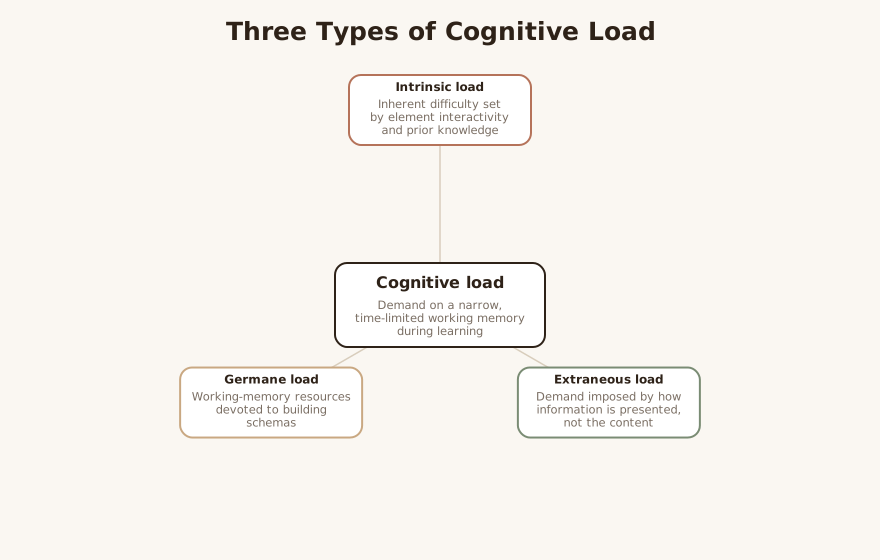
CLT classically partitions cognitive load into three types. 1 Intrinsic load is the inherent difficulty of the material itself, set by the number of interacting elements a learner must hold in mind simultaneously—its element interactivity—relative to that learner’s prior knowledge. 14 Extraneous load is the demand imposed by the way information is presented, irrespective of the content; poor instructional design generates extraneous load that competes for the same scarce resource. 1 Germane load refers to the working-memory resources devoted to the actual building of schemas, though later formulations have reframed germane load as a redistribution of effort toward intrinsic load rather than a fully separate category. 2
A central, clinically resonant principle follows: because the three loads are additive and working memory is fixed, the practical goal is to reduce extraneous load and manage intrinsic load so that capacity remains available for learning. 1 Prior knowledge is the master variable, because an expert’s well-developed schemas let working memory treat complex material as few elements, while a novice must juggle many—so the same instruction can be optimal for one learner and overwhelming for another. 4
Interventions & Techniques
CLT does not prescribe clinical procedures, but its principles translate into a recognizable set of instructional design effects that map onto how clinicians teach. 1 The worked-example effect shows that novices learn more from studying fully worked solutions than from solving problems unaided, because unstructured problem-solving floods working memory; the clinical analogue is modeling a skill in full before asking the client to perform it. 1 The split-attention effect warns that forcing learners to integrate separate, mutually referring sources of information (a diagram on one page, its explanation on another) imposes extraneous load, so related information should be physically and temporally integrated. 1
The modality effect and redundancy effect concern channel use: presenting information across both visual and auditory channels can expand effective capacity, whereas presenting the same information redundantly in two forms (reading aloud text the learner is also reading) wastes capacity. 14 The expertise reversal effect is the crucial caution that techniques helpful for novices can become counterproductive for more knowledgeable learners, so support must fade as competence grows. 2 Translated into clinical moves, these become: model first, integrate materials, segment information into small steps, narrate handouts rather than duplicating them word-for-word, and reduce scaffolding as the client gains mastery. LLM
LLM-generated illustrative example (not a guideline): A clinician introducing a five-step grounding sequence to an overwhelmed client notices that handing over a dense printed worksheet while also explaining it verbally produces a glazed, lost look—classic redundancy and split-attention overload. The clinician switches to demonstrating the full sequence once (a worked example), then coaching the client through a single step per turn, and replaces the worksheet with a three-word cue card. Retention at the next session improves markedly. LLM
Evidence Base
CLT is an established and heavily researched theory, with a large body of controlled experiments supporting its core load-reduction effects across subject domains and age groups. 12 The instructional effects—worked examples, split attention, modality, redundancy, expertise reversal—are among the more replicated findings in instructional psychology, and education systems have adopted CLT-based recommendations on the strength of this record. 1
Honest appraisal nonetheless requires naming the debates. The theory’s developers themselves have examined CLT in light of the broader replication crisis in psychology, reporting that while many central effects hold, some have shown moderation or boundary conditions that demand a more nuanced reading than early enthusiasm suggested. 2 The construct of germane load has been repeatedly contested and revised, and the difficulty of measuring the three load types independently remains a genuine methodological weakness. 2 The theory has also expanded—incorporating motivational and environmental factors and revisiting its categories—rather than standing static, which is a sign of vitality but also of unfinished business. 2 For the clinician, the takeaway is that the broad prescription (respect working-memory limits; cut extraneous load) is robust and safe to apply, while the finer architecture of load types should be held with appropriate humility. LLM CLT is not, in itself, an outcome-validated psychotherapy; its clinical value lies in improving how evidence-based interventions are delivered. LLM
Populations & Indications
CLT was developed for learners acquiring complex, biologically secondary knowledge, so its most natural fit is with anyone whose presenting difficulty involves learning or skill acquisition under constrained working memory. 2 Students and academic underachievers are the populations in which the theory was elaborated, and it speaks directly to instructional comprehension and information retention problems. 1 The theory is especially salient for learners whose working-memory resources are already reduced—children with learning disabilities, individuals with intellectual disability, and people with ADHD—because for them the margin between manageable and overwhelming load is narrow. LLM
Educators and instructional designers are an applied audience, and trainees in any structured skill acquisition (including clinicians themselves learning new protocols) benefit from the same principles. 4 In therapy specifically, the indication is any moment where the clinician is teaching—psychoeducation, coping-skills training, behavioral activation planning, exposure rationales—and the client’s capacity to absorb is the rate-limiting step. LLM
Problems-for-Work
CLT gives traction on a cluster of learning-related presenting problems. With working memory deficits and cognitive overload, the theory names the mechanism directly and prescribes the remedy: segment material, reduce extraneous demands, and externalize information onto cues so the client need not hold it all in mind. 1 For specific learning disorder and learning difficulties, CLT reframes failure as a load problem rather than a motivation or intelligence problem, redirecting intervention toward how material is structured. 4
In ADHD-related learning impairment and attention difficulties, the additive nature of load means that every avoidable extraneous demand subtracts from already-scarce capacity, so simplifying delivery has outsized benefit. LLM For skill acquisition difficulties, the worked-example and faded-scaffolding sequence offers a concrete progression from modeling to independent practice. 1 With academic underachievement and instructional comprehension problems, the expertise-reversal principle reminds the clinician to calibrate to the learner’s actual prior knowledge rather than to an assumed level. 2 And for information retention deficits, CLT’s insistence that learning is schema change reframes the goal from momentary understanding to durable consolidation in long-term memory. 4
LLM-generated illustrative example (not a guideline): A teenager with ADHD repeatedly fails to follow a multi-part emotion-regulation plan agreed in session. Reframing through CLT, the clinician recognizes the plan as a high-element-interactivity task exceeding the client’s working-memory budget. They collapse it to one if-then rule, embed it in the client’s phone as a reminder rather than relying on recall, and add steps only after the first is automatic. Adherence climbs as load per moment drops. LLM
Contraindications, Cautions & Cultural Humility
CLT is a conceptual lens, so there are no procedural contraindications; the cautions concern misapplication. LLM The most important is the expertise reversal effect: heavy scaffolding and worked examples that help a novice can frustrate or insult a more knowledgeable client, and may bore them into disengagement, so load-reduction must be calibrated and faded as competence grows. 2 A second caution is not to mistake load reduction for oversimplification; the goal is to manage intrinsic difficulty, not to strip material of necessary complexity, since some interacting elements are irreducible features of the content. 1
A third is to remember that CLT applies primarily to biologically secondary knowledge requiring explicit instruction, and not every therapeutic process is a teaching task—insight, relationship, and emotional processing are not reducible to load management. 2 Cultural humility matters because prior knowledge—the master variable—is shaped by educational access, language, and cultural familiarity; what reads as low extraneous load to one client may be alien to another, and assumptions about baseline schemas can encode bias. LLM The clinician should treat the client’s actual prior knowledge as something to assess, not presume, and hold the theory’s finer load categories lightly given their contested measurement. 2
Treatment-Plan Suggestions & SMART Objectives
| Goal | SMART objective (example) | Mechanism |
|---|---|---|
| Reduce extraneous load in psychoeducation | Within 3 sessions, clinician and client will convert each handout to an integrated single-page format and client will paraphrase its main point with 90% accuracy in session | Cutting split-attention and redundancy load 1 |
| Make a complex skill learnable | Over 4 sessions, client will perform a previously overwhelming coping sequence after first studying a full worked demonstration, completing it unaided on 4 of 5 attempts | Worked-example effect; schema construction 1 |
| Match instruction to prior knowledge | Within 2 sessions, clinician will assess client’s baseline knowledge of the target skill and tailor scaffolding accordingly, documenting the calibration | Prior knowledge as master variable; expertise reversal 2 |
| Lower per-moment load for working-memory limits | Within 4 weeks, client will externalize one multi-step routine onto a phone cue or card and rely on it rather than recall, used on 5 of 7 days weekly | Offloading to reduce intrinsic element interactivity 1 |
| Segment information to fit capacity | Over 6 weeks, client will receive new material in steps of no more than 2-3 elements at a time and report reduced overwhelm (2+ point drop on a 0-10 scale) | Managing intrinsic load via segmentation 4 |
| Fade scaffolding as competence grows | Within 8 weeks, clinician will progressively remove worked examples once client reaches 80% independent accuracy, documenting each reduction | Expertise reversal effect 2 |
| Consolidate learning into long-term memory | Over 6 weeks, client will demonstrate retention of a taught skill at a 2-week delay on at least 3 occasions | Schema automation; durable change in long-term memory 4 |
Common Misconceptions
A first misconception is that “cognitive load” is the same as effort or difficulty in general; CLT specifies working-memory load during learning and distinguishes intrinsic, extraneous, and germane components, which is what makes it actionable. 1 A second is that all load is bad and the aim is to minimize it; in fact only extraneous load is unambiguously wasteful, intrinsic load is necessary, and resources must remain available for the schema-building that constitutes learning. 12 A third is that the theory is settled and monolithic; in reality the germane-load construct, the measurement of load, and several effects have been revised, and the theory’s own architects have re-examined its replication record. 2
A fourth misconception is that load-reduction techniques are universally beneficial; the expertise reversal effect shows the same support can hurt knowledgeable learners. 2 A fifth, important clinically, is that CLT is a therapy—it is a theory of learning that informs how clinicians teach, not a treatment in its own right. LLM
Training & Certification
There is no certification in Cognitive Load Theory, because it is an academic theory rather than a credentialed clinical method. LLM Clinicians and educators develop competence by reading the primary and review literature—Sweller’s foundational work and the recent account of the theory’s replication and expansion are anchor texts—and by studying accessible syntheses written for practitioners. 21 Education-sector summaries, such as the New South Wales Centre for Education Statistics and Evaluation guide, distil the theory into concrete instructional practices and are a practical entry point. 1 Applied skill comes from integrating the principles into the teaching components of modalities the clinician is already trained in, rather than from any CLT-specific credential. LLM
Key Terms
- Working memory: The limited-capacity, transient system that processes novel information; the bottleneck CLT is built around. 5
- Long-term memory: The effectively unlimited store where learning is consolidated as schemas. 4
- Schema: A structured knowledge unit in long-term memory that, once formed, working memory can treat as a single element. 4
- Intrinsic load: Inherent difficulty of material, driven by element interactivity relative to the learner’s prior knowledge. 1
- Extraneous load: Avoidable demand imposed by how information is presented rather than by its content. 1
- Germane load: Working-memory resources devoted to schema construction; a revised and contested category. 2
- Element interactivity: The number of interacting items that must be held in working memory at once. 4
- Expertise reversal effect: Instructional support that helps novices can hinder experts, requiring support to fade. 2
Resources & Further Reading
▶ Watch — a video introduction to this concept:
- Cognitive load theory: Research that teachers really need to understand (NSW CESE, 2017, PDF)
- The Development of Cognitive Load Theory: Replication Crises and Theory Expansion (Educational Psychology Review)
- Cognitive Load Theory: Principles, Learning Processes, and Implications for Instructional Design (EducationalTechnology.net)
- Cognitive Load Theory (EdTech Books encyclopedia)
- Cognitive load (Wikipedia)
Reflective / Supervision Questions
- When this client failed to follow through on a skill, was it really motivation—or did I exceed their working-memory budget in how I taught it? 1
- How well do I actually know this client’s prior knowledge of the material, given that prior knowledge determines whether my instruction is manageable or overwhelming? 2
- Where in my psychoeducation am I generating extraneous load—dense handouts, split attention, redundant narration—that I could strip without losing content? 1
- Am I fading my scaffolding as the client gains competence, or am I over-supporting in a way that now bores or insults them (expertise reversal)? 2
- Which parts of my work with this client are genuinely teaching tasks suited to CLT, and which are relational or emotional processes the theory does not govern? 2
- Within which established modality am I delivering this instruction, and does my documentation reflect the clinical intervention rather than the theory itself? LLM