
Type & Discipline
The Working Memory Model is a theoretical framework from cognitive science, not a treatment modality or therapeutic technique LLM. It describes the architecture of short-term, active memory — the limited-capacity system that holds and manipulates information over seconds while we reason, comprehend language, and solve problems 3. It belongs to the broader family of memory-systems models within experimental and cognitive psychology 5. For clinicians, its value is conceptual and indirect: it gives a vocabulary and a map for understanding the attentional and information-processing difficulties that show up constantly in therapy, and it informs psychoeducation, accommodation, and cognitive-rehabilitation work rather than prescribing a course of treatment LLM.
It is essential to state at the outset what this article is and is not LLM. There is no “Working Memory Model therapy” LLM. The model is a basic-science account of cognition; the clinically oriented sections below describe how that account informs practice, and they therefore rest heavily on clinical reasoning rather than on the basic-science sources cited for the model itself LLM.
Creators & Lineage
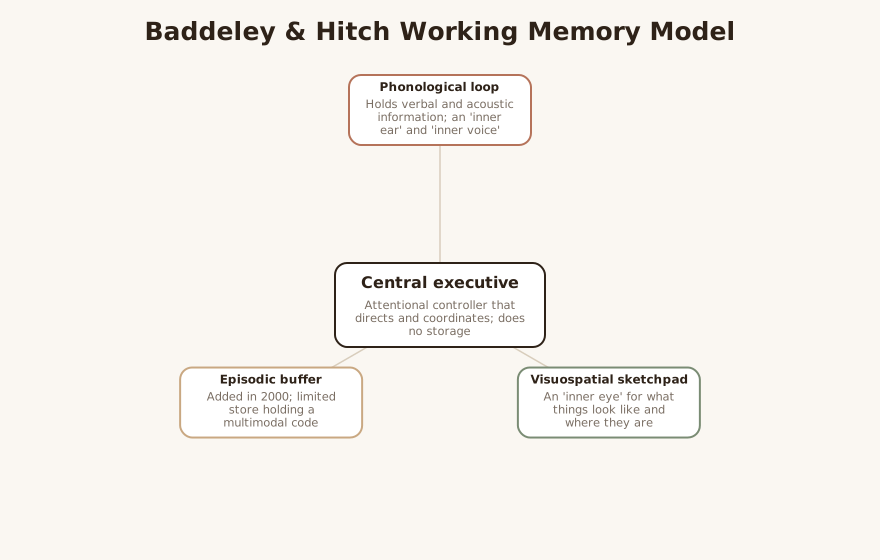
The model was introduced by Alan Baddeley and Graham Hitch in 1974 as a deliberate revision of the then-dominant Atkinson-Shiffrin multi-store model, which treated short-term memory as a single passive store 5. Baddeley and Hitch argued that short-term memory is not one unitary buffer but a multicomponent working system that actively processes information rather than merely holding it 3. The original architecture had three parts: a central executive and two subordinate “slave” systems — the phonological loop and the visuospatial sketchpad 4.
The model evolved substantially over the following decades 5. Its most significant later addition came in 2000, when Baddeley proposed a fourth component, the episodic buffer, to address phenomena the three-component version could not explain — chiefly, how information from different sources is bound into unified, integrated representations 1. This shifted the model’s emphasis from the isolation of separate subsystems toward the integration of information across them 1. The model sits within a contested theoretical landscape; Nelson Cowan’s embedded-processes model, which frames working memory as the activated portion of long-term memory under the focus of attention, is a prominent alternative account LLM.
Core Principles
The central executive is the model’s attentional controller 4. It is a limited-capacity, modality-free system that directs attention, allocates resources to the subsidiary systems, coordinates multiple simultaneous tasks, and switches between them 4. It is the component most closely tied to what clinicians call executive function, and it does no storage itself — it supervises 3.
The phonological loop handles verbal and acoustic information 4. It is conventionally split into a phonological store (an “inner ear” that holds sound-based traces for roughly one to two seconds before they decay) and an articulatory rehearsal process (an “inner voice” that refreshes those traces by silent repetition) 4. This is the system engaged when you hold a phone number in mind by repeating it 3.
The visuospatial sketchpad is the parallel system for visual and spatial information — an “inner eye” that stores what things look like and where they are located 4. It supports tasks such as mentally navigating a route or rotating an object in the mind 3.
The episodic buffer, added in 2000, is a limited-capacity store that holds information in a multimodal code 1. Its defining function is binding: it integrates information from the phonological loop, the visuospatial sketchpad, and long-term memory into a single unified episodic representation 1. Baddeley proposed that conscious awareness is the principal mode of retrieval from this buffer, making it the component most closely linked to the felt experience of holding a coherent scene or idea in mind 1.
Two principles cut across all four components and matter most for clinical translation LLM. First, capacity is sharply limited — working memory can juggle only a handful of items at once, and that limit is a structural feature, not a failure of effort 3. Second, the system is active: information is manipulated, not merely parked, which is why dividing attention or adding task demands degrades performance so reliably 4.
Interventions & Techniques
Because this is a framework rather than a therapy, “interventions” here means clinical strategies that the model informs, not a branded protocol LLM. The most direct application is psychoeducation: explaining to a client that working-memory capacity is finite and structural can reframe self-blame (“I’m stupid / lazy”) into a workable account of a cognitive bottleneck LLM. This reframe alone often reduces shame and opens the door to compensatory strategy LLM.
A second family of applications is load reduction — engineering tasks and environments so they do not exceed available capacity LLM. Concretely, this means breaking multi-step instructions into single steps, writing things down to offload the phonological loop onto an external store, using visual aids and checklists to recruit the sketchpad, and minimizing competing demands during effortful tasks LLM. These are the everyday tactics of educational accommodation and occupational adjustment, and they follow directly from the capacity-limit principle LLM.
A third family is compensatory and metacognitive strategy training, often delivered within cognitive rehabilitation after acquired brain injury or as part of skills coaching for attention problems LLM. Here clients learn to recognize when they are overloaded and to deploy external supports — planners, reminders, chunking, rehearsal — as deliberate habits LLM.
A fourth and more contested application is direct working-memory training — repetitive computerized tasks (such as n-back or complex-span drills) intended to expand capacity itself rather than teach workarounds LLM. The distinction between teaching compensation (well supported) and training raw capacity (poorly supported) is taken up directly in the Evidence Base below LLM.
LLM-generated illustrative example (not a guideline): A clinician working with an adult who “can never remember what their manager just asked” might explain the phonological loop’s brief decay window, then coach the client to immediately repeat the request back, jot a one-line note, and confirm — converting a fleeting auditory trace into a stable external record before it fades LLM.
Evidence Base
Honesty here requires separating two very different claims that are easy to merge LLM.
The first claim is about the model. The Working Memory Model is well established and remains one of the dominant frameworks in cognitive psychology 5. It is supported by decades of experimental evidence — dual-task studies showing that two verbal tasks interfere with each other while a verbal and a visual task can run in parallel, the word-length and phonological-similarity effects in the phonological loop, and neuropsychological dissociations in brain-injured patients who lose one component while sparing others 3. The episodic buffer was a principled theoretical addition grounded in phenomena the earlier model could not explain 1. None of this means the model is uncontested: the central executive in particular has been criticized as underspecified, and alternative architectures such as Cowan’s embedded-processes model compete with it LLM. As a description of cognitive architecture, however, its maturity is fairly characterized as established LLM.
The second claim is about interventions derived from the model — and the picture is far weaker LLM. Compensatory and accommodation strategies grounded in capacity limits are sensible and widely used, but direct working-memory training (computerized drills aimed at expanding capacity) has a contested evidence base LLM. The consistent finding across the broader literature is near transfer with little far transfer: people get better at the trained task and similar tasks, but improvements rarely generalize to untrained real-world abilities such as reading comprehension or academic achievement LLM. Treating “the model is established” as if it implied “working-memory training works” is the central evidence error to avoid, and the two claims should never be collapsed in clinical communication LLM.
Populations & Indications
The model is most clinically relevant for presentations in which a working-memory bottleneck is part of the picture LLM. Adults and children with ADHD frequently show working-memory weaknesses that the model helps frame and explain LLM. People with acquired brain injury or TBI are a core population for cognitive-rehabilitation work that draws on the model’s component structure LLM. Learning disabilities such as dyslexia and dyscalculia often involve phonological-loop or executive demands the model makes legible LLM. Older adults and those with mild cognitive impairment may show capacity decline that the framework helps normalize and accommodate LLM. School-age children with unexplained academic difficulty are another group for whom load-aware accommodation can be transformative LLM. Finally, the model is useful even outside any diagnosis — anxiety, worry, and trauma reliably consume central-executive resources, so capacity language explains why distressed clients “can’t think straight” in session LLM.
Problems-for-Work
The framework most usefully informs work on concrete, observable difficulties rather than diagnoses LLM.
- Difficulty holding and following multi-step instructions — the model attributes this to capacity overflow and supports a single-step, write-it-down approach LLM.
- Attention and concentration deficits — framed as central-executive load, addressable by reducing competing demands LLM.
- Losing the thread mid-task or mid-conversation — explained by phonological-loop decay, addressed with immediate rehearsal or note-taking LLM.
- Mental-arithmetic and reading-comprehension breakdown — framed as the simultaneous storage-and-processing demand exceeding capacity, addressed by offloading onto paper LLM.
- Academic or occupational underperformance — reframed from a character flaw to a capacity-management problem, opening the door to accommodation LLM.
- Cognitive overload in session — recognized as executive resources consumed by distress, addressed by slowing pace and reducing in-session demands LLM.
LLM-generated illustrative example (not a guideline): A student who “blanks” during exams might be helped by naming the mechanism — anxiety occupying the central executive and crowding out the very capacity the test requires — and then pairing a brief grounding routine with a brain-dump of formulas onto scratch paper at the start, freeing working memory for reasoning LLM.
Contraindications, Cautions & Cultural Humility
As a conceptual framework there are no procedural contraindications, but there are real cautions LLM. The most important is not overselling working-memory training: presenting capacity-expansion drills as a proven fix for ADHD, academic difficulty, or post-injury cognition would misrepresent a contested evidence base and risks both wasted effort and false hope LLM. A second caution is reductionism — treating a client’s struggles as “just a memory problem” can obscure emotional, relational, motivational, and systemic contributors that matter more LLM.
The model also carries assumptions worth holding lightly across cultures LLM. Standardized working-memory tasks are language- and education-dependent; the phonological loop’s measured capacity can be confounded by literacy, multilingualism, and test familiarity, so apparent “deficits” may reflect unfamiliarity rather than impairment LLM. Clinicians should avoid pathologizing performance on culturally loaded tasks and should frame capacity language as a shared, blame-free explanatory tool rather than a verdict about a person’s worth or intelligence LLM.
Treatment-Plan Suggestions & SMART Objectives
| Goal | SMART objective (example) | Mechanism |
|---|---|---|
| Reduce overload from multi-step demands | Within 6 weeks, client will independently break tasks into single steps in 4 of 5 logged instances | Lowers concurrent load on the central executive LLM |
| Offload verbal information reliably | Within 4 weeks, client will write down or repeat back instructions at point of receipt in 80% of work interactions | Externalizes the decaying phonological loop 4 |
| Improve follow-through on instructions | Within 8 weeks, client will complete multi-step home tasks using a written checklist on 5 of 7 days/week | Recruits external store to spare internal capacity LLM |
| Build metacognitive overload awareness | By week 6, client will name “I’m overloaded” and pause/offload in 3 of 5 self-reported episodes | Strengthens executive monitoring and strategy selection LLM |
| Reduce anxiety-driven blanking | Within 8 weeks, client will use a grounding-plus-brain-dump routine before high-demand tasks in 4 of 5 instances | Frees executive resources captured by worry LLM |
| Normalize capacity limits (reduce shame) | By session 4, client will restate the capacity-bottleneck reframe in own words and report reduced self-blame | Psychoeducation reframes deficit as structural 3 |
| Improve reading comprehension via offloading | Within 6 weeks, client will use note-taking/summarizing on 80% of effortful reading tasks | Reduces simultaneous storage-and-processing load LLM |
Common Misconceptions
A frequent misconception is that the model describes a single “short-term memory store”; it explicitly replaced that unitary view with a multicomponent working system that actively manipulates information 3. A second is conflating working memory with long-term memory or with general intelligence — they are related but distinct, and the model concerns the temporary, active workspace, not durable storage LLM. A third, clinically consequential misconception is that working-memory training reliably improves real-world functioning; the evidence for far transfer is weak, and this should not be presented to clients as established LLM. A fourth is treating the central executive as a fully understood “homunculus” — in fact it remains the model’s most criticized and underspecified component LLM. Finally, the four components are conceptual systems, not literal brain regions, and should not be described to clients as fixed anatomical locations LLM.
Training & Certification
There is no certification in the Working Memory Model because it is a scientific framework, not a clinical credential or modality LLM. Clinicians typically encounter it within graduate cognitive-psychology coursework and within neuropsychology and cognitive-rehabilitation training, where it underpins assessment interpretation and strategy work 5. Formal application of the model to clinical practice — for example, administering and interpreting working-memory indices on standardized cognitive batteries, or designing cognitive-rehabilitation programs — falls within the scope of trained neuropsychologists, school psychologists, and rehabilitation specialists rather than being a free-standing certifiable technique LLM. Accessible overviews suitable for foundational learning include introductory psychology texts and explainer resources 36.
Key Terms
Working memory — the limited-capacity system for temporarily holding and actively manipulating information 3. Central executive — the modality-free attentional controller that allocates resources and coordinates the subsystems 4. Phonological loop — the verbal/acoustic subsystem, comprising a phonological store and articulatory rehearsal 4. Visuospatial sketchpad — the subsystem for visual and spatial information 4. Episodic buffer — the multimodal store that binds information from the other components and long-term memory into a unified representation, with conscious awareness as its principal retrieval mode 1. Binding — the integration of information from multiple sources into a single coherent episode, the defining function of the episodic buffer 1. Capacity limit — the structural ceiling on how much can be held and processed at once 3. Far transfer — generalization of a trained skill to dissimilar, untrained real-world abilities; the weak point of working-memory training LLM.
Resources & Further Reading
▶ Watch — a video introduction to this concept:
- Baddeley (2000), The episodic buffer: a new component of working memory? — PubMed
- Baddeley (2000), full text — Trends in Cognitive Sciences (Cell Press)
- Working Memory Model — Simply Psychology
- Components: Central Executive, Phonological Loop, Visuospatial Sketchpad (Andrade & Walker) — Social Sci LibreTexts
- Baddeley’s model of working memory — Wikipedia
- Working Memory Model EXPLAINED (AQA Psychology, A-level) — YouTube
Reflective / Supervision Questions
- When a client struggles to follow through, how do I distinguish a genuine working-memory bottleneck from motivational, emotional, or relational factors — and do I check before assuming? LLM
- Am I using capacity language to reduce a client’s shame, or could I be inadvertently handing them a new deficit label? LLM
- How would I explain to a client the difference between teaching compensatory strategies (well supported) and training raw capacity (poorly supported), without overselling either? LLM
- For clients from different linguistic or educational backgrounds, how confident am I that observed “working-memory” difficulties aren’t artifacts of unfamiliar, culturally loaded tasks? LLM
- In sessions where a distressed client “can’t think straight,” am I attributing this to executive overload and adjusting pace and demand accordingly? LLM