
Type & Discipline
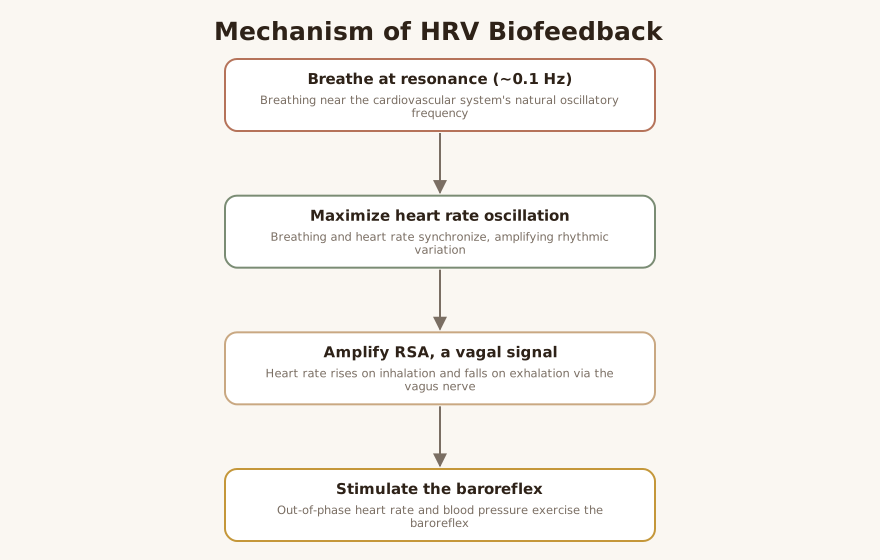
Heart rate variability biofeedback (HRVB) is a psychophysiological self-regulation technique situated within applied psychophysiology and belonging to the family of biofeedback and autonomic-regulation methods 2. Its defining procedure is slow, paced breathing at an individually determined resonance frequency — for most adults near six breaths per minute, or roughly 0.1 Hz — undertaken while the client receives real-time feedback on heart rate or heart rate variability 2. The aim is to maximize the amplitude of heart rate oscillations and, through repeated practice, to exercise and strengthen the reflexes that regulate cardiovascular rhythm 2.
HRVB is best understood as a structured, clinician-guided training protocol rather than a freestanding school of psychotherapy 5. It is frequently integrated into broader treatment as an adjunctive skill for stress and emotion regulation, and it is delivered across rehabilitation, behavioral-health, and performance settings 5. For clinicians, the most accurate framing is that HRVB is a well-specified, mechanistically grounded technique with robust meta-analytic support for stress and anxiety and more modest support for depression 1 4.
Creators & Lineage
The technique grows out of decades of cardiovascular psychophysiology, and its modern form is most closely associated with Evgeny Vaschillo and Paul Lehrer, whose work identified the resonance properties of the cardiovascular system and operationalized them into a trainable protocol 2. Vaschillo’s research established that maximum heart rate oscillations at respiratory frequency occur at approximately 0.1 Hz, or about six breaths per minute, which became the empirical anchor for the resonance-frequency concept 2. Lehrer’s subsequent collaborations translated this physiology into clinical training procedures and, more recently, into introductory guidance written specifically for clinicians 5.
The lineage runs directly through the broader biofeedback tradition and the discipline of applied psychophysiology, which together supply the instrumentation, the feedback logic, and the self-regulation paradigm on which HRVB depends 2. It also sits downstream of long-standing work on diaphragmatic breathing and paced respiration, since the active ingredient is slow, regular breathing at a target rate 2. Conceptually, HRVB is often discussed alongside polyvagal theory and other accounts of vagal regulation, because the technique is theorized to act on vagal and baroreflex pathways, though the proposed brain-level mechanisms remain an area of active and partly speculative inquiry 2.
Core Principles
The first organizing principle is resonance: the cardiovascular system has a natural oscillatory frequency near 0.1 Hz, and breathing at this rate drives heart rate oscillations to their maximum amplitude 2. At the resonance frequency, breathing and heart rate reach an essentially zero-degree phase relationship — heart rate begins to rise at the start of each inhalation and falls during exhalation — so the two oscillations are maximally synchronized 2. This synchrony is what allows slow breathing to amplify, rather than merely accompany, the heart’s rhythmic variation 2.
The second principle is respiratory sinus arrhythmia (RSA) as a vagal signal: the rise of heart rate on inhalation and its fall on exhalation is controlled by the vagus nerve, making RSA a readable index of parasympathetic activity 2. The third principle is baroreflex stimulation: when heart rate and blood pressure oscillate at the resonance frequency, they fall into a roughly 180-degree, out-of-phase relationship that exercises the baroreflex, and training has been associated with large increases in baroreflex gain during practice and persistent increases in resting baroreflex gain afterward 2. The fourth, more tentative principle is that stimulation of vagal afferent pathways may reach brain regions involved in affect regulation and mood, such as the locus coeruleus, orbitofrontal cortex, insula, hippocampus, and amygdala — a proposed route for HRVB’s effects on anxiety and depression that the source itself frames as a possibility rather than a settled fact 2. Clinicians should present this brain-level account to clients as a working hypothesis, not established physiology LLM.
Interventions & Techniques
The core intervention is a structured assessment to find the client’s resonance frequency, followed by repeated paced-breathing practice at that rate 3. In the published assessment protocol, the clinician first lets the client practice relaxed breathing at about 5.5 to 6 breaths per minute, then records physiological activity in separate two-minute epochs while the client breathes at rates stepped down from 6.5 to 4.5 breaths per minute in 0.5-breath decrements, with two-minute rests between trials 3. The optimal frequency is then selected using a weighted set of criteria, the highest priority being phase synchrony — heart rate beginning to rise at the start of inhalation — followed by peak-to-trough heart rate amplitude, low-frequency spectral power, the size of the maximum low-frequency peak, the smoothness of the heart rate curve, and a preference for fewer low-frequency peaks 3.
Once the resonance frequency is identified, the working intervention is regular paced breathing at that rate while the client watches feedback that reflects the amplitude or pattern of their heart rate oscillations 5. In practice this is delivered as a clinician-guided training in which the client learns the breathing skill in session and then rehearses it as a home practice between sessions, building the regulation as a trainable capacity over time 5. The feedback display, the pacing aid, and the resonance target together distinguish HRVB from generic slow breathing, because the rate is individualized and the client can see the effect of getting it right 3 5.
LLM-generated illustrative example (not a guideline): A client with chronic work stress is assessed across several two-minute breathing trials, and the clearest synchrony and largest heart rate swings appear at 5.5 breaths per minute. The clinician sets a visual pacer to that rate, and over the following weeks the client practices ten to twenty minutes daily at home, learning to recognize the calmer, more rhythmic state the breathing produces and to deploy it before stressful meetings. LLM
Evidence Base
HRVB qualifies as an established technique: it rests on robust meta-analytic support and a characterized physiological mechanism, though the strength of the evidence varies by target condition 1 4. The honest headline is a split between anxiety and depression. For stress and anxiety, a meta-analysis of 24 studies and 484 participants receiving HRVB found large effects, with a within-group pre-post effect of Hedges’ g = 0.81 and a between-groups effect versus control of g = 0.83, and the authors concluded that HRVB is associated with a large reduction in self-reported stress and anxiety 1. They nonetheless cautioned that further rigorous controlled research is needed to strengthen the base 1.
For depressive symptoms the effect is real but more modest. A meta-analysis of 14 randomized controlled trials and 794 participants found a medium effect of g = 0.38 (95% CI 0.16 to 0.60), with moderate heterogeneity (I² = 45%), and concluded that HRVB improves depressive symptoms across several psychophysiological conditions and should be considered a valid technique for increasing psychological well-being 4. The mechanistic literature complements these clinical findings: a randomized controlled study of 95 undergraduates comparing resonance-frequency breathing, breathing one step faster, and quiet sitting found that the resonance-frequency group showed lower systolic blood pressure during and after a stressor and reported higher positive mood than the other two groups after the breathing exercise 6. That study is a small analog sample of young adults, which limits how far its mood and blood-pressure findings should be generalized to clinical populations 6 LLM. Taken together, the evidence supports HRVB most strongly for anxiety and stress, more modestly for depression, and across a literature that still contains many small and heterogeneous trials 1 4 LLM. A clinician-facing introduction co-authored by Lehrer presents HRVB to practitioners as a credible, deliverable training method, consistent with this overall picture 5.
Populations & Indications
HRVB has been studied predominantly in adults, and the strongest indications are stress and anxiety, where the meta-analytic effects are largest 1. People with diagnosed anxiety disorders are an appropriate target, and the anxiety meta-analysis specifically examined whether an anxiety-disorder diagnosis moderated outcomes, situating the technique within clinical as well as subclinical stress 1. People with chronic stress are a natural fit because the training directly targets the autonomic arousal that chronic stress sustains 1 LLM.
People with depression are a supported but more modest indication, given the medium pooled effect on depressive symptoms 4. People with PTSD are a clinically common application, since autonomic hyperarousal is central to the disorder and HRVB targets exactly that physiology, though the technique should be offered as an adjunctive regulation skill rather than a stand-alone trauma treatment LLM. People with cardiovascular conditions and elevated blood pressure are an indication suggested by the baroreflex mechanism and by the lower systolic blood pressure observed with resonance-frequency breathing, and athletes are a frequent performance-oriented population, though these applications are weighted more on mechanism than on large clinical trials 2 6 LLM.
Problems-for-Work
The clearest problems-for-work are generalized anxiety disorder and chronic stress, where the large meta-analytic effects align with the technique’s direct action on autonomic arousal 1. In application, a client with generalized anxiety can use resonance-frequency breathing as a daily regulation practice and as an in-the-moment tool when worry spikes, with the feedback display reinforcing that the physiological state is shifting 1 3 LLM. Panic disorder is a related target, since the breathing skill gives clients a concrete, practiced way to down-regulate the surge of arousal that precedes or accompanies a panic episode 1 LLM.
Depression is a supported problem-for-work given the medium effect on depressive symptoms, best framed as one component of a broader plan rather than a sole intervention 4. Autonomic dysregulation and emotional dysregulation are mechanistically central targets, because HRVB trains the baroreflex and vagal pathways that underlie autonomic flexibility 2. Hypertension is a plausible adjunctive target supported by the blood-pressure findings for resonance-frequency breathing, while insomnia, chronic pain, and PTSD-related hyperarousal are reasonable extensions wherever calming autonomic arousal is part of the clinical goal, with the caveat that the controlled evidence is concentrated in anxiety, stress, and depression 6 1 4 LLM.
LLM-generated illustrative example (not a guideline): A client with panic disorder learns their resonance frequency and rehearses paced breathing daily, then practices deploying it at the first interoceptive cue of a rising panic — a quickening heartbeat — using the slow, rhythmic breath to interrupt the catastrophic escalation rather than waiting for the panic to peak. LLM
Contraindications, Cautions & Cultural Humility
HRVB is generally low-risk, but a few cautions apply. Some clients with respiratory or cardiac conditions may find slow, deep paced breathing uncomfortable or destabilizing, so breathing parameters should be introduced gradually and adjusted to tolerance LLM. A minority of clients experience light-headedness or anxiety when first attempting unfamiliar slow breathing, which warrants pacing the practice and coaching the client through the early sessions rather than pushing for an immediate target rate LLM. HRVB should not be presented as a stand-alone treatment for conditions where it functions as an adjunct, such as PTSD or major depression, and clinicians should match the framing to the evidence — large effects for anxiety and stress, more modest effects for depression 1 4 LLM.
Interpreting the physiological feedback also calls for humility. The brain-level account of why HRVB helps — vagal afferent stimulation reaching affect-regulation regions — is explicitly hedged in the source literature, so it should be offered to clients as a plausible mechanism rather than a proven one 2 LLM. Cultural humility matters in how breathwork is introduced: paced breathing intersects with contemplative and religious breathing practices in many traditions, and clinicians should connect the skill to the client’s own framework and comfort rather than imposing a single rationale, while remaining attentive to clients for whom focused attention on the body or breath is aversive LLM.
Treatment-Plan Suggestions & SMART Objectives
| Goal | SMART objective (example) | Mechanism |
|---|---|---|
| Identify the client’s resonance frequency | Within 1 assessment session, determine the breathing rate (between 4.5 and 6.5 breaths/min) that maximizes heart rate oscillation and phase synchrony | Resonance-frequency assessment across stepped two-minute breathing trials 3 |
| Establish a daily regulation practice | Over 4 weeks, client completes paced resonance-frequency breathing for 10–20 minutes on at least 5 days per week | Repeated paced breathing as a clinician-guided home training 5 |
| Reduce self-reported anxiety | Within 8 weeks, achieve a clinically meaningful drop on a validated anxiety measure | Large meta-analytic reduction in self-reported stress and anxiety with HRVB 1 |
| Reduce depressive symptoms | Over the treatment course, achieve a measurable reduction on a depression measure as part of a broader plan | Medium pooled effect of HRVB on depressive symptoms 4 |
| Strengthen autonomic regulation | Over repeated sessions, increase in-session heart rate oscillation amplitude at the resonance frequency | Baroreflex exercise increasing baroreflex gain during and after training 2 |
| Apply the skill to acute arousal | By end of treatment, client reports using paced breathing to down-regulate arousal in at least 3 real-world trigger situations | RSA-mediated vagal engagement reducing physiological arousal 2 |
| Support blood-pressure goals (adjunctive) | Over the practice period, client demonstrates lower in-session systolic readings during paced breathing | Lower systolic blood pressure observed with resonance-frequency breathing 6 |
| Improve positive mood and well-being | Within agreed sessions, client reports improved positive affect after breathing practice | Higher positive mood following resonance-frequency breathing 6 |
Common Misconceptions
A first misconception is that HRVB is just deep breathing; the technique is individualized to a resonance frequency identified by assessment and is paired with real-time feedback, which is what distinguishes it from generic slow breathing 3. A second is that faster or deeper is better; the maximum effect occurs specifically near the resonance frequency, and breathing even one step faster produces a measurably weaker physiological response, as the comparison between resonance-frequency and resonance-plus-one breathing showed 2 6. A third is that the resonance frequency is the same for everyone; while it clusters around six breaths per minute, the optimal rate is determined per client across a range of tested rates 2 3.
A fourth misconception is that the mechanism is fully understood; the resonance, RSA, and baroreflex accounts are well grounded, but the proposed pathway from vagal afferents to mood-regulating brain regions is presented in the literature as a possibility rather than established fact 2. A fifth is that the evidence is uniformly strong across conditions; in reality the effect is large for anxiety and stress but only medium for depression, and the depression literature shows moderate heterogeneity across trials 1 4. Finally, the impression that a single in-session demonstration is sufficient overlooks that HRVB is a trained skill built through repeated home practice, not a one-time procedure 5 LLM.
Training & Certification
HRVB is delivered by clinicians who have learned the resonance-frequency assessment and the paced-breathing training, and the peer-reviewed introduction written for clinicians reflects an explicit effort to make the method teachable to practitioners across disciplines 5. Competent delivery requires familiarity with the assessment protocol — the stepped breathing trials and the weighted criteria for selecting the resonance frequency — and with the instrumentation that provides the feedback 3. Clinicians new to the technique benefit from practicing the assessment and interpreting the physiological signals before delivering it, since selecting the wrong rate undermines the resonance effect 3 LLM.
Beyond the published protocols and clinician introduction, biofeedback is supported by professional certification structures within applied psychophysiology, and supervised practice on early cases is the prudent standard, particularly when integrating HRVB into care for anxiety, depression, or trauma-related arousal 5 LLM. Clinicians should match their informed-consent language to the evidence and present the mechanism honestly, distinguishing the well-supported physiology from the more tentative brain-level claims 2 LLM.
Key Terms
- Resonance frequency: The individual breathing rate, near 0.1 Hz or about six breaths per minute, at which heart rate oscillations reach maximum amplitude 2.
- Respiratory sinus arrhythmia (RSA): The vagally controlled rise of heart rate on inhalation and fall on exhalation, used as an index of parasympathetic activity 2.
- Baroreflex gain: The strength of the blood-pressure regulation reflex, which increases during and after HRVB training 2.
- Phase synchrony: A near-zero-degree relationship in which heart rate begins to rise at the start of inhalation, the highest-priority criterion for selecting the resonance frequency 3.
- Low-frequency power: Spectral power in the low-frequency band of HRV, used as a selection criterion in resonance-frequency assessment 3.
- Paced breathing: Breathing at a fixed, externally cued rate, the active ingredient delivered at the resonance frequency in HRVB 3.
- Heart rate variability (HRV): Beat-to-beat variation in heart rate, the physiological signal HRVB seeks to increase through resonance breathing 2.
Resources & Further Reading
▶ Watch — a video introduction to this concept:
- The effect of heart rate variability biofeedback training on stress and anxiety: a meta-analysis (PubMed)
- Heart rate variability biofeedback: how and why does it work? (Frontiers in Psychology, 2014)
- A Practical Guide to Resonance Frequency Assessment for Heart Rate Variability Biofeedback (Frontiers in Neuroscience, 2020)
- A meta-analysis on heart rate variability biofeedback and depressive symptoms (Scientific Reports, 2021)
- Heart Rate Variability Biofeedback Training: An Introduction for Clinicians (Archives of Physical Medicine and Rehabilitation, 2024)
- The Impact of Resonance Frequency Breathing on Measures of Heart Rate Variability, Blood Pressure, and Mood (PMC)
Reflective / Supervision Questions
- For a given client, am I framing HRVB as a primary intervention or an adjunct, and does that framing match the evidence for their target condition? 1 4
- How do I describe the mechanism to clients honestly, distinguishing the well-supported resonance and baroreflex physiology from the more tentative vagal-afferent-to-brain account? 2 LLM
- Am I taking the time to assess each client’s individual resonance frequency rather than defaulting to six breaths per minute for everyone? 3
- How do I support the home practice that HRVB depends on, and how will I know whether the client is actually practicing? 5 LLM
- For clients with respiratory, cardiac, or trauma-related sensitivities, how am I pacing the introduction of slow breathing to avoid destabilization? LLM
- How am I connecting paced breathing to each client’s own cultural or contemplative framework rather than imposing a single rationale? LLM