
Type & Discipline
Applied tension is a behavioral technique, not a stand-alone therapy, and it belongs to clinical psychology’s exposure-based tradition rather than to any cognitive or insight-oriented school 2. Its defining feature distinguishes it from almost every other anxiety technique a clinician knows: where most procedures aim to lower physiological arousal, applied tension deliberately raises it, asking the client to repeatedly tense the large skeletal muscles in order to drive blood pressure back up 1. This inversion exists because the problem it targets is also inverted — the danger in blood-injection-injury (BII) phobia is not runaway arousal but a sudden collapse of it, the vasovagal drop in heart rate and blood pressure that ends in fainting 1. Applied tension is therefore best understood as a countermeasure to a specific physiological event rather than as an anxiety-reduction strategy in the ordinary sense LLM.
For the practicing clinician, the most important framing is that applied tension is almost always delivered within an exposure protocol, not instead of one 5. The tension manoeuvre gives a fainting-prone client a tool that makes graded confrontation with blood and needles physically survivable, which in turn makes exposure possible; the two are designed to run together 5. Holding this nesting clearly — applied tension as the physiological tool, exposure as the therapeutic engine — prevents the common error of treating the muscle exercise as if it were the whole treatment LLM.
Creators & Lineage
Applied tension was developed by the Swedish clinical psychologist Lars-Göran Öst together with Kerstin (Ulla) Sterner, and introduced in their 1987 paper Applied tension. A specific behavioral method for treatment of blood phobia in Behaviour Research and Therapy 2. Öst was already a prominent figure in the behavioral treatment of anxiety, and applied tension joined a family of structured, manualized techniques he is associated with 2. The work was a direct response to a clinical puzzle that ordinary exposure could not solve: clients with blood phobia were not merely frightened but at genuine risk of fainting on contact with the feared stimulus, which both endangered them and short-circuited the exposure itself 1.
The lineage runs through the broader behavioral and exposure tradition. Applied tension shares the graded-confrontation logic of systematic desensitization and modern exposure therapy, in which a feared cue is approached in steps until it loses its power 5. It sits as a deliberate counterpart to Öst’s own applied relaxation, his technique for anxiety presentations where lowering arousal is the goal — a contrast worth keeping crisp, because applied tension does the physiological opposite and is meant for a different problem entirely 1. The conceptual debt is to the recognition that BII phobia is physiologically distinct from other phobias, a recognition that has shaped how the disorder is classified and treated ever since 1.
Core Principles
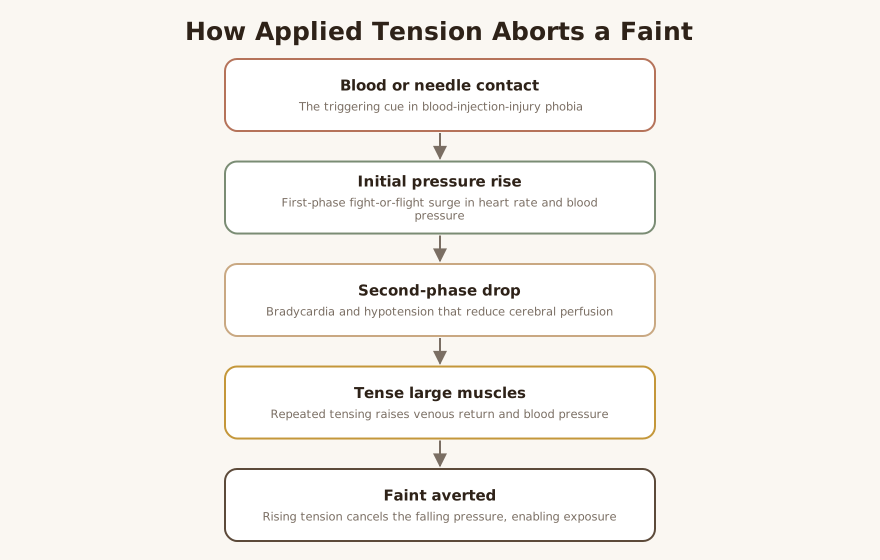
The first principle is the diphasic (biphasic) cardiovascular response that makes BII phobia unique 1. On contact with blood or needles, susceptible individuals show an initial fight-or-flight rise in heart rate and blood pressure, followed by a sharp second-phase fall — bradycardia and hypotension — that reduces cerebral perfusion and can culminate in vasovagal syncope 1. It is this second phase, the collapse rather than the alarm, that distinguishes BII phobia from every other anxiety disorder and that fainting makes its signature feature 1.
The second principle is the mechanism of the countermeasure: brief, repeated tensing of the skeletal muscles increases venous return, raises blood pressure, and improves cerebral perfusion, while also producing vagal withdrawal that can truncate the bradycardia component before it deepens into a faint 1. The client is taught to deploy this manoeuvre the moment the early warning signs of fainting appear — lightheadedness, warmth, a drained feeling — so that the rising tension meets the falling pressure and the two cancel 1.
The third principle is that the technique is a vehicle for exposure, not a substitute for it 5. Once the client can reliably arrest the pre-syncopal drop, they can stay in contact with the feared stimulus long enough for the fear itself to attenuate through repeated, completed exposures rather than escapes 5. The clinical aim is not merely to prevent one faint but to break the cycle in which the threat of fainting drives avoidance, which prevents exposure, which preserves the phobia LLM.
Interventions & Techniques
The core manoeuvre is taught first, in isolation, so the client can perform it on cue before any feared material is introduced 5. The client tenses the muscles of the arms, legs, and torso simultaneously and holds the contraction for roughly 15 to 20 seconds, then releases and sits quietly for 20 to 30 seconds before repeating 5. A practical endpoint clinicians use is to tense until a feeling of warmth reaches the face, then relax, wait a few seconds, and tense again 4. A full practice run is about five tense-and-release cycles and takes three to five minutes 5. Clients are asked to rehearse several sets a day — ideally three to five — so the response is automatic before it is needed in a real situation 5.
Once the manoeuvre is fluent, it is folded into a stepped exposure hierarchy 5. The client moves through increasingly challenging steps — for example beginning with images of needles while applying tension throughout — and advances only as each step becomes manageable, until real-world medical situations such as a blood draw or injection can be completed calmly and without fainting 5. The technique is portable to the medical setting itself: the client applies tension during the actual procedure as a fainting countermeasure, which is much of its real-world value 4. In the originating reports, structured courses of this kind were brief 2.
LLM-generated illustrative example (not a guideline): A client who has fainted at every blood draw since childhood first learns the tension manoeuvre with the clinician, practicing five cycles three times a day for a week until the warm-face cue is reliable. They then work up a hierarchy from photographs of syringes, to a video of a venipuncture, to handling a capped needle, applying tension at the first hint of lightheadedness at each step, before attempting a real blood draw at a clinic while maintaining the manoeuvre throughout. LLM
Evidence Base
The maturity of applied tension is best described as established in the sense that matters most to a clinician: it is the standard, widely recommended technique for the fainting-prone BII client, and it occupies a settled place in practice as the default tool when vasovagal syncope is part of the picture 5. That status is well earned by clinical utility — there is no comparably specific or physiologically rational alternative for the fainting problem LLM.
Honesty requires immediately qualifying that the empirical base is thinner than the technique’s standing suggests 1. The supporting evidence rests substantially on a small set of studies from the originating research group, with limited independent replication, so the strength of the trial base does not match the confidence with which the technique is recommended 1. The evidence has been subjected to formal critical review, which is itself a sign that the field regards the question as open rather than closed 3.
Two findings complicate the simple story and deserve clinical attention 1. First, applied tension has not shown a clear advantage in effect size over exposure alone, which means a clinician should not assume the tension component is the proven active ingredient — the exposure embedded in the protocol may be doing much of the work 1. Second, and more puzzling, effectiveness does not differ between clients who actually faint and those who do not, even though the entire physiological rationale predicts the benefit should concentrate in fainters 1. Compounding this, actual fainting during laboratory or treatment exposure occurs in considerably fewer people than their fainting history would predict, and the classic diphasic response is itself less consistently demonstrable than the textbook account implies 1. The defensible stance is to use applied tension with confidence as the established practice for fainting-prone clients while treating “the muscle tension is what cures the phobia” as an unproven mechanistic claim LLM.
Populations & Indications
The paradigm population is adults with blood-injection-injury phobia, a condition affecting roughly 4% of the population and distinguished from other phobias by its culmination in vasovagal syncope 1. The most direct indication is a client whose fear is bound up with fainting or the dread of fainting on contact with blood, needles, or injury, since that is precisely the event applied tension is engineered to prevent 1. Needle-phobic clients facing blood draws, injections, or vaccination — trypanophobia in the colloquial sense — are core candidates 4.
The technique is especially indicated where avoidance of the feared stimulus carries real medical cost: clients who delay or forgo necessary blood work, dental treatment, vaccination, or obstetric care because they fear fainting are the population for whom restoring access to care is the explicit goal LLM. It can be adapted for children and adolescents, who are over-represented among the needle-fearful, though the clinician should note that the conscious recognition of an exaggerated response seen in adults can be absent in children, which changes how the rationale is explained 1. Across all of these, the unifying indication is a cue-bound fear in which the physiological threat of fainting is a barrier to exposure LLM.
Problems-for-Work
Applied tension reframes a recognizable cluster of presenting problems as a fainting-driven avoidance cycle that a physiological countermeasure can interrupt LLM. Blood-injection-injury phobia is the cleanest application: the client learns to abort the vasovagal drop and then completes graded exposure to blood and needle cues until the fear attenuates 1. Vasovagal syncope on exposure — the faint itself — is the discrete event the manoeuvre directly targets, applied at the first pre-syncopal warning sign 1.
Avoidance of blood draws, injections, and vaccination is worked by pairing the tension tool with a stepped hierarchy that ends in a completed real procedure, so that approach replaces escape 5. Avoidance of medical, dental, and obstetric care more broadly is addressed by treating the underlying fainting fear that drives the avoidance, restoring the client’s access to necessary treatment LLM. Anticipatory anxiety about fainting is reduced as the client accumulates evidence that they can prevent the faint with a reliable, rehearsed response, which shifts the relationship to the feared situation LLM. Needle phobia (trypanophobia) is approached the same way, with the tension manoeuvre making graded needle exposure physically tolerable 4.
LLM-generated illustrative example (not a guideline): A pregnant client who has been avoiding required prenatal blood work because she fainted at a draw years earlier learns the tension manoeuvre, rehearses it daily, and then works through a brief hierarchy of needle images and a clinic visit while applying tension, so that she can complete the bloodwork her care requires without losing consciousness. LLM
Contraindications, Cautions & Cultural Humility
The technique has few absolute contraindications, but the muscle-tensing manoeuvre is a physical exertion, so the clinician should account for cardiovascular, musculoskeletal, or other medical conditions for which sustained whole-body tensing may be inadvisable, and coordinate with medical providers where there is any doubt LLM. Because applied tension is meant to be applied at the onset of pre-syncopal symptoms, the client must be able to recognize their own early warning signs; clients who faint with little or no warning need particular care, and the technique should be practiced and supervised before being relied upon in a real procedure 1.
A distinctively honest caution follows from the evidence: a clinician should not promise the tension component will outperform straightforward exposure, nor assume the benefit is mechanistic, since the data do not establish either 1. Framing the manoeuvre as a useful, low-risk tool that makes exposure feasible — rather than as a proven cure in its own right — keeps the client’s expectations calibrated LLM. The exposure work itself carries the usual caution that steps must be genuinely graded; a step that overwhelms the client can entrench avoidance LLM.
Cultural humility applies in how the rationale and the procedure land LLM. Attitudes toward blood, needles, fainting, and bodily control vary, and the meaning a client attaches to “losing consciousness” or to deliberately tensing the body should be explored rather than assumed LLM. The clinician should present the physiological explanation tentatively, check that it makes sense within the client’s framework, and adapt the pacing and language to fit the person rather than imposing a fixed protocol LLM.
Treatment-Plan Suggestions & SMART Objectives
| Goal | SMART objective (example) | Mechanism |
|---|---|---|
| Acquire the tension manoeuvre | Client will perform 5 tense-and-release cycles (15-20s tension, 20-30s rest) on cue in 4 of 5 trials by session 2 5 | Builds the muscle-tensing response that raises blood pressure and aborts the vasovagal drop 1 |
| Recognize pre-syncopal warning signs | Client will identify and report their personal early fainting cues (lightheadedness, warmth) in 3 monitored situations within 2 weeks LLM | Enables timely deployment of tension before bradycardia deepens 1 |
| Consolidate daily practice | Client will complete 3-5 tension sets per day, logged, for 2 consecutive weeks 5 | Makes the response automatic before it is needed in vivo 5 |
| Build an exposure hierarchy | Client and clinician will produce a ranked hierarchy of blood/needle cues from images to a real procedure by session 2 5 | Structures graded confrontation that allows fear to attenuate 5 |
| Tolerate graded imaginal/visual exposure | Client will complete the bottom 3 hierarchy items while applying tension, without fainting, within 4 weeks 5 | Pairs the fainting countermeasure with sustained exposure to the cue 1 |
| Complete an in vivo medical procedure | Client will complete a real blood draw or injection while applying tension, without syncope, within 6-8 sessions 5 | Confirms restored access to care and completed exposure 5 |
| Reduce anticipatory fear of fainting | Client will rate anticipatory distress before medical cues weekly, showing a downward trend across 4 weeks LLM | Accumulated mastery experiences recalibrate the threat appraisal LLM |
Common Misconceptions
The most consequential misconception is that applied tension is a relaxation technique 1. It is the physiological opposite: it deliberately raises blood pressure to prevent fainting, and confusing it with Öst’s applied relaxation — meant for arousal-driven anxiety — would lead a clinician to apply exactly the wrong tool 1. A second misconception is that the muscle tensing is the curative ingredient; the evidence does not show a clear advantage over exposure alone, so the embedded exposure may be doing much of the work and the tension is best understood as what makes that exposure possible for fainting-prone clients 1.
A third error is assuming the technique only helps clients who actually faint; in the data, effectiveness does not differ between fainters and non-fainters, which both complicates the rationale and means non-fainting but blood-phobic clients are not excluded 1. A fourth is overestimating how often fainting will occur in session — actual fainting during exposure is less common than fainting history would predict — so the clinician should be prepared for the manoeuvre to function partly as reassurance and partly as countermeasure 1. Finally, applied tension is sometimes presented as a complete treatment, when in practice it is the physiological tool nested inside an exposure protocol 5.
Training & Certification
There is no certification specific to applied tension, because it is a discrete technique rather than a credentialed therapy LLM. Clinicians typically learn it within broader training in exposure-based and cognitive behavioral treatment of anxiety, where it is taught as the specialized tool for the BII presentation, and the foundational primary source remains Öst and Sterner’s 1987 paper 2. Accessible explainer and clinic-based descriptions are sufficient for grasping the manoeuvre and the practice schedule 4.
For applied competence, the relevant skills are the exposure-therapy repertoire — constructing valid hierarchies, pacing graded confrontation, and coaching in vivo work — combined with the specifics of the tension manoeuvre and an understanding of the diphasic physiology behind it 1. Because applied tension is delivered inside exposure, the most useful preparation is supervised training in exposure-based treatment, within which the technique is one specialized component LLM.
Key Terms
Applied tension: Öst and Sterner’s behavioral technique of repeatedly tensing the skeletal muscles to raise blood pressure and prevent vasovagal fainting during exposure to blood-injection-injury cues 2.
Blood-injection-injury (BII) phobia: an anxiety disorder, affecting about 4% of the population, distinguished by its culmination in vasovagal syncope on contact with blood, needles, or injury 1.
Diphasic (biphasic) response: the two-phase cardiovascular pattern of an initial rise in heart rate and blood pressure followed by a sharp fall, the second phase of which can produce fainting 1.
Vasovagal syncope: fainting caused by a sudden drop in heart rate and blood pressure that reduces blood flow to the brain — the event applied tension is designed to abort 1.
Pre-syncopal symptoms: early warning signs of an impending faint, such as lightheadedness and warmth, that cue the client to begin tensing 1.
Tension manoeuvre: the brief whole-body muscle contraction held about 15-20 seconds, then released, repeated in cycles, that raises blood pressure and cerebral perfusion 5.
Applied relaxation: Öst’s separate, arousal-lowering technique for other anxiety presentations, named here only to contrast it with applied tension’s opposite physiological aim 1.
Resources & Further Reading
▶ Watch — a video introduction to this concept:
- The psychophysiology of blood-injection-injury phobia: beyond the diphasic response (PMC)
- Öst & Sterner (1987), Applied tension. A specific behavioral method for treatment of blood phobia — PubMed
- Treatments for blood-injury-injection phobia: A critical review of current evidence — ScienceDirect
- Applied Tension Technique: Phobias, How It Works, and More — PsychCentral
- Applied Tension Technique for BII Phobia — Anxiety & OCD Specialists
Reflective / Supervision Questions
- When I attribute a fainting-prone client’s progress to the tension manoeuvre, am I sure the tension is doing the work, or could the embedded exposure be the active ingredient? 1
- Have I confirmed this client can reliably recognize their own pre-syncopal warning signs early enough to apply tension before a faint sets in? 1
- Am I framing applied tension honestly as a useful tool that makes exposure possible, rather than over-promising it as a proven cure in its own right? 1
- Have I checked for any cardiovascular or musculoskeletal reasons that sustained whole-body tensing might be inadvisable for this person, and coordinated with medical providers where needed? LLM
- Am I keeping applied tension and applied relaxation clearly distinct in my formulation, given that they pursue opposite physiological aims? 1
- How does this client understand fainting and bodily control, and have I adapted my rationale and pacing to fit their framework rather than imposing the protocol? LLM