
Type & Discipline
TARGET (Trauma Affect Regulation: Guide for Education and Therapy) is a manualized, trauma-focused psychotherapy and psychoeducational intervention developed within clinical psychology and psychiatry for adolescents and adults affected by posttraumatic stress.1 It is best understood as a present-centered, affect-regulation model: rather than processing traumatic memories through repeated exposure, it teaches a structured sequence of skills for recognizing and managing the trauma-driven “alarm” reactions that intrude on daily life.4 The model sits within the broader family of present-centered trauma treatments and is explicitly designed to be compatible with, and a foundation for, other evidence-based behavioral health interventions.5
Because it functions as a flexible skills framework rather than a rigid single-disorder protocol, TARGET has been deployed across an unusually wide range of settings, including schools, clinics, addiction programs, justice systems, and homeless services.4 It is delivered in individual, group, couple/family, and milieu formats, and the same FREEDOM skill set anchors all of them.2 This article addresses the adult and adolescent applications most relevant to outpatient behavioral health, while noting the model’s developmental-trauma roots in youth and juvenile-justice systems.3
Creators & Lineage
TARGET was developed by Julian Ford, PhD, a clinical psychologist and Professor of Psychiatry at the University of Connecticut Health Center, with initial funding from the National Institute of Mental Health between 2001 and 2006.5 Ford’s research and clinical work center on the assessment and treatment of complex traumatic stress disorders across children, adolescents, and adults, and he has served as a principal investigator on studies of Developmental Trauma Disorder, poly-victimization, and trauma-informed juvenile justice.5 The model is copyrighted by the University of Connecticut and continues to be supported through the university’s Center for the Treatment of Developmental Trauma Disorders.3
Conceptually, TARGET draws on emotion-regulation research to build skills in bodily awareness, impulse control, emotional tolerance, and the translation of feelings into meaningful action.3 Its broader lineage blends cognitive behavioral therapy, emotion regulation theory, and a neurobiologically informed, trauma-informed-care stance that frames posttraumatic reactivity as a real but reversible biological change in the brain’s alarm and information-processing systems.5 Ford has also translated the model for lay audiences in the self-help book Hijacked by Your Brain (2013), extending its reach beyond professional settings.4
Core Principles
The central premise of TARGET is that PTSD is best understood as an extreme but normal-rooted version of the human stress response: trauma can leave the brain’s “alarm” system stuck in a hyperactivated mode, so that current stressors are misread as survival threats.4 When the alarm dominates, a person loses ready access to clear thinking, and reacts rather than chooses—producing the relational and functional difficulties that bring clients to treatment.5 The model describes these reactions as the product of interacting brain networks: a stress/salience network, a self-referential memory network, and an executive-function network.3
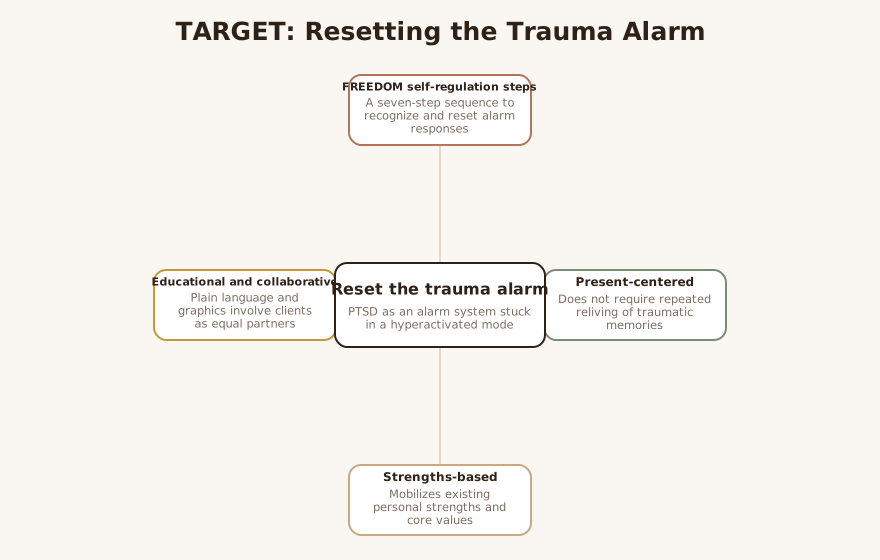
Three principles distinguish the approach.LLM First, it is present-centered: it does not require repeated reliving of traumatic memories, though it can serve as a safe preparation for memory work when that is later indicated.5 Second, it is strengths-based: rather than targeting symptoms as flaws to be eliminated, it helps clients recognize and mobilize existing personal strengths and core values.5 Third, it is educational and collaborative, using accessible graphics and plain language to involve clients as equal partners in their own recovery.5 The stated goal is a shift from automatic reactivity toward focused mindfulness—feeling in control and thinking clearly under stress.4
Interventions & Techniques
The clinical heart of TARGET is the FREEDOM sequence, a seven-step set of skills taught through repeated coaching and guided practice.5 The acronym stands for: Focus, Recognize triggers, Emotion self-check, Evaluate thoughts, Define goals, Options, and Make a contribution.1
- Focus trains attention on the present moment rather than alarm-driven reaction, using the SOS skill—Slow down, Orient, Self-Check—to attend to body signals, clear the mind, and settle on one main thought.5
- Recognize triggers helps clients anticipate and reset alarm signals by distinguishing a genuine current threat from a trauma reminder.5
- Emotion self-check asks clients to identify two kinds of feelings: “alarm” emotions such as terror, rage, and guilt, and “main” emotions that reflect positive strivings, so that both can be held in balance.5
- Evaluate thoughts addresses the rigid, global, catastrophic thinking of alarm mode and works toward a healthier balance of “reactive” and “main” thoughts.5
- Define goals distinguishes survival-oriented reactive goals from deeper “main” goals that reflect a person’s values and hopes.5
- Options surfaces the positive intentions hidden behind extreme reactive choices, widening the range of responses available.5
- Make a contribution orients the client toward recognizing how their choices contribute to their own life and to others, reinforcing core values.1
Delivery is highly structured: manuals, session-by-session scripts, discussion guides, handouts, and laminated wall posters scaffold individual, group, and home-based family work.5 The same sequence can be used as a brief skills course or as the regulatory foundation layered beneath longer treatment.2
Evidence Base
The evidence base is established but moderate, not definitively well-supported, and it deserves a candid reading.LLM CrimeSolutions rates TARGET “Effective” on the strength of two randomized controlled trials by Ford and colleagues, while the CEBC assigns a scientific rating of 3 out of 5—indicating a promising/moderate research base rather than a top “well-supported” tier.12
The supporting trials show a mixed and population-specific picture.LLM In a 12-session individual-therapy trial with 147 low-income, predominantly minority mothers with victimization-related PTSD, TARGET produced significantly lower PTSD, depression, and anxiety and greater gains in emotion regulation than comparison conditions.1 In a trial with delinquent girls (n≈59), however, results were narrower: a significant reduction in intrusive re-experiencing (PTSD Criterion B) but no significant improvement on other outcomes, and—unexpectedly—lower hope in the treatment group.1 An ongoing trial with male military veterans found TARGET equivalent (not superior) to Prolonged Exposure for reducing PTSD and anger, with comparable or greater gains in emotion regulation and higher treatment completion.5 Group trials with incarcerated women and substance-use populations have shown reductions in PTSD severity, improved self-efficacy and emotion regulation, and low dropout.5 Clinicians should weigh that several flagship studies remain developer-led and population-bounded.LLM
Populations & Indications
TARGET has been tested and field-implemented across a notably broad set of populations.4 Federally funded research has supported its use with adults in addiction treatment, mothers with PTSD, at-risk and delinquent girls, incarcerated women, and combat veterans returning from Iraq and Afghanistan.4 In youth and family systems it has been disseminated through juvenile justice, detention, residential, and child-welfare programs, reflecting its origins in developmental trauma work.5
Indications extend beyond PTSD itself.LLM The model is described as applicable to anxiety, depression, anger, dissociation, addictions, self-harm, and family and marital conflict, across diverse trauma types including military trauma, domestic violence, childhood abuse, and racism-related trauma.2 It is therefore a reasonable fit for adults with complex trauma or C-PTSD whose presentation is dominated by affect dysregulation and interpersonal difficulty, and for clients who are not yet ready—or not appropriate—for memory-focused exposure work.LLM
Problems-for-Work
TARGET maps cleanly onto the regulation-focused problems clinicians most often see in trauma caseloads.LLM
- Emotion/affect dysregulation. The Emotion Self-Check and SOS skills give clients a repeatable way to name and balance alarm versus main emotions in the moment.5
- Anger and aggression. In juvenile-detention milieu implementations, session attendance was associated with measurable reductions in disciplinary incidents and seclusion time.5
- Substance use disorders. Used alongside addiction treatment, TARGET was superior to trauma-informed treatment-as-usual in maintaining sobriety-related self-efficacy at six-month follow-up.5
- PTSD intrusions and avoidance. The Recognize-triggers step targets the trigger-to-alarm chain that drives re-experiencing and avoidance.1
- Interpersonal difficulties. Define-goals, Options, and Make-a-contribution reorient clients from reactive, threat-driven choices toward values-consistent relational action.5
LLM-generated illustrative example (not a guideline): A veteran who “goes from zero to rage” when interrupted at home learns to run SOS at the first body cue (jaw clenching), Recognize the interruption as a reminder rather than a threat, name the alarm emotion (rage) alongside a main emotion (wanting to be a present father), and choose an Option aligned with that main goal. LLM
Contraindications, Cautions & Cultural Humility
TARGET is not framed as a memory-processing therapy, and it explicitly does not require exposure; clinicians should not treat it as a substitute for trauma-memory work where that is indicated, but rather as preparation for or a complement to it.5 The mixed delinquent-girls findings—including the unexpected drop in hope—are a caution that skills-only delivery may underperform for some adolescents and that outcomes should be monitored rather than assumed.1
Cultural humility deserves particular emphasis here, grounded in the model’s own data.LLM One randomized trial showed differential response by ethnicity, with White TARGET participants reporting more improvement than non-White participants on certain measures.2 Clinicians serving racially and ethnically diverse clients should therefore deliver the model attentively, monitor whether the alarm/strengths framing resonates for the individual, and adapt language accordingly.LLM The model has been translated into Spanish (following NCTSN cultural-translation guidelines) and into several other languages, but linguistic translation is not the same as cultural equivalence of outcomes.54
Treatment-Plan Suggestions & SMART Objectives
| Goal | SMART objective (example) | Mechanism |
|---|---|---|
| Improve in-the-moment regulation | Client will independently use the SOS skill (Slow down, Orient, Self-Check) at the first body cue of alarm in ≥4 of 7 days, logged for 4 weeks | Focus step shifts processing from alarm reactivity to present-moment attention5 |
| Reduce trigger-driven reactivity | Client will identify and record 3 personal trauma triggers and one non-threat distinction for each within 3 sessions | Recognize-triggers step separates real threat from reminder5 |
| Build emotional awareness | Client will name one alarm emotion and one “main” emotion in ≥3 logged daily situations per week for 4 weeks | Emotion Self-Check balances reactive and values-based affect5 |
| Decrease catastrophic thinking | Client will reframe one rigid/catastrophic “reactive” thought into a balanced “main” thought in each of 6 consecutive sessions | Evaluate-thoughts step restores cognitive flexibility5 |
| Clarify values-based goals | Client will articulate 2 “main” goals distinct from survival/reactive goals by session 6 | Define-goals step links action to deeper values5 |
| Expand behavioral options | Client will generate ≥2 values-consistent options for a recurring conflict in 4 of 5 weekly sessions | Options step widens the response range beyond reactive choices5 |
| Reduce anger-driven behavior | Client will report a measurable decrease in reactive outbursts (self-rated, weekly) over 8 weeks | Full FREEDOM sequence applied to anger episodes5 |
Common Misconceptions
A frequent misconception is that any trauma treatment must involve reliving the index trauma; TARGET was developed specifically as an alternative path that helps clients reset present-day stress reactions without requiring memory exposure.4 A second misconception is that present-centered, skills-based work is merely “supportive” or pre-treatment; in the veterans trial, TARGET was equivalent to Prolonged Exposure on PTSD and anger outcomes, suggesting the skills pathway can stand as active treatment for some clients.5
A third, important caution concerns marketing claims.LLM Vendor materials assert that TARGET is “the only psychological therapy based on the neurobiology of post-traumatic stress”; this is best read as developer positioning rather than established fact, since neurobiologically informed framing now pervades the broader trauma field.5 Finally, the “alarm” metaphor is a teaching device, not a literal neuroanatomical claim—clinicians should present it as a useful model, not settled brain science.LLM
Training & Certification
TARGET is disseminated through Advanced Trauma Solutions (ATS), described as the sole licensed provider, which supplies intensive training and quality-assurance services to health-care, behavioral-health, correctional, juvenile-justice, child-welfare, and educational systems.5 Training is organized as a structured implementation process covering onsite assessment and planning, trauma/PTSD screening tools, manuals and materials, outcomes monitoring, intensive onsite training, ongoing consultation, and fidelity monitoring.5
Delivery requirements vary by format: individual and couple/family therapy call for master’s- or doctoral-level clinicians, while group delivery can be provided by bachelor’s-level or higher staff.2 Full certification—preparing a clinician, case manager, or line staff member to deliver TARGET in individual, group, family, and milieu modalities—is achieved through training, consultation, supervised field experience, fidelity review, and direct feedback over a period of roughly 12 to 15 months.5 One stated feature of the model is that it can be taught to deliverers from a wide range of professional and educational backgrounds.5
Key Terms
- FREEDOM steps — the seven-skill sequence (Focus, Recognize triggers, Emotion self-check, Evaluate thoughts, Define goals, Options, Make a contribution) at the core of TARGET.1
- SOS — the Focus-step micro-skill: Slow down, Orient, Self-Check, used to attend to body signals and settle on one main thought.5
- Alarm — TARGET’s plain-language term for the hyperactivated stress-response system that drives trauma reactivity.5
- Reactive vs. “main” emotions/thoughts/goals — the contrast between alarm-driven survival responses and values-based, deliberate ones.5
- Present-centered — treatment focused on current stress reactions rather than reliving past traumatic memories.5
- Developmental Trauma Disorder — the chronic, early-life trauma construct central to the model’s youth/justice origins.3
Resources & Further Reading
▶ Watch — a video introduction to this concept:
- CrimeSolutions (NIJ/OJP): TARGET Program Profile
- CEBC: TARGET (Adults) — Detailed Program Description
- UConn Center for the Treatment of Developmental Trauma Disorders: Treatment
- UConn Today: Innovative Therapeutic Program Helps Those Living With PTSD
- Advanced Trauma Solutions / FREEDOM Program Overview Brochure
- NCTSN: What is TARGET? (intervention fact sheet)
Reflective / Supervision Questions
- For a given client, is affect dysregulation the primary obstacle—making the present-centered FREEDOM pathway appropriate—or is memory-focused processing the more pressing need?LLM
- How will you monitor for the kind of non-response (or paradoxical drop in hope) seen in the adolescent trial, rather than assuming benefit from skill delivery?LLM
- Given documented differential response by ethnicity, how are you checking whether the “alarm” and “main goals” framing genuinely resonates for each client’s cultural context?LLM
- When you describe TARGET’s neurobiological model to a client, are you presenting it as a useful teaching metaphor rather than as settled brain science?LLM
- How are you documenting FREEDOM-based work within your primary billable psychotherapy and integrating it with the rest of the treatment plan?LLM