
Type & Discipline
The T-group, short for “training group” and historically called sensitivity training, is an experiential small-group method rather than a formal psychotherapy 1. Its disciplinary home is social psychology and organizational behavior, where it grew out of mid-twentieth-century research on group dynamics 3. A T-group typically convenes roughly eight to fifteen adults who meet with no fixed agenda, no curriculum, and only a deliberately non-directive trainer, so that the group’s own unfolding process becomes the material for learning 1. The defining mechanism is here-and-now feedback: members share the emotional reactions that arise in real time in response to one another’s behavior, and through that feedback they learn how they are actually experienced by others 1. For practicing clinicians, the most useful frame is that the T-group is a historical laboratory technique whose insights were later absorbed into interpersonal and experiential group psychotherapy, not a reimbursable treatment in its own right LLM.
Creators & Lineage
The method originated with Gestalt-influenced social psychologist Kurt Lewin in 1946, when civic leaders in Connecticut asked him to facilitate workshops aimed at easing community racial tensions 4. The pivotal discovery was accidental: one evening, participants overheard the research staff debriefing the day’s group interactions and asked to join that discussion, and the resulting conversation about the group’s own process was essentially the first T-group 4. In 1947 Lewin and colleagues founded the National Training Laboratories (NTL) in Bethel, Maine, formalizing the approach; Lewin died that same year, but co-founders Leland Bradford, Ronald Lippitt, and Kenneth D. Benne carried the work forward 34. The lineage then branched: Carl Rogers extended the format into encounter groups in the 1950s, shifting emphasis from group dynamics toward each individual’s deep expression of feeling, and he regarded the intensive group experience as among the most significant social inventions of the century 26. Will Schutz, working at the Esalen Institute, noted that the labels T-group, sensitivity training group, and encounter group were by then often used interchangeably 2. This Lewinian root system feeds directly into modern interpersonal process group therapy, where here-and-now relational learning remains central LLM.
Core Principles
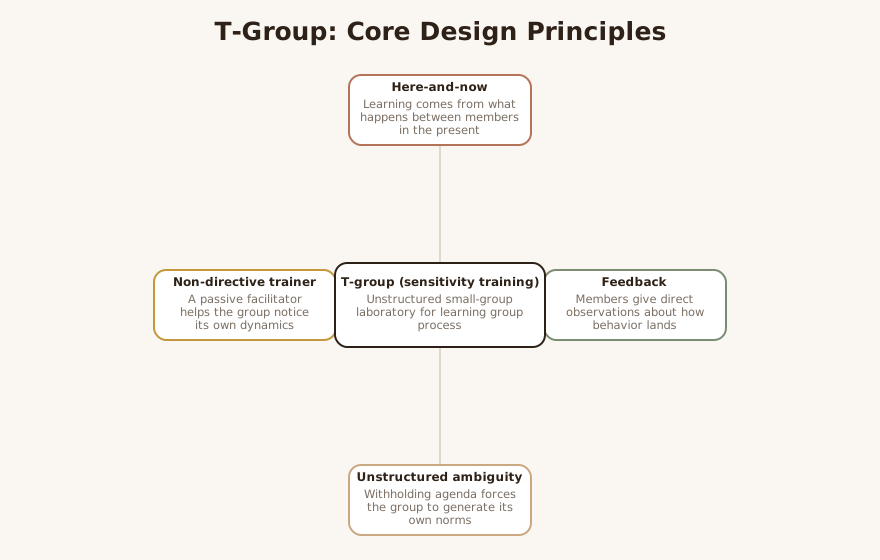
The first principle is the here-and-now: learning comes from attending to what is happening between members in the present moment rather than from discussing outside events or abstract theory 3. The second is feedback: members offer one another direct observations about how their behavior lands, creating continuous loops of interpersonal data that are normally unavailable in everyday social life 3. The third is unstructured ambiguity: by withholding agenda and direction, the design forces the group to generate its own norms, and the anxiety this provokes surfaces each member’s characteristic interpersonal style 1. The fourth is the non-directive trainer, a relatively passive facilitator whose role is to help the group notice its own dynamics rather than to lead, teach, or fix 3. Underlying all of these is an experiential learning premise: insight that is felt and tested in live interaction transfers better than insight that is merely explained LLM. Stated goals classically included greater self-awareness, recognition of one’s prejudices and impact, and improved sensitivity to others and to group process 2.
Interventions & Techniques
In practice the trainer opens with minimal structure and tolerates the resulting silence and confusion, letting the group’s reaction to ambiguity become the first object of study 1. The core activity is soliciting and shaping feedback, often through prompts that move members from content to process and from interpretation to observable behavior and felt reaction LLM. Classic T-groups also drew on adjacent methods such as problem-solving exercises and role play to surface interpersonal patterns 1. During the 1960s and 1970s, some descendants of the method incorporated heavy nonverbal and physical-contact exercises; this was later discouraged in favor of a more modest emphasis on emerging group process 2.
LLM-generated illustrative example (not a guideline): A member who habitually rescues others is told by two peers, “When I started to cry, you immediately handed me tissues and changed the subject—I felt managed, not met.” The trainer slows the moment down so the member can notice the impulse, the others’ impact, and the relational pattern in real time rather than analyzing it abstractly LLM.
Evidence Base
The evidence base is best described as historical and methodologically weak by contemporary standards, and clinicians should present it honestly as such LLM. The technique predates modern randomized-trial conventions, and reviews even at the time raised doubts about whether the training experience produced lasting behavioral change rather than transient insight 3. One often-cited figure held that roughly 30% of participants reported durable benefit while about 8% reported equally lasting negative effects, which—if accurate—signals both real impact and real risk 2. The movement’s own trajectory is instructive: T-groups flourished in organizations and universities through the 1950s and 1960s but declined in the 1970s, partly because spin-off encounter and sensitivity seminars developed problematic practices, and partly because the core ideas became so mainstream that, as one observer put it, the method “died of success” 4. The honest clinical takeaway is that the T-group’s enduring contribution is conceptual—the here-and-now feedback mechanism that modern group therapies operationalize with better safeguards—rather than a body of high-quality outcome trials supporting the T-group as delivered LLM.
Populations & Indications
Historically the method served adults in group settings, particularly leaders, managers, and organizational teams seeking better interpersonal effectiveness 7. It was also widely adopted as a development tool for helping professionals and for counselors and therapists in training, where experiencing group process from the inside builds facilitation skill 3. For a contemporary clinical audience, the T-group’s principles are most indicated, within a proper group-therapy container, for clients whose difficulties are fundamentally interpersonal: people who struggle to read their impact on others, who avoid emotional contact, or who repeat relational conflicts they cannot see LLM. It is suited to clients with adequate ego strength and frustration tolerance, since unstructured feedback is demanding, and it presumes a willingness to be observed and to observe oneself in relationship LLM.
Problems-for-Work
The T-group tradition speaks directly to a cluster of interpersonal and self-awareness problems that clinicians can target when they import its mechanism into structured group treatment LLM. Poor self-awareness and defensiveness are addressed because the group functions as a mirror, returning data the client cannot generate alone 3. Communication problems and empathy or perspective-taking deficits are worked through repeated cycles of giving and receiving feedback, which build sensitivity to others’ experience 2. Interpersonal difficulties, relationship conflict, and assertiveness deficits become visible as patterns reenacted live in the room, where they can be named and rehearsed differently LLM. Emotional avoidance, low self-esteem, and social anxiety are engaged gradually as the member tolerates being seen and discovers that authentic contact is survivable LLM.
LLM-generated illustrative example (not a guideline): A client with social anxiety predicts that peers find him boring; across sessions, members repeatedly report the opposite and describe wanting to hear more from him, providing disconfirming relational evidence that abstract reassurance never supplied LLM.
Contraindications, Cautions & Cultural Humility
The historical literature itself flags real hazards, and these are not optional caveats LLM. Carl Rogers warned that group pressure could shade into bullying and that members needed solid egos to benefit, which argues against using intensive feedback formats with fragile, acutely symptomatic, or poorly screened clients 2. The reported rate of lasting negative outcomes underscores that confrontational, unstructured feedback can harm, so screening, informed consent, and an experienced facilitator are essential 2. Critics have gone further, charging that some sensitivity-training practices verged on coercive psychological manipulation, a critique worth taking seriously when the method drifts toward pressuring conformity 2. The term sensitivity training later acquired politicized and sometimes derisive cultural baggage, so clinicians should be precise about what they are and are not offering 2. Cultural humility is especially salient given the method’s own origin in race-relations work: norms about emotional disclosure, direct confrontation, and eye contact vary widely across cultures, and a facilitator must not treat reticence as resistance or pathologize culturally grounded ways of relating LLM.
Treatment-Plan Suggestions & SMART Objectives
| Goal | SMART objective (example) | Mechanism |
|---|---|---|
| Increase interpersonal self-awareness | Within 8 group sessions, client will accurately restate feedback received from at least 2 peers in 3 separate sessions, per facilitator log | Here-and-now feedback loop 3 |
| Reduce defensiveness | Over 6 weeks, client will respond to corrective feedback with curiosity rather than justification in 70% of observed instances | Tolerating ambiguity and impact data 1 |
| Improve perspective-taking | By session 10, client will accurately name another member’s stated feeling before responding in at least 4 interactions | Empathy via feedback exchange 2 |
| Build assertiveness | Within 8 sessions, client will voice a differing opinion in group at least once per session for 3 consecutive sessions | Live rehearsal in safe group LLM |
| Decrease emotional avoidance | Over 12 weeks, client will name a present-moment feeling aloud in group in 80% of sessions | Here-and-now affect labeling 3 |
| Increase accurate self-appraisal | By discharge, client will compare self-rated and peer-rated interpersonal impact with <1-point average discrepancy on a 5-point scale | Mirror function of the group 3 |
| Generalize relational learning | Client will report applying one specific group insight to an outside relationship in 4 of the final 6 sessions | Transfer of experiential learning LLM |
Common Misconceptions
A frequent misconception is that the T-group is itself a form of psychotherapy; historically it was framed as training and education in group dynamics, not treatment 1. Another is that T-group, encounter group, and sensitivity training are precisely distinct—in practice they were often used synonymously, even though the encounter-group strand leaned more toward individual emotional expression than group-process learning 2. A third is that the trainer leads or teaches; the defining stance is non-directive, with structure deliberately withheld 3. Finally, some assume strong evidence supports the method, when in fact even contemporaneous reviews questioned its durability 3.
Training & Certification
There is no clinical license specific to running T-groups; the lineage instead runs through the institution Lewin’s colleagues founded LLM. The NTL Institute for Applied Behavioral Science has operated for over seventy-five years and still treats the T-group as central to its identity, embedding it in its signature Human Interaction Laboratory 5. NTL offers experiential programs and professional development including organizational-development certificate programs and a dedicated “Transforming Through T-Group” offering for trainers and facilitators 5. Clinicians who want to apply these methods in practice should pair such facilitation exposure with formal training and supervision in group psychotherapy, which supplies the screening, ethics, and safety scaffolding the original T-group lacked LLM.
Key Terms
- T-group (training group): unstructured small group whose own process is the curriculum 1.
- Sensitivity training: broader label for group methods aimed at awareness of self, prejudice, and group dynamics 2.
- Here-and-now: focus on present-moment interaction rather than outside content 3.
- Feedback: members’ direct reports of how a peer’s behavior affects them 3.
- Encounter group: Rogers-associated descendant emphasizing individual emotional expression 26.
- Non-directive trainer: facilitator who clarifies process rather than leading 3.
Resources & Further Reading
▶ Watch — a video introduction to this concept:
- T-groups — Wikipedia 1
- Sensitivity training — Wikipedia 2
- Sensitivity Training — Encyclopedia.com 3
- A Brief History of T-Groups — Ed Batista 4
- NTL Institute (National Training Laboratories) 5
- Carl Rogers on Encounter Groups (Google Books) 6
- A History of the T-Group and Its Early Applications in Management Development (ResearchGate) 7
Reflective / Supervision Questions
- When I give a client feedback in group, am I sharing my here-and-now reaction or slipping into interpretation and advice LLM?
- How do I distinguish therapeutic confrontation from the bullying pressure Rogers warned about 2?
- Which clients on my caseload have the ego strength for unstructured interpersonal feedback, and which do not LLM?
- How do my own cultural assumptions about disclosure and directness shape what I read as “openness” versus “resistance” in a group LLM?
- Am I honest with clients and referrers that this method’s evidence is historical and conceptual rather than trial-grade 3?