
Type & Discipline
Speech act theory and the theory of conversational implicature are not therapies. They are foundational frameworks within pragmatics, the branch of linguistics and philosophy of language that studies how utterances communicate meaning beyond the literal definitions of their words, shaped by speaker intention and conversational context 5. Pragmatics is conventionally distinguished from semantics: semantics concerns the rule systems that fix the literal meanings of words and sentences, while pragmatics concerns the nonliteral, context-dependent layer of what speakers actually mean and do when they talk 5.
For clinicians, the relevance is conceptual rather than procedural. These frameworks supply a precise vocabulary for describing what goes wrong when communication breaks down — in couples who feel chronically misunderstood, in autistic clients who take indirect requests literally, in clients whose flat or hyper-literal interpretation of others fuels interpersonal conflict LLM. They are a lens, not a manual LLM.
Creators & Lineage
The modern study of speech acts begins with the British philosopher J. L. Austin, who rejected the logical-positivist assumption that the only meaningful utterances are empirically verifiable statements, and instead argued that many utterances do things rather than merely describe things 5. Austin distinguished three layers of any utterance: the locutionary act (uttering meaningful words with conventional meaning), the illocutionary act (the characteristic communicative aim — promising, commanding, asserting), and the perlocutionary act (the effect produced in the listener, such as persuading or convincing) 1.
Austin’s student John Searle systematized the framework, most influentially in Speech Acts: An Essay in the Philosophy of Language (1969) 4. Searle analyzed illocutionary force into components including the point of the act, the conditions on its propositional content, preparatory conditions, and sincerity conditions, and organized acts partly by their direction of fit — whether words are meant to match the world (assertions) or the world is meant to be made to match the words (commands) 1.
The second pillar is H. P. Grice, whose 1975 paper “Logic and Conversation” introduced the Cooperative Principle and the conversational maxims that explain how listeners routinely infer far more than is literally said 3. Grice’s account remains the canonical theory of conversational implicature, and his maxims are still the reference point for the entire field 2. Within clinical disciplines, these ideas were absorbed indirectly: they inform how speech-language pathology conceptualizes pragmatic language, and they resonate with communication-focused models such as emotionally focused couples therapy and the cognitive-behavioral attention to interpretation and attribution LLM.
Core Principles
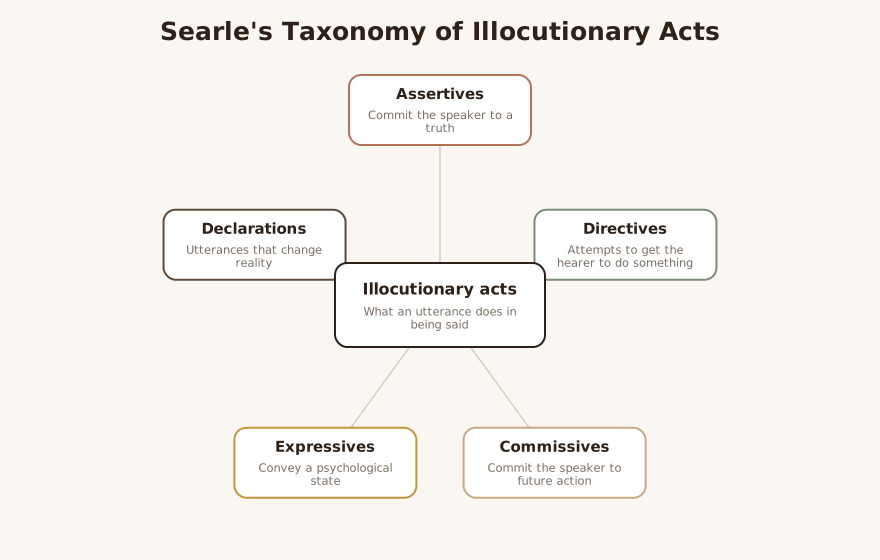
The first principle is that utterances perform actions. Performative sentences such as “I promise to meet you” accomplish the act of promising in the very act of being said, rather than reporting on some independent fact 1. Searle’s taxonomy, building on Austin, sorts illocutionary acts into broad families — assertives (committing the speaker to a truth), directives (attempts to get the hearer to do something), commissives (committing the speaker to future action, e.g., promises), expressives (conveying a psychological state), and declarations (utterances that change reality, e.g., “I now pronounce you…”) 5.
The second principle is that speech acts succeed or fail according to felicity conditions — the contextual prerequisites for the act to come off. Austin distinguished misfires, where the act simply does not occur because conditions are not met (someone lacking the authority to appoint another to office), from abuses, where the act technically occurs but is performed insincerely (promising with no intention to follow through) 1.
The third principle is inference under cooperation. Grice proposed a Cooperative Principle: make your conversational contribution what is required, at the stage at which it occurs, by the accepted purpose of the exchange 2. This is realized through four maxims: Quantity (be as informative as required, no more), Quality (do not say what you believe false or lack evidence for), Relation/Relevance (be relevant), and Manner (be perspicuous — avoid obscurity and ambiguity, be brief and orderly) 2. Crucially, Grice treated these not as arbitrary etiquette rules but as expressions of rational cooperative behavior 2.
Fourth, implicature is meaning conveyed beyond what is literally said. A conversational implicature depends on context and the maxims rather than on sentence meaning: when one person declines a party invitation by saying “I have to work,” the sentence does not literally mean “I won’t attend,” yet the listener reliably infers it 2. Implicatures are cancellable — one can say “Some athletes smoke; in fact, all of them do” without contradiction — which distinguishes them from literal content 2.
Interventions & Techniques
Speech act theory is descriptive, not prescriptive, so it does not come with a technique manual. Clinically, it is best used as an assessment and reframing lens that is then delivered inside a recognized modality LLM. The following are reasonable translations, all of which require a host treatment frame rather than standing alone LLM.
- Mapping the illocutionary force of stuck exchanges. With couples, naming whether an utterance was meant as an assertion, a request (directive), or a commitment (commissive) can expose a force mismatch — for example, one partner intending a soft request while the other hears a criticism LLM.
- Working with indirect speech acts explicitly. “Can you take out the trash?” is grammatically a question about ability but functions as a request 1. Teaching clients to recognize and produce indirect requests is a staple target in social-communication work LLM.
- Maxim-based repair. Framing a breakdown as a violated maxim — too little information (Quantity), an irrelevant tangent (Relation), or ambiguity (Manner) — gives clients a concrete, non-blaming label for the problem LLM.
- Distinguishing flouting from failing. Sarcasm and irony are deliberate, mutually understood floutings of the maxim of Quality, as when someone says “the weather’s lovely” during a blizzard 2. Clients who miss this distinction can be coached to check whether a literal reading makes sense in context LLM.
- Slowing perlocutionary attribution. Helping a client separate what was said and meant (illocution) from the effect it had on them (perlocution) can interrupt the leap to “they did that to hurt me” 1LLM.
LLM-generated illustrative example (not a guideline): A couple repeatedly fights about chores. The clinician maps a recent exchange: Partner A said “The dishes have been in the sink since yesterday.” Intended as an indirect request (directive), it was received as an accusation (a negatively-valenced assertive). Naming the force mismatch lets both partners practice making requests direct and explicit, reducing the inferential gap where blame accumulates LLM.
Evidence Base
Honesty here requires a sharp split. As theory, speech act theory and conversational implicature are established — canonical, roughly half a century old, and still the organizing frameworks of pragmatics in linguistics and philosophy 125. That maturity refers to their standing as accounts of how language works, not to any clinical efficacy LLM.
As clinical application, the situation is entirely different and far less mature. None of the foundational sources are clinical; they make no claims about treatment outcomes LLM. Speech act theory is not itself an evidence-based therapy, and there is no body of randomized trials testing “speech act therapy” as a discrete intervention LLM. What exists instead is indirect influence: pragmatic-language constructs derived from this tradition are embedded in speech-language pathology and in social-communication interventions, and the underlying ideas are compatible with established modalities such as CBT and emotionally focused therapy LLM. Clinicians should therefore treat the framework as a conceptual tool that informs case formulation and psychoeducation, while drawing any efficacy claims from the evidence base of the host modality, not from speech act theory itself LLM.
A related caution: even within linguistics, the field is not monolithic. Relevance Theory (Sperber and Wilson) reframes pragmatics in cognitive terms around “optimal relevance,” and critics note that such models can be hard to falsify because the relevant contextual implications are, in principle, unbounded 5. The frameworks are useful and durable, but they remain theories, not settled empirical machinery LLM.
Populations & Indications
The framework is most clinically apt where the inferential and action layers of communication are the problem rather than vocabulary or grammar LLM.
- People on the autism spectrum, who may interpret indirect requests, irony, or implicature literally, missing the intended illocutionary force LLM.
- People with social (pragmatic) communication difficulties, for whom the gap between what is said and what is meant is the core complaint LLM.
- Children with language disorders, whose pragmatic development may lag receptive or expressive vocabulary LLM.
- People with traumatic brain injury, in whom acquired pragmatic deficits — over-literal interpretation, difficulty reading implicature — can emerge or worsen LLM.
- Couples and families, where chronic miscommunication and misattribution often trace to force mismatches and unstated implicatures rather than to disagreement about facts LLM.
Problems-for-Work
- Social (pragmatic) communication disorder / pragmatic language deficits. Target: recognizing and producing indirect speech acts and repairing maxim violations. Application: a clinician role-plays requests phrased indirectly and coaches the client to detect the underlying directive LLM.
- Autism spectrum disorder. Target: building explicit, rule-based strategies for detecting irony, sarcasm, and implicature so the client can check whether a literal reading fits the context 2LLM.
- Relationship conflict and interpersonal conflict. Target: surfacing illocutionary mismatches so partners stop hearing requests as accusations LLM.
- Miscommunication and misattribution. Target: separating illocution (what was meant) from perlocution (its effect), interrupting hostile attributions 1LLM.
- Assertiveness deficits. Target: converting hinted, indirect requests into clear, direct directives that state the want explicitly LLM.
- Social skills deficits. Target: scaffolding the Quantity and Manner maxims so a client gives the right amount of clearly organized information 2LLM.
Contraindications, Cautions & Cultural Humility
This framework should never be used as a standalone treatment or as a substitute for a properly indicated modality; it is an adjunctive lens LLM. A central caution is over-literal application by the clinician: maxims describe tendencies in cooperative talk, not universal laws, and labeling a client’s speech as “violating a maxim” can pathologize ordinary variation LLM.
Cultural humility is essential because Grice’s maxims, while framed as rational and general, are operationalized differently across cultures and communities LLM. What counts as the “required” amount of information (Quantity), an acceptable degree of directness versus indirectness, or appropriate manner varies widely; high-context communication styles routinely convey meaning through implicature that a low-context listener would read as evasive or insufficient LLM. Neurodivergent communication is likewise a difference, not merely a deficit: an autistic client’s literal style is a legitimate communicative profile, and intervention should aim at mutual intelligibility and the client’s own goals, not at enforcing neurotypical norms LLM. Clinicians should also avoid assuming that a felicity failure reflects insincerity — Austin’s “abuse” category is a philosophical distinction, not a verdict on a client’s character 1LLM.
Treatment-Plan Suggestions & SMART Objectives
| Goal | SMART objective (example) | Mechanism |
|---|---|---|
| Recognize indirect requests | Within 8 sessions, client will correctly identify the intended request in 8/10 indirectly phrased utterances in role-play | Mapping illocutionary force behind interrogative/declarative forms 1LLM |
| Produce direct assertive requests | Within 6 weeks, client will state a want as an explicit direct request in 3 logged real-world situations per week | Converting indirect directives into direct speech acts to reduce inferential load 1LLM |
| Detect irony and sarcasm | Within 10 sessions, client will flag whether a literal reading fits context in 7/10 vignettes involving flouted Quality | Explicit strategy for recognizing deliberate maxim flouting 2LLM |
| Reduce hostile attribution in conflict | Over 8 sessions, couple will pause and check intended meaning before responding in 75% of in-session disagreements | Separating illocution from perlocution to interrupt misattribution 1LLM |
| Repair maxim breakdowns | Within 6 sessions, client will name which maxim broke down (information, relevance, clarity) in 6/8 reviewed exchanges | Maxim-based labeling as a non-blaming repair tool 2LLM |
| Improve information-giving | Within 5 sessions, client will deliver the contextually appropriate amount of clearly ordered information in 4/5 narrative tasks | Scaffolding the Quantity and Manner maxims 2LLM |
| Generalize pragmatic skills | Within 12 weeks, client will self-report applying a request or repair strategy in 5 logged outside-session situations | Transfer of practiced acts to natural conversation LLM |
Common Misconceptions
- “Pragmatics is just politeness or being nice.” Pragmatics is the systematic study of context-dependent meaning and the actions utterances perform, of which politeness is only a small part 5LLM.
- “Implicature is the literal meaning of the sentence.” Conversational implicature is precisely the meaning beyond the literal — it is inferred via the maxims and is cancellable, which the literal content is not 2.
- “Grice’s maxims are rules people are obligated to follow.” They are descriptions of rational cooperative behavior; speakers routinely and deliberately flout them (as in irony) to convey meaning, and this is normal, not a violation to be corrected 2.
- “A felicity ‘abuse’ means the client is lying.” Austin’s category is a technical distinction about whether sincerity conditions were met, not a moral judgment about an individual 1LLM.
- “Speech act theory is a therapy with an evidence base.” It is an established linguistic-philosophical theory; its clinical use is indirect and adjunctive, and efficacy claims must come from the host modality LLM.
Training & Certification
There is no certification in “speech act therapy,” because it is not a standalone clinical modality LLM. Clinicians gain competence through two routes. First, foundational literacy in pragmatics via the primary literature — Austin and Searle on speech acts, and Grice’s “Logic and Conversation” on implicature — supported by encyclopedic overviews 12345. Second, formal training in the modalities that carry this content clinically: graduate and continuing education in CBT-based social-skills intervention, in established couples therapies, and, for pragmatic language work with children and acquired deficits, the scope and supervision of speech-language pathology LLM. The framework deepens an existing competency; it does not replace credentialing in a delivery modality LLM.
Key Terms
- Locutionary / illocutionary / perlocutionary act — uttering meaningful words; the intended communicative act (promising, asserting); the effect on the listener 1.
- Illocutionary force — the kind of act an utterance performs and its strength, analyzable via point, content, preparatory, and sincerity conditions 1.
- Direction of fit — whether words are meant to match the world (assertions) or the world is to be changed to match the words (commands) 1.
- Felicity conditions; misfire; abuse — contextual prerequisites for a speech act; failure of the act to occur; insincere performance of an act that technically occurs 1.
- Performative vs. constative — an utterance that performs an act in being said vs. one that describes/asserts 1.
- Direct vs. indirect speech act — form matches force (“Close the door!”) vs. one form used to perform another (“Can you close the door?”) 1.
- Cooperative Principle — make your contribution what the accepted purpose of the exchange requires 2.
- Maxims of Quantity, Quality, Relation, Manner — be appropriately informative, truthful, relevant, and clear 2.
- Conversational implicature — context-derived, cancellable meaning beyond the literal, inferred via the maxims 2.
- Flouting — patently violating a maxim to convey meaning, as in irony 2.
Resources & Further Reading
- Speech Acts — Stanford Encyclopedia of Philosophy
- Implicature — Stanford Encyclopedia of Philosophy
- Grice, H. P. (1975), “Logic and Conversation” (original paper PDF)
- Searle, J. R., Speech Acts: An Essay in the Philosophy of Language (1969), Cambridge University Press
- Pragmatics — Encyclopaedia Britannica
- Pragmatics: Crash Course Linguistics #6 (video)
- Speech act — Wikipedia
Reflective / Supervision Questions
- When a client reports being “misunderstood,” can I identify whether the breakdown is at the level of illocutionary force (what act was intended), implicature (what was inferred), or perlocution (the effect it had)? LLM
- Am I treating a client’s indirect or literal communication style as a deficit to correct, or as a difference to work with toward the client’s own goals? LLM
- How do my own cultural assumptions about directness, the “right” amount of information, and clarity shape which client utterances I read as problematic? LLM
- When I use this lens with a couple or family, am I delivering it inside a coherent host modality, and is that reflected in my formulation and documentation? LLM
- Am I being honest with myself and supervisees that I am applying a linguistic theory adjunctively, rather than implying it is an evidence-based treatment in its own right? LLM