
Type & Discipline
The neurodiversity paradigm is a conceptual framework, not a treatment modality or a set of techniques 1. It sits at the intersection of disability studies, the social sciences, and self-advocacy, and it has increasingly entered the literature of child and adolescent psychiatry as a lens through which to reconsider conditions such as autism, attention-deficit/hyperactivity disorder, and dyslexia 5. At its core it is a way of understanding human neurological variation: the claim that the diversity of human minds is a natural feature of our species rather than a collection of defects awaiting correction 1.
A precise vocabulary matters here, because the field is careful to separate three things that everyday usage tends to blur 1. “Neurodiversity” itself names a biological fact, the infinite variation in neurocognitive functioning within the human population, and as a fact it is neither good nor bad and cannot be argued with 1. The “neurodiversity paradigm” is the interpretive stance that treats that variation as natural and valuable, that rejects the idea of a single “normal” brain, and that reads the dynamics around neurological difference through the lens of social power 1. The “neurodiversity movement” is the social-justice movement that pursues civil rights, respect, and full inclusion for neurodivergent people 1. For a clinician, the paradigm functions much like a cultural-humility framework: it does not tell you what to do in session so much as reshape how you understand the person in front of you and the language you use about them LLM.
Creators & Lineage
The term “neurodiversity” first appeared in print in 1998, in an article by the journalist Harvey Blume and in the sociology honours thesis of Judy Singer, both of whom were drawing on conversations within the early online autism self-advocacy community 3. Singer, who is herself described as likely on the autistic spectrum, is the figure most often credited with naming the concept, and her work helped translate the lived insistence of autistic self-advocates into a sociological frame 3. Foundational groundwork for the movement is also widely attributed to Jim Sinclair’s 1993 address “Don’t Mourn for Us,” which reframed autism as part of a person rather than an affliction to be grieved 3. The closely allied terms “neurodivergent” and “neurodivergence” were coined separately, around 2000, by the activist Kassiane Asasumasu 1.
The paradigm did not emerge in a vacuum LLM. It grew directly out of the disability rights movement and builds on the social model of disability, which locates a substantial share of “disability” in societal barriers and in the mismatch between a person and an environment, rather than treating it as residing wholly inside the individual 3. It stands in deliberate contrast to the medical model of disability, which frames neurological difference as pathology to be diagnosed, treated, and ideally cured 3. The contemporary theorist most associated with articulating the paradigm in rigorous terms is Nick Walker, whose book Neuroqueer Heresies gathers the foundational definitions and pushes the framework toward what she calls “neuroqueer” and “postnormal” possibilities 2. Notably, some figures within the tradition, including Singer herself, have come to describe the paradigm as a middle ground between a strong medical model and a strong social model rather than a wholesale rejection of either 3.
Core Principles
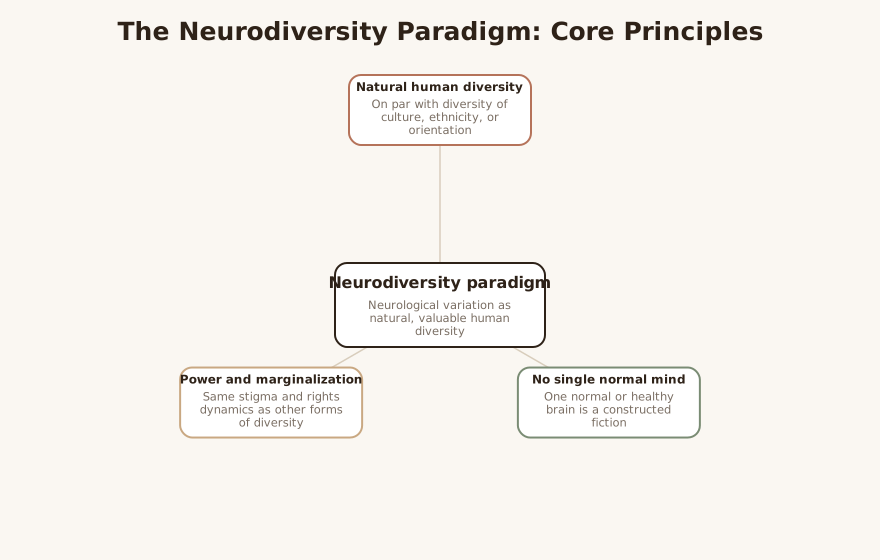
The first principle is that neurodiversity is a natural and valuable form of human diversity, on par with diversity of culture, ethnicity, or sexual orientation 1. The second is that the idea of a single “normal” or “healthy” type of brain or mind is a culturally constructed fiction, no more defensible than the idea of a single normal ethnicity 1. The third is that the social dynamics surrounding neurodiversity, including who is privileged and who is marginalized, mirror the power inequalities that attach to other forms of human diversity, and are therefore amenable to the same analysis of stigma, accommodation, and rights 1.
From these flow a working vocabulary the clinician should hold precisely 1. “Neurodivergent” means having a mind that functions in ways diverging significantly from dominant societal standards of normal; the divergence may be innate, acquired through experience, or both 1. “Neurotypical” is its opposite, a style of neurocognitive functioning that falls within those dominant standards 1. A “neurominority” is a group sharing a form of neurodivergence that is largely innate and inseparable from who they are, and that faces prejudice, misunderstanding, or discrimination, with autistic and dyslexic people offered as examples 1.
A further principle, drawn from the social model on which the paradigm rests, is that distress and impairment are often produced at the interface between person and environment rather than lying entirely within the person 3. On this view, much of the suffering associated with being neurodivergent stems from barriers imposed by societal norms and inaccessible settings, not solely from the neurology itself 4. Crucially, in its careful formulations the paradigm does not deny that disability or genuine support needs exist; it reframes where the problem is located and how it should be addressed 3.
Interventions & Techniques
The paradigm prescribes no proprietary techniques, so what follows is the clinical translation of its principles, and these are the author’s synthesis rather than directives from the literature LLM. The most fundamental shift is affirmative reframing: describing a client’s neurology in terms of difference, strengths, and needs rather than exclusively in terms of deficits, while still naming real challenges honestly 4. This is often paired with identity-first language and a willingness to follow the client’s own preferences about how they wish to be described, since language is itself a site of the stigma the paradigm seeks to dismantle 1.
A second application is environmental accommodation rather than person-only remediation 4. In practice this means working with the client to identify and adjust the demands of their settings: offering sensory accommodations such as quieter spaces or noise-reduction, giving concise and explicit instructions, avoiding sarcasm and implied messages, providing advance notice of changes, and asking about individual preferences rather than assuming them 4. A third is the deliberate reduction of masking, the effortful suppression of natural neurodivergent behavior to appear neurotypical, which the paradigm reframes from an adaptive skill to be perfected into a frequent driver of exhaustion and distress LLM. A fourth is the use of strengths-based assessment that maps a client’s range of abilities, interests, and supports alongside their challenges, so the formulation is not exhausted by a problem list 4.
None of this entails withholding support 4. The paradigm, in its mainstream clinical reading, is explicit that people who need and want behavioural supports or interventions should have access to them, while insisting that such approaches cannot be one-size-fits-all and must be aligned with the person’s own goals 4.
LLM-generated illustrative example (not a guideline): An autistic adult arrives describing chronic exhaustion and a sense of being “a fraud,” having spent decades scripting conversations, suppressing stimming, and forcing eye contact to pass as neurotypical at work. Working from the paradigm, the clinician names this pattern as masking rather than as social skill deficit, validates the cost it has exacted, and shifts the work toward identifying which masking the client wants to keep, which they can safely shed, and which workplace accommodations would reduce the need for it, while remaining alert to co-occurring anxiety that may warrant direct treatment LLM.
Evidence Base
The honest characterization is that the neurodiversity paradigm is an established and influential conceptual framework, not an intervention with a randomized-trial evidence base 5. Its maturity is the maturity of a paradigm: it has a coherent body of foundational theory, a settled technical vocabulary, a substantial advocacy literature, and a growing presence in the academic and clinical discourse of psychiatry and disability studies, including editorial treatment within child and adolescent psychiatry 5. There are no controlled trials of “neurodiversity” itself, because it is a way of understanding people rather than a procedure applied to them, and it would be a category error to present it to a client as an evidence-based therapy LLM.
What the framework does have is a strong conceptual and historical grounding and a clear lineage in the social model of disability, together with an active and serious scholarly debate about its scope and limits 3. That debate is itself a marker of maturity rather than weakness LLM. The most prominent criticism is that the paradigm can downplay the challenges associated with some conditions and can overlook people with significant support needs, with critics observing that autistic people with higher support needs would continue to face substantial challenges even in a fully accommodating society 3. Defenders respond that the paradigm, properly understood, does not deny disability or support needs at all 3. For the clinician, the practical implication is to treat neurodiversity as a credible and well-developed interpretive framework that reliably generates humane and useful questions, while not overclaiming it as a validated treatment or as a reason to withhold indicated, wanted support LLM.
Populations & Indications
The framework is most directly relevant to people whose neurology is itself the locus of identity and stigma: autistic individuals, people with ADHD, and people with dyslexia and other specific learning differences 1. It extends naturally to neurodivergent adults navigating late or recent diagnosis, who are often renegotiating their self-understanding LLM. It is also salient for students and adolescents, a population for whom the framework has been taken up within child and adolescent psychiatry, and whose developing identity intersects with how their difference is named at school and at home 5. People with learning disabilities and other conditions framed as neurominorities, including those named in the source literature such as people with Down syndrome, fall within its scope as well 1.
Indications for adopting the lens are less about a specific diagnosis than about a clinical situation LLM. It is especially apt when internalized stigma, shame, or a sense of brokenness is central to the presentation, when a client is exhausted by sustained masking, when the presenting distress appears to track environmental mismatch more than intrinsic impairment, and when the work involves identity consolidation around a neurodivergent self 4. It is also useful with families and systems, where a shift from a deficit frame to a difference-and-accommodation frame can change how a child is treated at home and in the classroom 4.
Problems-for-Work
The paradigm speaks most directly to internalized stigma and the low self-esteem that so often accompany a lifetime of being treated as deficient; the affirmative reframe and the relocation of “the problem” toward environment and stigma give the clinician concrete leverage on a client’s belief that they are fundamentally broken 4. It addresses masking and the burnout that follows from it, recasting chronic self-suppression as a cost to be reduced rather than a competence to be perfected LLM. It is central to work on identity and self-acceptance, particularly after a late autism or ADHD diagnosis, where the task is to integrate a new self-understanding without either grief-stricken self-rejection or denial of real needs 3.
LLM-generated illustrative example (not a guideline): A university student recently identified as having ADHD oscillates between relief and self-blame, convinced that years of missed deadlines mean they are “lazy and stupid.” Using the paradigm, the clinician reframes the executive-function differences as a recognized neurodivergence rather than a moral failing, helps the student request concrete academic accommodations such as extended time and written instructions, and works on self-acceptance, while still building practical structures and discussing whether medication or skills work fits the student’s own goals LLM.
The framework also organizes work on concrete workplace and academic accommodation needs, giving both clinician and client a vocabulary for what to request and a rationale grounded in person-environment fit rather than special pleading 4. Underlying all of these, the presenting conditions themselves, autism spectrum disorder, attention-deficit/hyperactivity disorder, and specific learning disorder such as dyslexia, are reframed as forms of natural variation to be understood and accommodated, which changes the therapeutic stance toward them even when symptom-focused treatment continues in parallel 1.
Contraindications, Cautions & Cultural Humility
The central caution is that an affirmative frame must never become a reason to minimize genuine suffering or to withhold wanted, effective support 4. The paradigm in its careful form is explicit that those who need and desire behavioural supports or interventions should have access to them, and a clinician who reads “difference, not disorder” as “therefore no help is needed” has misapplied it and can do real harm 4. This caution carries the most weight with high-support-needs presentations, intellectual disability, and co-occurring conditions; the most serious critique of the paradigm is precisely that it can overlook people for whom substantial challenges would persist even in a fully accommodating world, and the clinician must hold that critique alongside the framework rather than against it 3.
A second caution is to avoid romanticizing neurodivergence or collapsing every difficulty into “society’s fault,” which can leave a client without help for treatable distress such as co-occurring anxiety, depression, trauma, or self-harm risk that warrants direct intervention regardless of how one frames the underlying neurology LLM. The relocation of the problem toward the environment is a corrective to an overly individualizing medical model, not a denial that internal states can be painful and treatable 3.
Cultural humility is intrinsic to the paradigm and should be extended to the paradigm itself LLM. What counts as divergent depends on dominant societal standards of “normal,” which are culturally specific, so the clinician should attend to how a client’s family and community understand neurological difference, recognizing that identity-first, rights-based framings developed in particular cultural contexts and may land differently elsewhere 1. Above all, the client’s own language, identity preferences, and goals govern: the paradigm’s commitment to self-advocacy means the clinician follows the client’s lead on how they wish to be described and what they want from treatment 1.
Treatment-Plan Suggestions & SMART Objectives
| Goal | SMART objective (example) | Mechanism |
|---|---|---|
| Reduce internalized stigma and self-blame | Within 6 sessions, client will reframe 3 self-statements (e.g., “I’m broken”) into difference-and-needs language describing their neurology | Affirmative reframing toward strengths and needs 4 |
| Reduce masking-related exhaustion | Over 8 weeks, client will identify masking behaviors in 2 settings and trial reducing 1 low-risk behavior, tracking energy and distress | Recasting masking as a removable cost rather than a skill LLM |
| Consolidate post-diagnosis identity | Within 5 sessions, client will articulate 3 strengths and 3 support needs that together describe their neurodivergent self | Strengths-based, non-deficit self-understanding 3 |
| Secure environmental accommodations | Over 4 weeks, client will draft and submit a written request for 2 concrete workplace or academic accommodations | Person-environment fit and the social model 4 |
| Improve self-acceptance | Within 6 sessions, client will describe 2 areas of life where their neurology is an asset, not only a liability | Reframing variation as natural and valuable 1 |
| Distinguish neurology from treatable co-occurring distress | Within 3 sessions, client and clinician will name which difficulties reflect difference and which reflect treatable anxiety or depression warranting direct work | Guarding against minimization of treatable distress LLM |
| Strengthen self-advocacy vocabulary | Over 6 weeks, client will use accurate neurodiversity terminology to describe their needs to 1 family member or institution | Self-advocacy and precise shared language 1 |
Common Misconceptions
A frequent error is to treat “neurodiversity” as a synonym for “autism” or for being neurodivergent; in its precise usage neurodiversity is the variation across all human minds, a fact that includes neurotypical people, and no single person “is” neurodiverse 1. A second is to conflate the biological fact of neurodiversity with the paradigm and the movement; the fact is not a belief one can disagree with, whereas the paradigm is an interpretive stance and the movement is organized advocacy, and the three should not be merged 1. A third is to assume the paradigm denies that disability or support needs are real; its careful formulations explicitly affirm both and reframe where the problem is located rather than erasing it 3.
Another misconception is that adopting the paradigm means opposing all treatment, medication, or skills work; the mainstream clinical reading insists that people who want supports should have access to them, provided the approach is individualized and goal-aligned 4. Some assume the framework is anti-science or merely rejects diagnosis, when in fact prominent voices position it as a middle ground between a strong medical model and a strong social model rather than a wholesale repudiation of either 3. Finally, the paradigm is not the property of a single organization or leader; the movement has no central authority, which means there is no one “official” position a clinician can simply defer to 1.
Training & Certification
There is no certification, credential, or licensing body for the neurodiversity paradigm, and any clinician claiming to be a “certified neurodiversity practitioner” of the paradigm itself would be misrepresenting a conceptual framework as a credential LLM. The framework is learned by reading its foundational literature and, importantly, by attending to the writing and testimony of neurodivergent self-advocates, since the paradigm originated from and remains anchored in lived self-advocacy rather than in a professional guild 1. Nick Walker’s Neuroqueer Heresies is a primary text for the rigorous definitions and the theoretical reach of the framework, and her shorter glossary of terms is a practical starting point for getting the vocabulary right 2.
Within clinical training, neurodiversity-affirming practice is increasingly taught as an orientation layered onto existing modalities rather than as a standalone therapy, and accessible overviews aimed at clinicians, such as those published by major medical institutions, are useful for translating the principles into concrete accommodation and communication practices 4. The most credible form of “training” combines this reading with ongoing consultation of, and accountability to, the neurodivergent communities whose interests the paradigm exists to serve LLM.
Key Terms
Neurodiversity — the diversity of human minds, the infinite variation in neurocognitive functioning within the species; a biological fact, not a belief or movement 1. Neurodiversity paradigm — the stance that this variation is natural and valuable, that a single “normal” brain is a cultural fiction, and that the surrounding dynamics reflect social power 1. Neurodiversity movement — the social-justice movement seeking civil rights, respect, and inclusion for neurodivergent people; it has no single leader or organization 1. Neurodivergent / neurodivergence — having a mind that diverges significantly from dominant standards of “normal,” whether innately, experientially, or both 1. Neurotypical — the opposite of neurodivergent; functioning within dominant societal standards 1. Neurominority — a group sharing a largely innate, identity-inseparable form of neurodivergence that faces prejudice or discrimination, such as autistic or dyslexic people 1. Masking — the effortful suppression of natural neurodivergent behavior to appear neurotypical, often at significant personal cost LLM. Medical model of disability — the contrasting framework that treats neurological difference as pathology to be diagnosed and cured 3. Social model of disability — the framework, foundational to the paradigm, that locates much disability in societal barriers and person-environment mismatch 3.
Resources & Further Reading
▶ Watch — a video introduction to this concept:
- Nick Walker — Neurodiversity: Some Basic Terms & Definitions
- Nick Walker — Neuroqueer Heresies: Notes on the Neurodiversity Paradigm, Autistic Empowerment, and Postnormal Possibilities
- What Is Neurodiversity? — Harvard Health
- Editorial Perspective: Neurodiversity — Journal of Child Psychology and Psychiatry (via PMC)
- Neurodiversity — Wikipedia
Reflective / Supervision Questions
- When I describe a neurodivergent client, am I defaulting to deficit language, and what would change in the formulation if I named strengths and needs alongside challenges LLM?
- Where am I at risk of using “difference, not disorder” to minimize real suffering or to withhold a support the client actually wants LLM?
- For a given client, how much of the presenting distress tracks intrinsic impairment versus environmental mismatch, and how would I tell the two apart LLM?
- Am I following the client’s own language and identity preferences, or imposing a framing, affirmative or medical, that they do not share LLM?
- How do I hold the strongest critique of the paradigm, that it can overlook people with high support needs, in the same hand as its insights, without discarding either LLM?
- Whose voices inform my understanding of neurodiversity, and am I accountable to neurodivergent people themselves rather than only to professional sources LLM?