
Type & Discipline
Microcounseling is a skills-training framework — a pedagogy for teaching the clinical interview rather than a treatment modality in its own right 2. Its home discipline is counselor education, and its method has migrated into social work, psychology, nursing, medicine, and peer-helper training wherever practitioners must learn to interview 3. The framework’s defining move is reductionist in the constructive sense: it breaks the seamless, intimidating act of “counseling” into discrete, observable, teachable units called microskills, each of which can be modeled, rehearsed in isolation, given feedback, and then reassembled into intentional practice 4. LLM
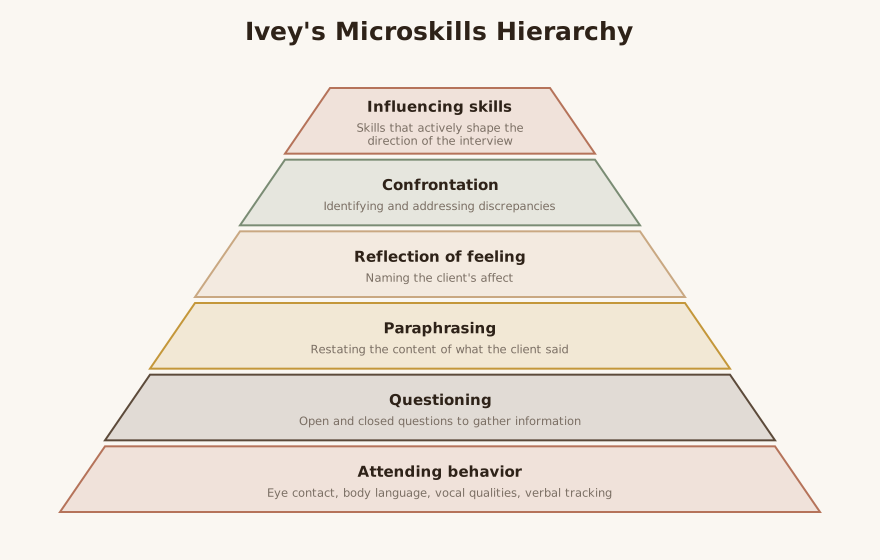
The microskills are organized into the microskills hierarchy, conventionally drawn as a pyramid: attending and observation behaviors at the base, the basic listening sequence (questions, encouragers, paraphrasing, reflection of feeling, summarizing) in the middle, and the more advanced influencing and integrative skills toward the top, culminating in the capacity to flexibly integrate skills into one’s own natural style 4. The logic is developmental and cumulative — you cannot meaningfully confront or influence a client whose story you have not first accurately heard 3. LLM
Creators & Lineage
The framework originated with Allen E. Ivey and colleagues at the University of Massachusetts and Colorado State University in the late 1960s 2. The seminal publication — Ivey, Normington, Miller, Morrill, and Haase’s 1968 Journal of Counseling Psychology monograph, “Microcounseling and attending behavior: An approach to pre-practicum counselor training” — introduced both the term and the first target skill, attending behavior, and demonstrated that it could be taught to novices through a brief, structured, video-based procedure 1. This was a deliberate response to a training problem of the era: students were sent into practicum having read about counseling but never having been taught the concrete behaviors that constitute it 1.
A central element from the beginning was media. Ivey’s 1974 “Microcounseling and media therapy: State of the art” consolidated a body of work showing that videotape — used both to model expert behavior and to give trainees feedback on their own recorded interviews — was integral to the method, not an accessory 6. Mary Bradford Ivey became a long-standing co-developer and co-author, and Carlos Zalaquett joined as co-author of the flagship text Intentional Interviewing and Counseling 3. A later, explicitly cross-cultural extension was developed with Jeffrey Daniels in Microcounseling: Making Skills Training Work in a Multicultural World, which reframed each skill as something whose appropriate expression varies across cultures rather than as a universal technique 5.
Conceptually, microcounseling sits downstream of the Rogerian/humanistic tradition — attending behavior, paraphrasing, and reflection of feeling operationalize the listening that person-centered therapy describes — and runs parallel to Carkhuff’s human-resource-development skills model, which likewise tried to make helping skills concretely trainable 4. Its descendants include the structured, skill-based emphasis visible in motivational interviewing and in nearly every modern graduate “counseling skills” or “interviewing” course 3. LLM
Core Principles
A handful of principles hold the framework together 2. LLM
- One skill at a time. Trainees learn a single microskill in isolation before combining it, so that attention is not split across the whole performance at once 4.
- Operationalize the abstract. Vague directives like “build rapport” or “be empathic” are replaced with specified, observable behaviors — eye contact, body language, vocal qualities, verbal tracking — that a trainee can actually do and an observer can actually count 1.
- Model, practice, feedback. Learning proceeds by watching a model demonstrate the skill, practicing it (often in a brief recorded interview), and reviewing performance against the skill’s defined criteria 1.
- Intentionality and flexibility. The goal is not rigid adherence to a script but intentional interviewing — the ability to generate multiple responses to any client statement and select the one most useful for this client at this moment 3.
- Predictability of impact. Each skill has a reasonably predictable effect on what the client does next, which trainees learn to anticipate and use deliberately 3.
- Cultural intentionality. The “right” amount of eye contact, the appropriateness of direct questions, and the meaning of silence are culturally variable; competent use of any microskill requires reading the cultural context, not applying a fixed rule 5.
Interventions & Techniques
The microskills themselves are the techniques. They are usually taught in the hierarchy’s ascending order 4. LLM
Attending and observation behavior is the foundation: culturally appropriate eye contact, attentive body language, vocal qualities, and verbal tracking (staying with the client’s topic rather than redirecting) 1. Trainees also learn client observation — noticing nonverbal cues, discrepancies, and shifts in affect 4.
The basic listening sequence is the middle of the pyramid and the workhorse of most sessions: open and closed questions; encouragers, minimal prompts, and restatements (“mm-hm,” repeating a key word); paraphrasing the cognitive content of what the client said; reflection of feeling, naming the emotion beneath the content; and summarizing, periodically gathering threads together 4. Used in sequence, these draw out the client’s story, demonstrate that it has been heard, and establish a working relationship before the clinician does anything more directive 3. LLM
Toward the top of the hierarchy sit the influencing skills and the more advanced relational moves: focusing (choosing whether to attend to the individual, the problem, others, the family, the cultural-environmental context, or the here-and-now relationship); reflection of meaning and interpretation/reframing; self-disclosure and feedback; logical consequences; directives and psychoeducation; and confrontation, which in this framework is not aggressive challenge but the supportive pointing-out of discrepancies — between two statements, between words and behavior, or between the client and their world — followed by helping the client work toward resolution 3. The apex of the hierarchy is skill integration: weaving the discrete skills into a coherent, personally authentic interviewing style and sequencing them across a full session 4.
Evidence Base
The evidence base for microcounseling is established and mature — among the most heavily researched approaches to clinical training 2. From the 1968 study onward, microcounseling was built as a research program: the original monograph reported controlled demonstrations that attending behavior could be taught and measured, and subsequent decades produced a large body of studies and several meta-analyses examining whether the discrete skills can be reliably trained 1. The honest summary is two-part. First, the acquisition of individual microskills through the model–practice–feedback procedure is robustly supported; trainees demonstrably learn the targeted behaviors 1. Second, two longer-standing questions are less cleanly settled: whether trained skills transfer and are maintained in real clinical work over time, and whether more microskill use translates into better client outcomes as opposed to better trainee performance 4. LLM
The video/media component, which Ivey reviewed as the “state of the art” in 1974, has strong support as a teaching and feedback tool and remains standard in skills courses today 6. The framework’s longevity is itself a form of evidence: its structure persists across many editions of Intentional Interviewing and Counseling and underlies the standard counseling-skills curriculum 3. Clinicians should hold it as a well-validated teaching technology while remaining appropriately modest about the leap from “trainee performs the skill” to “client benefits” 4. LLM
Populations & Indications
The primary “population” for microcounseling is the learner: pre-practicum counselor trainees, graduate students in counseling and psychology, and — notably from early on — paraprofessionals and peer helpers, for whom the structured, single-skill format made systematic training feasible without years of supervision 1. It is indicated whenever a helper needs to acquire interviewing competence in a structured, accountable way, and it scales from a single workshop on attending behavior to a full graduate sequence 4.
On the client side, the framework is deliberately pan-theoretical: the microskills are the common building blocks of nearly every talking therapy, so they apply across client presentations and across counseling orientations rather than being tied to one diagnosis or method 3. The later multicultural reformulation makes the relevant client population explicitly broad — the skills are meant to be used responsively with clients across cultural, racial, linguistic, gender, and ability backgrounds, with the clinician adapting expression to context 5.
Problems-for-Work
Because microcounseling is a meta-framework for the interview, the “problems” it most directly addresses are problems of the clinician’s behavior, which then ripple into the clinical relationship 4. LLM
- Deficient listening and interviewing skills. The core indication — a trainee or clinician who has theory but no reliable repertoire of concrete responses 1.
- Over-questioning and premature advice-giving. Sequencing the basic listening sequence before influencing skills directly counters the novice habit of interrogating or fixing before understanding 3.
- Weak rapport and alliance. Attending behavior and accurate reflection are the operational substrate of the working alliance 4.
- Low self-awareness of one’s own style. Video self-review surfaces habits (interrupting, topic-shifting, flat affect) that clinicians cannot see in real time 6.
- Culturally non-responsive interviewing. The multicultural framing names cultural mismatch in eye contact, questioning, and silence as an explicit target for skill development 5.
LLM-generated illustrative example (not a guideline): A second-year trainee reviews a recorded role-play and notices she asked eleven closed questions in five minutes, never once reflecting feeling; her supervisor assigns one week of practicing only paraphrasing and reflection of feeling before re-recording, and the follow-up tape shows the “client” disclosing far more. LLM
Contraindications, Cautions & Cultural Humility
Microcounseling has no clinical contraindications in the usual sense, but it carries real pedagogical cautions 4. LLM The most common failure mode is mechanical, wooden application: trainees who treat the hierarchy as a checklist can produce technically correct but relationally dead interviews, which is precisely why the framework names integration and intentionality, not mere skill possession, as the goal 3. Decomposing the interview into parts also risks losing the whole; the skills are a scaffold to be internalized and then transcended, not a permanent script 4. LLM
The framework’s own most important caution is cultural. Microskills are not culture-neutral: sustained eye contact, direct questioning, naming emotion explicitly, and comfort with silence all carry different meanings across cultures, and a skill applied “correctly” by a universal rulebook can be experienced as intrusive or disrespectful 5. The Daniels and Ivey reformulation insists that cultural intentionality — reading the client’s context and adapting expression accordingly — is itself part of competent skill use, not an add-on 5. Clinicians should also remember the evidence caveat above: demonstrated skill acquisition is not the same as demonstrated client benefit, so microskill fluency should be held with humility rather than treated as proof of effectiveness 4. LLM
Treatment-Plan Suggestions & SMART Objectives
Microcounseling is most naturally framed within counselor education and supervision; the objectives below are written for a supervisee or trainee. They can be adapted for any clinician deliberately strengthening interviewing competence 4. LLM
| Goal | SMART objective (example) | Mechanism |
|---|---|---|
| Strengthen attending behavior | Within 3 sessions, demonstrate culturally appropriate eye contact, body language, and verbal tracking on a recorded interview, rated met on ≥4 of 5 criteria | Operationalized foundational skill; observable behavior with defined criteria 1 |
| Reduce over-questioning | Over 4 weeks, decrease closed-question rate and increase reflective responses in recorded role-plays to a documented target | Sequencing the basic listening sequence ahead of directive skills 3 |
| Build reflection of feeling | In 2 weeks, accurately name the client’s primary affect at least twice per 10-minute segment, confirmed on tape review | Single-skill isolation, model–practice–feedback loop 4 |
| Develop summarizing | Within 3 sessions, deliver an accurate summary at each transition point, verified by supervisor rating | Periodic integration of content into a coherent thread 4 |
| Use supportive confrontation | Over 6 weeks, identify and gently reflect one client discrepancy per session without rupture, per supervisor feedback | Advanced influencing skill targeting incongruence 3 |
| Increase self-awareness of style | Complete weekly video self-review for 8 weeks, logging one strength and one growth edge each time | Media feedback surfacing out-of-awareness habits 6 |
| Improve cultural responsiveness | Within the term, adapt attending and questioning to two clients of differing cultural backgrounds and reflect on the adaptations in supervision | Cultural intentionality as a component of skill 5 |
| Achieve skill integration | By term’s end, conduct a full recorded interview flexibly sequencing ≥5 microskills, rated as integrated rather than mechanical | Reassembly of discrete skills into authentic style 4 |
Common Misconceptions
“Microcounseling is a therapy.” It is a training framework for the interview, deliberately pan-theoretical; the skills are meant to be embedded inside whatever modality the clinician practices 2. LLM
“Master the hierarchy and you are a competent counselor.” The hierarchy teaches building blocks; competence lives in integration and intentionality, the apex of the pyramid, not in possessing the parts 3. LLM
“The skills are universal techniques.” The multicultural reformulation explicitly rejects this — each skill’s appropriate expression is culturally contingent 5. LLM
“It’s an outdated 1960s relic.” The framework is continuously revised across many editions of Intentional Interviewing and Counseling and remains the backbone of contemporary skills curricula 3. LLM
“Confrontation means challenging or arguing with the client.” In this framework confrontation is the supportive identification of discrepancies, used to help the client resolve incongruence, not to combat them 3. LLM
Training & Certification
Microcounseling is not a certified, licensable modality; it is the standard pedagogy by which interviewing is taught inside accredited counseling, psychology, and social-work programs 3. Most clinicians encounter it through a graduate “counseling skills,” “interviewing,” or “pre-practicum” course built around Intentional Interviewing and Counseling, with its model–practice–video-feedback cycle 3. There is no separate credential to obtain; mastery is demonstrated through supervised, recorded performance rather than a certificate 4. LLM Self-directed study is feasible via the flagship text and the original primary literature, and the official site maintained by the Iveys documents the framework’s structure and history 2. The multicultural extension is available for clinicians wanting to deepen the cultural dimension of skill use 5.
Key Terms
- Microskill — a single, discrete, observable, teachable unit of interviewing behavior 4.
- Microskills hierarchy — the pyramid arranging skills from attending at the base through the basic listening sequence to influencing and integration at the apex 4.
- Attending behavior — the foundational cluster of eye contact, body language, vocal qualities, and verbal tracking 1.
- Basic listening sequence — questions, encouragers, paraphrasing, reflection of feeling, and summarizing used together to draw out and confirm the client’s story 4.
- Reflection of feeling — accurately naming the emotion beneath the client’s words 4.
- Confrontation — the supportive identification of discrepancies to help resolve incongruence 3.
- Focusing — deliberately choosing the dimension of the client’s experience to attend to (individual, problem, family, cultural-environmental context, relationship) 3.
- Intentionality — the capacity to generate multiple responses and select the most useful, rather than reacting habitually 3.
- Cultural intentionality — adapting skill expression to the client’s cultural context as part of competent practice 5.
- Skill integration — weaving discrete microskills into a coherent, authentic interviewing style 4.
Resources & Further Reading
▶ Watch — a video introduction to this concept:
- Ivey, Normington, Miller, Morrill & Haase (1968) — Microcounseling and attending behavior (the seminal monograph)
- Microcounseling — Allen and Mary Ivey (official site)
- Intentional Interviewing and Counseling, 10th ed. (Ivey, Ivey & Zalaquett) — the flagship text
- Counseling Microskills — Penn State World Campus (RHS 301) overview of the hierarchy
- Microcounseling: Making Skills Training Work in a Multicultural World (Daniels & Ivey)
- Ivey (1974) — Microcounseling and media therapy: State of the art
Reflective / Supervision Questions
- When you review your own recorded interviews, which microskill do you over-rely on, and which do you avoid — and what might that pattern protect you from? LLM
- Where on the hierarchy do your interviews tend to stall: do you move to questions and advice before the basic listening sequence has done its work? LLM
- How do you distinguish, in a supervisee, mechanical skill use from genuine integration, and how do you coach the difference? LLM
- For a given client, how might culturally “correct” attending or questioning differ from the textbook defaults, and how would you know? LLM
- Given that skill acquisition is better evidenced than client-outcome improvement, how do you keep humble about what your microskill fluency actually delivers for clients? LLM
- When you use confrontation, can you point to the specific discrepancy you named — and was your aim to help the client resolve incongruence or to be right? LLM