
Type & Discipline
The Mental Status Examination (MSE) is a structured assessment of a patient’s behavioral and cognitive functioning at a single point in time 2. It is a clinical technique rather than a treatment — the observational and inquiry-based procedure through which a clinician describes how a person looks, behaves, speaks, feels, thinks, perceives, reasons, and understands their own situation 1. The MSE is the descriptive backbone of psychiatric evaluation and is documented in essentially every initial and follow-up mental-health encounter 1.
Although the MSE is most closely identified with psychiatry, it is not the property of psychiatrists alone 1. StatPearls describes it as essential for psychiatrists and for clinicians across many specialties, including primary care, emergency medicine, and internal medicine 1. The Cleveland Clinic notes plainly that any healthcare provider can perform it, and that portions are often folded into routine visits as well as dedicated assessments 3. This places the MSE at the intersection of psychiatry, neurology, and general medicine, because it surveys association areas of the cortex and broad mental functioning rather than the narrow motor and sensory functions of the standard neurologic exam 2.
A defining feature of the discipline is that the MSE is descriptive, not interpretive 5. It documents what is observed and reported in clinical language, deferring formulation and diagnosis to a later synthesis 1. This descriptive stance is what makes the MSE a shared vocabulary across the field: two clinicians may disagree about a diagnosis yet still communicate precisely about a patient’s affect, thought process, or orientation LLM.
Creators & Lineage
The MSE has no single inventor; it is a consolidation of nineteenth- and twentieth-century descriptive psychiatry into a standardized clinical routine LLM. Its intellectual lineage runs through descriptive psychopathology, an approach that Wikipedia traces to the philosopher and psychiatrist Karl Jaspers, who emphasized understanding patients through careful description of their own reported experience rather than through theory-laden interpretation 5. This Jaspersian commitment — describe the phenomenon faithfully before explaining it — is the philosophical core the MSE inherited 5.
In American psychiatry, the systematic, organized documentation of mental functioning is commonly associated with Adolf Meyer, whose insistence on careful, structured recording of a patient’s mental state helped establish the MSE as a teachable clinical habit LLM. Over the twentieth century the examination settled into the recognizable sequence of domains used today, from appearance through judgment 1.
A distinct but related strand is the development of brief, standardized cognitive screens that can be slotted into the MSE’s cognition section 5. The best known is the Mini-Mental State Examination (MMSE), commonly credited to Marshal Folstein and colleagues, which Wikipedia describes as a simple structured cognitive assessment in widespread use as a component of the MSE 5LLM. The MMSE is narrower than the full MSE — a focused dementia and cognitive-impairment screen rather than the whole observational examination — and the two should not be conflated 5.
Core Principles
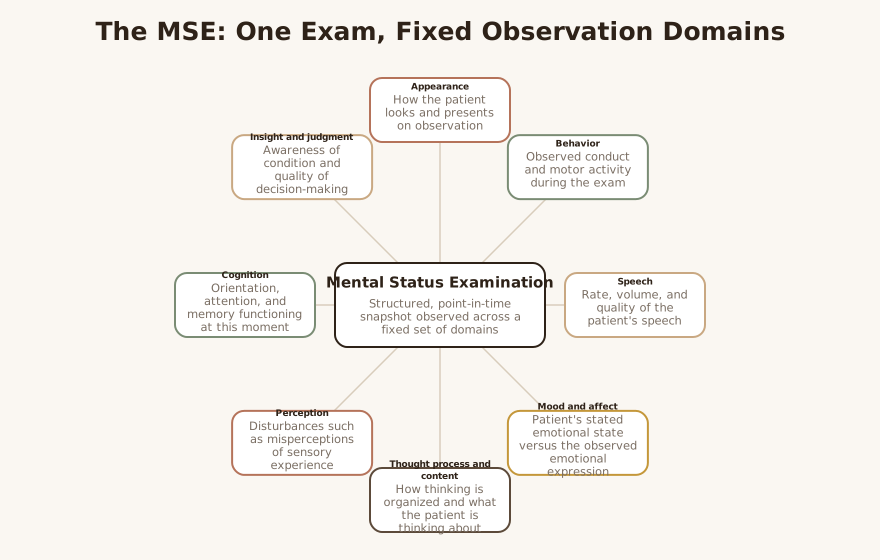
The first principle is structured observation across fixed domains 2. The MSE imposes a consistent order — appearance, behavior, motor activity, speech, mood, affect, thought process, thought content, perception, cognition, insight, and judgment — so that nothing salient is overlooked and so that findings can be communicated and compared reliably 1. The structure is the safeguard against an unsystematic, impressionistic write-up LLM.
The second principle is the separation of subjective report from objective observation 4. Mood is the patient’s own stated emotional state, ideally recorded verbatim, whereas affect is the clinician’s observation of the patient’s moment-to-moment emotional expression 1. Holding these apart prevents the examiner from collapsing what the patient says they feel into what the examiner infers they feel 4.
The third principle is that the MSE is a snapshot, not a verdict 3. It captures functioning at a given moment, which is precisely why serial examinations are so valuable: comparing a current MSE to prior ones lets the clinician judge whether symptoms are improving or worsening over time 1. The fourth principle is honest acknowledgment of subjectivity — the Cleveland Clinic states directly that the assessment is subjective, that different providers may reach different conclusions, and that findings are shaped by the patient’s culture, language, education, and current stressors such as sleep deprivation or pain 3.
Interventions & Techniques
Several domains are assessed passively, simply by attending to the patient throughout the interview 1. Appearance notes apparent versus stated age, grooming, hygiene, and distinguishing features, recognizing that poor grooming may accompany severe depression, neurocognitive disorders, or negative symptoms of psychosis — while remembering that a well-groomed patient is not necessarily well 14. Behavior captures the patient’s conduct and rapport: cooperative, agitated, avoidant, or unable to be redirected 1. Motor activity describes psychomotor retardation or agitation, gait, posture, abnormal movements, and akathisia, the restless urge to move 1. Speech is observed for rate, rhythm, volume, fluency, and tone, where pressured speech may signal mania or intoxication 1.
The emotional domains pair self-report with observation 4. Mood is elicited with an open question — for example, “How have you been feeling recently?” — and documented in the patient’s words 4. Affect is then characterized by its quality, range, intensity, stability, and congruence with stated mood, using descriptors such as euthymic, restricted, blunted, flat, labile, or euphoric 1.
Thought process describes the form and connection of thought — circumstantial, tangential, flight of ideas, loose or disorganized, perseverative, or showing thought blocking 1. Thought content covers what the patient is thinking about, with deliberate attention to suicidal ideation, homicidal ideation, obsessions, and delusions 14. Perception screens for hallucinations, defined as perception in the absence of an external stimulus, and illusions, defined as misinterpretation of an actual stimulus, most commonly in the auditory and visual modalities 14.
Cognition is the most actively tested domain and surveys alertness (alert, somnolent, obtunded, stuporous, or comatose), orientation, attention and concentration, memory across immediate, recent, and long-term timeframes, and abstract reasoning 12. Attention can be probed with digit spans or serial tasks, and brief standardized tools such as the MMSE or the Montreal Cognitive Assessment (MoCA) may be embedded here, with care for language, age, and educational fairness 24. Finally, insight (the patient’s understanding of their own condition) and judgment (their capacity for sound decisions) are each rated along a gradient such as poor, limited, fair, or good 14.
LLM-generated illustrative example (not a guideline): A clinician records: “Affect restricted and incongruent with stated euthymic mood; thought process tangential; denies suicidal or homicidal ideation; reports intermittent auditory hallucinations; oriented to person and place but not date; insight limited, judgment poor.” The sentence conveys a precise clinical picture without yet committing to a diagnosis LLM.
Evidence Base
The MSE’s status is best described as established as the standard of practice rather than as a validated psychometric instrument 1. It is the lingua franca of psychiatric documentation, used in initial and subsequent encounters and across general medical settings, and its serial use to track change over time is a core, well-recognized clinical function 1. In that sense its “evidence base” is its near-universal adoption and its proven utility as a shared descriptive framework 1.
Honest appraisal requires distinguishing ubiquity from reliability LLM. The Cleveland Clinic is explicit that the MSE is subjective and that different providers may reach different conclusions, which is the practical reality of an observational, judgment-based examination rather than a standardized test 3. Findings are sensitive to the patient’s culture, language, education, and transient states such as fatigue or pain, and the examination alone does not establish a diagnosis — providers must combine it with history, physical examination, and laboratory data 3. The embedded cognitive screens such as the MMSE are the more formally validated components, but they assess only the narrow cognitive slice and not the full examination 5.
The clinical implication is to use the MSE as designed: as a structured, comparable description that gains its greatest power from serial repetition and from being one input within a broader evaluation 1. Clinicians should present its findings with appropriate humility about inter-rater variability and context-dependence rather than as objective measurement 3.
Populations & Indications
The MSE is indicated for essentially any patient undergoing psychiatric or behavioral assessment, and its components appear far beyond specialty psychiatry 1. The primary population is adults in psychiatric evaluation, where the full examination anchors both the initial encounter and ongoing monitoring 1. It is equally central in the emergency department, where rapid characterization of agitation, psychosis, intoxication, or risk is needed, and in primary care, where abbreviated versions are woven into routine visits 13.
Older adults are a particularly important population because the cognition domain, supported by screens like the MMSE, is the front line for detecting delirium and neurocognitive disorders such as Alzheimer’s and Parkinson’s disease 13. More broadly, the Cleveland Clinic frames the MSE as relevant across general medical specialties, since any provider may perform it and many conditions — metabolic, infectious, neurological — first declare themselves as a change in mental status 3.
Problems-for-Work
The MSE is the assessment vehicle through which many high-stakes clinical problems are first detected and then tracked 1. Psychosis and delusional thinking are surfaced in the thought-content and perception domains, where the clinician documents delusions and hallucinations while carefully separating them from culturally normative beliefs 15. Suicidal and homicidal ideation are deliberately screened within thought content, making the MSE a primary safety instrument as well as a descriptive one 1.
Mania is often signaled across multiple domains at once — pressured speech, psychomotor agitation, and flight of ideas — while depression may present as psychomotor retardation, poor grooming, and restricted affect 1. Delirium and acute confusional states declare themselves in the cognition domain through impaired alertness, disorientation, and inattention, and cognitive decline is tracked there over serial examinations 12. Substance intoxication or withdrawal may appear as pressured or slurred speech, altered motor activity, or perceptual disturbance 1.
LLM-generated illustrative example (not a guideline): An emergency clinician notes pressured speech, psychomotor agitation, flight of ideas, and grandiose thought content. None of these is a diagnosis, but together they orient the workup toward mania and intoxication and away from a purely cognitive cause, and they give the next clinician a precise baseline to compare against LLM.
Contraindications, Cautions & Cultural Humility
There are no contraindications to performing an MSE — it is observational and non-invasive — but there are serious cautions in interpretation LLM. The foremost is cultural: a delusion is, by definition, a fixed false belief that is not part of the patient’s cultural or religious framework, so distinguishing genuine psychopathology from normative spiritual or cultural belief is essential and is a recognized site of clinician error 15. Wikipedia notes the real risk of misjudgment when cultural contexts differ between clinician and patient, including the influence of racial bias 5.
Cognitive testing carries its own fairness cautions: language barriers, age, educational background, and sensory limitations can all depress performance independent of any true impairment, so tools must be chosen and interpreted with those factors in mind 4. Documentation language matters too — practical guidance is to avoid vague, stigmatizing descriptors like “odd” in favor of constructive, specific terms, and to record the patient’s own words to prevent misinterpretation 4. Finally, because the examination is subjective and snapshot-bound, the clinician should hold findings tentatively, corroborate them against history and collateral, and remember that transient stressors such as sleep loss or pain can distort the picture 3.
Treatment-Plan Suggestions & SMART Objectives
Because the MSE is an assessment technique rather than a treatment, the objectives below frame its administration and serial use within a broader evaluation; all are illustrative and must be individualized LLM. The mechanism in each case is structured observation plus serial comparison, which StatPearls identifies as how the examination detects change over time 1.
| Goal | SMART objective (example) | Mechanism |
|---|---|---|
| Establish a documented baseline | Complete a full multi-domain MSE at intake and record it in the chart within the first session | Structured observation across fixed domains creates a comparable baseline 1 |
| Monitor symptom trajectory | Repeat a focused MSE at each visit and compare key domains to the prior exam for 8 weeks | Serial comparison detects improvement or worsening over time 1 |
| Screen safety at every contact | Document thought-content screening for suicidal and homicidal ideation at each encounter | Targeted inquiry within thought content surfaces acute risk 1 |
| Track cognition objectively | Administer a brief standardized cognitive screen (e.g., MMSE) at baseline and at 3 months | Validated cognitive screening within the cognition domain quantifies change 5 |
| Distinguish state from trait | Note current stressors (sleep, pain) alongside each MSE for 4 consecutive visits | Contextualizing findings separates transient states from stable features 3 |
| Improve descriptive precision | Replace vague descriptors with specific, non-stigmatizing terms in 100% of notes over 1 month | Precise descriptive language improves communication and reduces bias 4 |
| Capture the patient’s voice | Record mood verbatim in the patient’s own words at every session for 6 weeks | Separating subjective mood from observed affect preserves accuracy 4 |
Common Misconceptions
A frequent misconception is that the MSE is the same thing as a cognitive screen such as the MMSE 5. In reality the MMSE is one narrow, dementia-oriented component that can live inside the cognition domain, whereas the full MSE spans eleven or twelve domains from appearance to judgment 15. Treating the two as interchangeable leads clinicians to skip the behavioral, affective, and perceptual examination entirely LLM.
A second misconception is that the MSE establishes a diagnosis 3. It does not; the Cleveland Clinic is clear that the examination alone is insufficient and must be combined with history, physical findings, and laboratory data 3. A third error is reading “well-groomed” or “cooperative” as evidence of psychiatric wellness — a patient can present neatly while acutely unwell, as the practical literature explicitly warns 4. A fourth is conflating mood with affect; they are deliberately distinct, the former reported and the latter observed 4. Finally, some treat the MSE as objective measurement, when its own standard descriptions concede that it is subjective and that examiners can disagree 3.
Training & Certification
There is no separate certification to “perform the MSE”; competence in it is built into the training of psychiatrists, psychiatric nurses, psychologists, social workers, and physicians across specialties 1. Because StatPearls frames mental-status assessment as the work of an interprofessional team — including psychiatrists, nurses, social workers, therapists, pharmacists, and primary-care clinicians — fluency in the examination’s vocabulary is a shared professional expectation rather than a niche credential 1.
In practice, competence is developed by learning the fixed sequence of domains, observing experienced clinicians, and practicing structured documentation under supervision LLM. Freely available structured guides — such as the StatPearls and Clinical Methods chapters and concise ten-point clinical walkthroughs — lower the barrier to learning the framework, while accurate, unbiased application still depends on supervised practice and attention to cultural and developmental factors 124.
Key Terms
- Mood vs. affect — mood is the patient’s subjective, self-reported emotional state (recorded verbatim); affect is the clinician’s observation of moment-to-moment emotional expression 14.
- Thought process — the form and connectedness of thinking: circumstantial, tangential, flight of ideas, loose, perseverative, or blocked 1.
- Thought content — what the patient is thinking about, including suicidal and homicidal ideation, obsessions, and delusions 14.
- Delusion — a firmly held false belief that is not part of the patient’s cultural belief system and persists despite contradictory evidence 1.
- Hallucination vs. illusion — a hallucination is a perception with no external stimulus; an illusion is a misinterpretation of a real stimulus 14.
- Psychomotor retardation / agitation — observable slowing or heightening of movement, part of the motor-activity domain 1.
- Insight and judgment — the patient’s understanding of their condition and their capacity for sound decisions, each rated on a gradient 14.
- Mini-Mental State Examination (MMSE) — a brief, structured cognitive screen used as a component within the MSE’s cognition domain 5.
Resources & Further Reading
▶ Watch — a video introduction to this concept:
- Mental Status Examination — StatPearls (NCBI Bookshelf)
- The Mental Status Examination — Clinical Methods, Chapter 207 (NCBI Bookshelf)
- Mental Status Exam: What It Is, Uses & Examples — Cleveland Clinic
- Ten Point Guide to Mental State Examination (MSE) in Psychiatry — Psych Scene Hub
- Mental status examination — Wikipedia
Reflective / Supervision Questions
- For a recent patient, did your write-up clearly separate mood (their words) from affect (your observation), or did the two blur together? 4
- When you documented a belief as a delusion, how confident are you that it falls outside the patient’s cultural and religious framework rather than within it? 1
- Are you using the MSE serially — comparing today’s exam to prior ones — or only generating isolated snapshots that miss the trajectory? 1
- Where might language, education, age, or transient stressors have depressed a patient’s cognitive performance independent of true impairment? 3
- Have you caught yourself reading “well-groomed” or “cooperative” as reassurance, when the patient may be acutely unwell beneath a composed surface? 4
- How do you communicate the MSE’s subjectivity and inter-rater variability to trainees and to the treatment team, rather than presenting it as objective measurement? 3