
Type & Discipline
The Cattell-Horn theory of fluid and crystallized intelligence is a psychometric model of cognitive ability situated within lifespan developmental psychology LLM. It is a theory of the structure of intelligence, not a treatment modality, and its clinical value to therapists is interpretive rather than interventional LLM. The model proposes that general intelligence is not a single undifferentiated capacity but comprises at least two broad, partially dissociable factors: fluid intelligence (Gf) and crystallized intelligence (Gc) 3.
Fluid intelligence is the capacity to reason through novel problems, perceive relationships, and solve puzzles without relying on prior knowledge 3. Crystallized intelligence refers to the use of accumulated knowledge, facts, vocabulary, and skills acquired over time through experience and acculturation 5. The two are distinct but interconnected, and many real-world tasks recruit both at once 3. For practicing therapists, the theory matters chiefly because it underlies how cognitive and neuropsychological tests are built and interpreted, and because it offers a framework for understanding which abilities decline and which are preserved in aging and disease 24.
Creators & Lineage
The conceptual seed of the theory belongs to Donald O. Hebb, who presented his distinction between Intelligence A and Intelligence B at the 1941 APA meeting in Evanston, Illinois 1. Hebb argued that intellectual development includes two distinct things: direct intellectual power arising from neural maturation (Intelligence A), and the qualitative modifications of perception and behavior that come from learning and experience (Intelligence B) 1. Raymond B. Cattell heard this presentation, adapted the framework for psychometric assessment, and renamed the constructs fluid and crystallized ability, publishing the formal theory in 1943 in Psychological Bulletin 1. Cattell explicitly acknowledged that Hebb “has independently stated very clearly what constitutes two thirds of the present theory” 1.
Cattell further formalized the model in subsequent publications across the 1960s and 1970s 5. His former student John L. Horn then extended the work substantially, investigating how these intelligences changed across the lifespan and, by 1991, expanding the model from two factors to nine or ten broad abilities 2. The pairing is therefore correctly called the Cattell-Horn Gf-Gc model 2.
The direct descendant of this lineage is the Cattell-Horn-Carroll (CHC) theory, which converged the Cattell-Horn model with John B. Carroll’s three-stratum theory at a 1985 meeting concerning revision of the Woodcock-Johnson test 2. Carroll, who analyzed 461 factor-analytic datasets, judged that the Gf-Gc model “appears to offer the most well-founded and reasonable approach to an acceptable theory of the structure of cognitive abilities” 2. Upstream, the work sits in dialogue with Spearman’s psychometric tradition of a general factor (g), which CHC retains at the apex of its hierarchy 2.
Core Principles
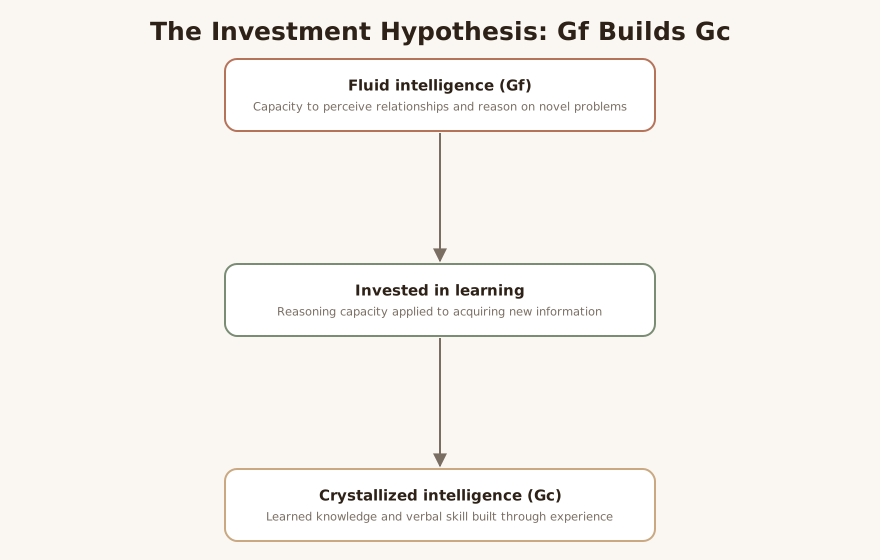
The first principle is dissociation of two factors. Fluid ability is the general capacity to perceive relationships and reason, whereas crystallized ability comprises learned discriminatory habits built through the prior application of fluid ability 1. The second principle is the investment hypothesis: crystallized intelligence is produced when fluid intelligence is invested in the learning of new information 3. In Cattell’s framing, today’s reasoning capacity is the engine that lays down tomorrow’s stored knowledge 1.
The third principle is divergent lifespan trajectories. Fluid intelligence shows an inverted-U pattern, rising through adolescence and into early adulthood and then declining 1. Crystallized intelligence rises gradually and is relatively maintained or continues to grow across most of adulthood 1. This divergence explains why cognitive decline does not immediately impair established competencies: fluid resources recede while crystallized reserves persist at higher functional levels 1.
A fourth principle, developed by Horn and his successors, is hierarchical breadth: beyond Gf and Gc lie additional broad abilities, and above them a general factor 2. The model is explicitly open-ended and empirical, designed so that future research could add factors as new abilities are measured 2.
Interventions & Techniques
The theory is not itself an intervention, but it informs several techniques therapists encounter LLM. The dominant application is psychometric assessment: fluid reasoning is measured by tasks such as Raven’s Progressive Matrices, the Woodcock-Johnson Concept Formation and Analysis-Synthesis subtests, and the Wechsler Matrix Reasoning and Picture Concepts subtests 35. Crystallized ability is measured by verbally loaded tasks such as the WAIS Vocabulary, Comprehension, and Information subtests 3.
A second technique is interpreting the Gf-Gc profile clinically LLM. Because crystallized abilities are relatively robust to aging and to many diffuse insults, a large gap in which crystallized scores remain strong while fluid scores drop can flag acquired impairment against a preserved baseline 14. Crystallized estimates such as word reading or vocabulary are often used as proxies for premorbid ability precisely because they resist decline 1.
A third area is cognitive training. Contrary to the older assumption that fluid intelligence is fixed, some research has reported gains from working-memory training, aerobic exercise, progressively learning complex skills, and quality sleep 3. The evidence is genuinely mixed: memory-training programs tend to produce short-term, task-specific effects that do not generalize broadly 5. Therapists should treat “brain training” claims with proportionate skepticism 5.
Evidence Base
Maturity: established. The Gf-Gc distinction is one of the most replicated structural findings in differential psychology, surviving decades of factor-analytic scrutiny and forming the backbone of its successor, CHC theory 2. Five of seven major intelligence tests now incorporate CHC as their theoretical foundation, and the framework dominates school psychology and psychoeducational assessment 2.
Convergent neural evidence exists. Fluid reasoning is associated with the dorsolateral prefrontal cortex, anterior cingulate, and attention and working-memory systems, while crystallized knowledge is associated with long-term memory storage regions including the hippocampus 5. Working-memory capacity correlates closely with fluid intelligence 5. Fluid intelligence predicts performance in complex, ambiguous work environments, and childhood fluid intelligence has been linked to adult earnings 5.
Honest limits remain. The textbook claim that fluid intelligence peaks in the late 20s (around age 27) and declines thereafter is now qualified: some components may not peak until around age 40, and trajectories are dynamic rather than predetermined, shaped by biology, lifestyle, and behavior 345. Low fluid scores can reflect motivation or task engagement rather than true capacity, a validity caveat clinicians must hold in mind 5.
Populations & Indications
The framework is most clinically useful with older adults, where it distinguishes normal cognitive aging (modest Gf decline with preserved Gc) from patterns that warrant concern 4. The Stanford Center on Longevity frames aging as shifting strengths rather than uniform loss: the 25-year-old brings processing speed and fresh perspective, the 50-year-old brings integration and judgment, and the 75-year-old contributes accumulated pattern recognition 4.
It is foundational for assessing children and adolescents, since CHC-based batteries underpin psychoeducational evaluation 2. It is relevant to people with neurocognitive disorders, traumatic brain injury, learning disabilities, and adults undergoing cognitive evaluation, where the Gf-Gc profile helps localize and characterize impairment 25.
Problems-for-Work
-
Cognitive decline and dementia. A widening Gf-Gc gap, with crystallized knowledge preserved against declining novel reasoning, is the classic early signature against which loss is measured 14.
-
Age-related memory and reasoning impairment. Distinguishing expected age-graded Gf softening from pathology helps frame realistic, hope-preserving conversations 4.
-
Specific learning disorder. CHC broad abilities (fluid reasoning, processing speed, working memory) anchor pattern-of-strengths-and-weaknesses identification in school settings 2.
-
Traumatic brain injury sequelae. Crystallized scores can estimate premorbid ability, sharpening the read on acquired fluid and processing deficits 1.
LLM-generated illustrative example (not a guideline): A 68-year-old retired teacher reports word-finding pauses and trouble managing new technology. Her vocabulary and general knowledge in session are rich and intact, yet she struggles to reason through an unfamiliar multi-step task. This dissociation — strong crystallized presentation, weak novel reasoning — is precisely the pattern that should prompt a referral for formal neuropsychological testing rather than reassurance alone LLM.
Contraindications, Cautions & Cultural Humility
The theory describes structure; it should never be used by a therapist as a stand-alone diagnostic instrument LLM. Formal Gf/Gc interpretation belongs to qualified neuropsychological and psychoeducational assessment 2.
Crystallized intelligence is, by definition, a product of acculturation — vocabulary, factual knowledge, and language mechanics that benefit from cultural exposure 5. Crystallized measures can therefore systematically disadvantage clients from different linguistic, educational, or cultural backgrounds, and a low Gc score may index opportunity and language rather than ability 5. Fluid tasks were historically promoted as more “culture-fair,” but no test is culture-free, and low fluid scores may reflect motivation or task engagement rather than capacity 5. Therapists should resist treating any single number as a verdict and should hold the dynamic, individually variable nature of cognitive trajectories in view 45.
Treatment-Plan Suggestions & SMART Objectives
| Goal | SMART objective (example) | Mechanism |
|---|---|---|
| Lean on preserved crystallized strengths | Within 6 weeks, client will use 3 vocabulary/knowledge-based compensatory strategies (lists, analogies to known material) in 80% of new-learning tasks | Leverages maintained Gc to scaffold weaker Gf 14 |
| Reduce demand on declining fluid reasoning | Within 8 weeks, client will break 2 recurring novel tasks into written step sequences, reported in session | Offloads Gf demand onto external structure LLM |
| Build realistic appraisal of cognitive aging | Within 4 sessions, client will articulate the difference between normal Gf change and pathology in their own words | Reframing reduces catastrophizing about aging 4 |
| Support adaptive working memory | Over 8 weeks, client will trial working-memory and aerobic-activity routines and log effects weekly | Targets Gf-linked working memory, with realistic expectations 35 |
| Coordinate appropriate assessment | Within 2 weeks, client will complete a referral for neuropsychological evaluation if profile dissociation persists | Matches structural concern to qualified testing 2 |
| Strengthen self-efficacy via skill mastery | Over 10 weeks, client will progressively learn one complex new skill, rated for confidence | Engages novel reasoning and motivation 35 |
| Family psychoeducation on strengths/limits | Within 6 weeks, caregiver will identify 3 preserved (Gc) abilities to engage at home | Aligns environment with maintained capacities 4 |
Common Misconceptions
-
“Cattell invented the theory in 1963.” Popular sources cite 1963, but the conceptual origin is Hebb’s 1941 Intelligence A/B presentation, with Cattell’s formal psychometric statement appearing in 1943 and elaborations following in the 1960s and 1970s 15.
-
“Fluid intelligence is fixed and untrainable.” Once standard, this assumption has been challenged; some studies show training and lifestyle gains, though effects are often short-term and task-specific 35.
-
“All intelligence declines with age.” Crystallized intelligence rises and is largely maintained into the seventh decade even as fluid ability declines earlier 45.
-
“There is one cognitive peak.” There are different peaks at different ages, with an experience-plus-ability “sweet spot” often around 55-60 4.
-
“Gf-Gc is the whole model.” Horn expanded it to roughly nine or ten broad abilities, and CHC adds a hierarchical g and narrow abilities beneath 2.
Training & Certification
There is no certification in “fluid and crystallized intelligence” as such LLM. The applied competency is in CHC-based cognitive and neuropsychological assessment, which is taught within school psychology, clinical psychology, and neuropsychology training and is embodied in the administration manuals of CHC-aligned batteries such as the Woodcock-Johnson and Wechsler scales 2. Cross-battery assessment methods allow evaluation across multiple measures within the CHC framework 2. Therapists without assessment credentials should understand the theory well enough to read reports and refer appropriately, leaving formal testing to qualified examiners 2.
Key Terms
- Fluid intelligence (Gf): Reasoning through novel problems independent of prior learning 3.
- Crystallized intelligence (Gc): Accumulated knowledge, vocabulary, and skills from experience and acculturation 5.
- Investment hypothesis: Fluid ability is “invested” in learning, producing crystallized ability 3.
- Intelligence A / Intelligence B: Hebb’s precursor distinction between neural potential and learned modification 1.
- Three-stratum structure: Carroll’s hierarchy of general ability (g), broad abilities, and narrow abilities 2.
- CHC theory: The merged Cattell-Horn-Carroll model with nine broad abilities under g 2.
- Premorbid estimate: Use of decline-resistant crystallized scores to infer prior ability level 1.
Resources & Further Reading
▶ Watch — a video introduction to this concept:
- Hebb and Cattell: The Genesis of the Theory of Fluid and Crystallized Intelligence (Frontiers in Human Neuroscience)
- Cattell–Horn–Carroll theory (Wikipedia)
- Fluid vs Crystallized Intelligence in Psychology (Simply Psychology)
- Fluid v. Crystallized Intelligence (Stanford Center on Longevity)
- Fluid and crystallized intelligence (Wikipedia)
- Crystallized Intelligence | Psychology Explained (YouTube)
Reflective / Supervision Questions
- When a client presents with rich vocabulary and intact general knowledge, how might I avoid being falsely reassured about their novel-reasoning capacity LLM?
- How do I distinguish, in my own clinical language, normal age-graded fluid change from a pattern warranting referral 4?
- Where might a crystallized-loaded measure or my own verbal impressions disadvantage a client from a different linguistic or cultural background 5?
- Am I treating a single test number as a verdict rather than as one data point within a dynamic, individually variable trajectory 45?
- When do I owe a client a referral for formal neuropsychological assessment rather than continuing within talk therapy alone 2?