
Type & Discipline
Kleinian psychoanalysis is a theoretical and clinical tradition within psychoanalysis, situated in clinical psychology and psychiatry LLM. It belongs to the object relations family, which holds that the mind is structured around internalized representations of relationships rather than around biological drives alone 3. In this model, “objects” denote significant others or part-objects, such as the mother’s breast, and the relationships between internal objects form the basic architecture of personality 3. The theory is descriptive and interpretive rather than manualized, and it functions as a lens for understanding severe and primitive mental states more than as a discrete protocol LLM. Clinicians encounter Kleinian ideas most often through long-form psychodynamic work, supervision, and case formulation rather than through brief structured treatments LLM.
Creators & Lineage
Melanie Klein (1882-1960) was an Austrian-born psychoanalyst who reshaped psychoanalytic thinking after Freud 3. She trained under Sandor Ferenczi in Budapest and Karl Abraham in Berlin before relocating to London in 1926, where she was supported by the British Psychoanalytical Society 3. Klein departed from Freud’s drive-based model and, rather than emphasizing biological instincts and paternal authority, centered the nurturing of the mother and interpersonal bonds as the primary motivational force in development 3. This departure placed her lineage within and beyond Freudian psychoanalysis: she extended Freud’s structural ideas while founding object relations theory as a distinct stream 3. Her work in turn became the soil from which Bionian psychoanalysis grew, with Wilfred Bion articulating the dynamic, oscillating nature of the positions she had described 5. Later thinkers such as Thomas Ogden and Grotstein continued to elaborate this dynamic view of psychic positions 5.
Core Principles
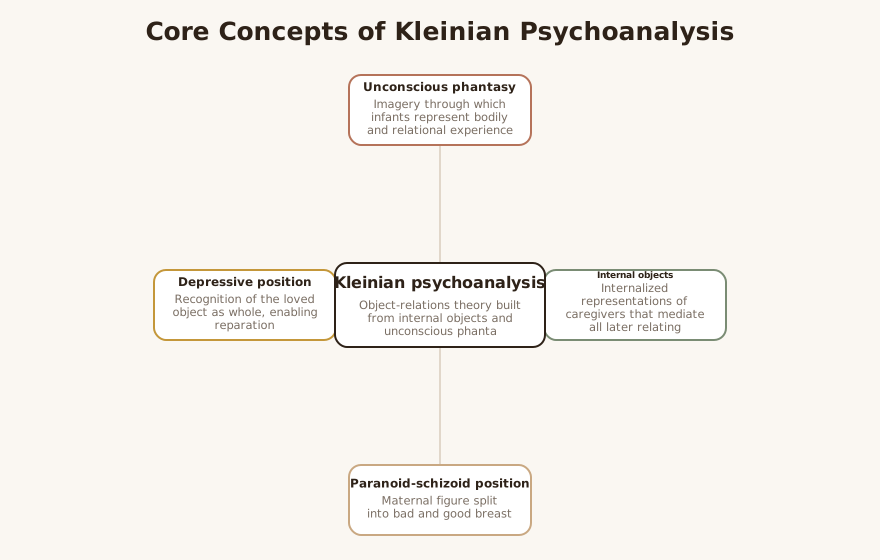
The first organizing concept is unconscious phantasy, spelled with “ph” to distinguish it from conscious daydreaming, referring to the unconscious imagery through which infants represent their bodily and relational experience from birth 3. The infant develops primitive mental images out of “good” sensations such as a full stomach and “bad” ones such as hunger 3. These experiences are organized into internal objects, which are internalized representations of relationships with primary caregivers and which mediate all later relating 63.
Klein described two recurring configurations of anxiety, defense, and object relations rather than fixed developmental stages 1. The paranoid-schizoid position is a constellation of anxieties, defenses, and internal and external object relations characteristic of the earliest months of life 1. In it, the maternal figure is split into a “bad” breast that is frustrating and persecutory and a “good” breast that is loving and gratifying, a binary division Klein considered essential for preserving sufficient positive experience 1. The depressive position emerges toward the middle of the first year, when the child recognizes that the loved and hated figures are the same person and moves beyond splitting into part-objects 2. Bion and later writers stressed that these are not stages left behind but states a person oscillates between across the lifespan 5.
A further principle is that internal reality, not objective reality, governs relating; our internal objects mediate every relationship, so the past continually shapes the present 6. Klein also emphasized innate aggression, destructive phantasy, and envy as foundational forces, in contrast to Freud’s primarily pleasure-seeking infant 3.
Interventions & Techniques
Klein’s principal methodological innovation was the play technique, in which children’s spontaneous play with toys and drawings is treated as a direct expression of unconscious mental life, the child’s equivalent of free association in adults 3. This allowed access to the primitive anxieties of infancy that analysis of adult verbal material could not fully reach 3.
In adult clinical work, the core technique is interpretation of the transference, in which the patient’s internal objects and the positions they occupy are read in the live relationship with the analyst LLM. Because clients oscillate between seeing others as wholly good or bad and fearing persecution, and recognizing ambivalence and feeling guilt, the therapist attunes to which position is active in the room 6. Containment is central: the therapist who can accept and welcome the part of the client that the client themselves dislikes enables movement from persecutory positions toward integration, allowing the client to tolerate anxiety without fragmenting 6. Projective identification, an extension of projection in which the patient unconsciously evokes in the clinician the disowned feeling itself, is tracked through the therapist’s countertransference, though this specific mechanism is a synthesis beyond the cited sources and should be held as clinical hypothesis rather than fact LLM. As depressive anxiety is worked through, projections are gradually withdrawn, allowing the other person more autonomy 5.
LLM-generated illustrative example (not a guideline): A patient consistently experiences the therapist as cold and withholding immediately after sessions in which they felt helped, then arrives the next week certain the therapist is angry. The clinician notices their own pull to over-reassure. Reading this as a paranoid-schizoid split – the “good” helping object becoming the “bad” persecuting one – the therapist names the difficulty of holding both experiences of the same person, working toward whole-object tolerance LLM.
Evidence Base
Honesty about maturity requires holding two facts together LLM. Kleinian psychoanalysis is an established and historically influential tradition that fundamentally reshaped psychoanalytic thought and seeded later developments such as attachment theory 3. Its concepts provided frameworks for understanding severe psychopathology, including borderline and psychotic features, and for understanding internalized relationship patterns 3.
At the same time, the theory has well-recognized empirical weaknesses 3. It lacks empirical testability, overspecifies early experience while neglecting genetics and later-life factors, and its emphasis on autonomous phantasy can obscure actual trauma and parental neglect, a criticism famously raised by John Bowlby 3. There is no body of controlled outcome trials specific to Kleinian technique in the provided literature, and its evidentiary footing is case-based and theoretical rather than experimental LLM. Clinicians should therefore present Kleinian ideas to clients and supervisees as a powerful interpretive framework rather than as an empirically validated treatment with established efficacy data LLM.
Populations & Indications
The play technique made the theory directly applicable to children, and its account of primitive anxieties was developed from clinical work with very young patients 3. In adults, the framework is most often applied in long-term psychoanalysis and intensive psychodynamic psychotherapy, where the depth and duration permit the positions to be observed and worked through LLM. The theory has been especially influential for people with personality disorders and for people with psychotic anxieties, because its concepts of splitting, fragmentation, and persecutory anxiety map onto these clinical pictures 31. Persistent fragmentation – splitting into many small pieces – weakens the fragile, unintegrated ego and causes severe disturbance, which is why the model speaks to the most disturbed relational presentations 1.
Problems-for-Work
The framework offers handles for a range of clinical problems LLM. Splitting and persecutory anxiety present as rigid all-good or all-bad views of others and fear of invasive harm, addressed by helping the client tolerate ambivalence rather than collapse into one pole 16. Borderline personality disorder, with its volatile idealization and devaluation, can be formulated as predominance of the paranoid-schizoid position 3.
LLM-generated illustrative example (not a guideline): A client describes a new partner as “perfect” in one session and “a manipulator who never cared” in the next, after a minor disappointment. Naming the swing as splitting – and slowly holding that the same person can both care and disappoint – becomes the explicit work LLM.
Depressive guilt and the urge to repair are addressed by supporting genuine reparation rather than manic over-functioning, since with pining for what has been damaged by hate comes an urge to repair 2. Aggression and envy, narcissistic personality disorder, interpersonal conflict, and severe relational disturbance are formulated through destructive phantasy and the projection of badness into the object, which the article notes can underlie irrational hatred 35. Projective identification as a problem-for-work shows up as the client repeatedly making others feel what they cannot bear, tracked in the clinician’s own reactions, and treated as a hypothesis to test rather than a certainty LLM.
Contraindications, Cautions & Cultural Humility
Because the theory privileges internal phantasy, its central caution is clinical and ethical: an over-reliance on phantasy can obscure real trauma and parental neglect, the very critique Bowlby raised 3. A clinician who attributes a client’s fear entirely to projected aggression may miss actual current or historical danger, so material reality must always be assessed alongside internal reality LLM. The model’s strong claims about universal infantile experience are not empirically testable and should not be presented to clients as established fact 3.
Cultural humility is essential because the theory’s developmental assumptions, including its centering of the mother’s breast and a particular family configuration, arose in a specific early-twentieth-century European context LLM. What a given culture considers healthy autonomy, appropriate dependence, or expression of aggression varies, and a Western reading of “splitting” or “envy” can pathologize culturally normative relating LLM. Clinicians should also be mindful that the framework’s depth and duration assume access to long-term treatment that many clients cannot obtain LLM.
Treatment-Plan Suggestions & SMART Objectives
| Goal | SMART objective (example) | Mechanism |
|---|---|---|
| Reduce all-or-nothing views of others | Within 12 sessions, client will identify and describe one mixed (both-positive-and-negative) appraisal of a key relationship in 3 of 4 consecutive sessions | Movement from part-object splitting toward whole-object relating 12 |
| Increase tolerance of relational ambivalence | Over 8 weeks, client will name a conflicting feeling toward a loved person without leaving the session or shutting down, on at least 2 occasions | Containment of depressive anxiety without retreat to splitting 26 |
| Decrease persecutory misreading of neutral events | Within 90 days, client will pause and generate one alternative, non-persecutory explanation for a perceived slight, recorded between sessions weekly | Withdrawal of projected badness from the object 5 |
| Convert manic over-functioning into genuine repair | Over 10 sessions, client will distinguish one act of authentic reparation from one act of guilt-driven over-doing, discussed in session | Reparative impulse linked to mourning rather than omnipotent fixing 2 |
| Increase awareness of impact on others | Within 12 sessions, client will articulate, in 2 separate sessions, how their behavior affected another person and tolerate the resulting guilt | Depressive-position concern felt on behalf of the object 2 |
| Recognize relational patterns in the here-and-now | Over 16 sessions, client will identify one recurring relational pattern as it appears with the therapist, on 3 occasions | Use of transference to surface internal objects 6 |
| Build tolerance for separateness | Within 90 days, client will tolerate a planned break or therapist absence and report feelings about it without crisis escalation | Reduced omnipotent control as the object is seen as separate 2 |
Common Misconceptions
A first misconception is that splitting is always pathological; Klein held that the early division into good and bad is essential for healthy development because it preserves sufficient positive experience, so the issue is rigidity and persistence, not splitting per se 1. A second is that the paranoid-schizoid and depressive positions are stages a healthy person outgrows; in fact they are configurations a person oscillates between throughout life, with retreat to paranoid-schizoid functioning available as a regression under stress 15. A third is that “depressive” means clinical depression; here it names the position of concern, guilt, and mourning that accompanies recognizing the whole, ambivalently loved object 2. A fourth is that “phantasy” is the same as conscious fantasy or daydream; Klein used the distinct spelling precisely to mark unconscious imagery 3. Finally, some assume the theory is interchangeable with Freud’s; it differs sharply, emphasizing relational bonds over biological drives, the first months rather than the first years, and an earlier Oedipal timing 3.
Training & Certification
Formal training in this tradition occurs through psychoanalytic institutes rather than through short certificate courses, reflecting its origin within organized psychoanalysis such as the British Psychoanalytical Society that supported Klein 3. Such training is typically lengthy and includes personal analysis, supervised clinical work, and theoretical seminars, consistent with a depth model practiced over long durations LLM. The Melanie Klein Trust serves as a primary scholarly custodian of the theory and a resource for clinicians seeking authoritative accounts of the concepts 12. Practicing therapists who are not pursuing full analytic certification commonly absorb Kleinian thinking through psychodynamic training programs, case supervision, and the secondary literature, applying its formulations within their existing licensed scope LLM.
Key Terms
Internal object: an internalized representation of a relationship with a primary caregiver, forming the basis of personality structure 63. Part-object: a fragment of a person experienced in isolation, such as the breast, before whole-person recognition 32. Phantasy: unconscious imagery, distinct from conscious daydreaming, present from birth 3. Paranoid-schizoid position: the early constellation of persecutory anxiety, splitting, and idealization that protects the fragile ego 1. Depressive position: the later configuration of whole-object relating, ambivalence, guilt, and reparation 2. Splitting: dividing self and object into polarized good and bad to protect the good from contamination 15. Projection: dealing with anxiety by splitting off bad feelings and locating them in an external object 5. Reparation: the urge to restore the loved object damaged by one’s hate 2. Containment: the therapist’s capacity to hold and accept disowned parts so the client can tolerate anxiety without fragmenting 6.
Resources & Further Reading
▶ Watch — a video introduction to this concept:
- Paranoid-schizoid position – Melanie Klein Trust
- Depressive position – Melanie Klein Trust
- Object Relations Theory (Melanie Klein) – Simply Psychology
- Melanie Klein, 1882-1960 – American Journal of Psychiatry
- Paranoid-schizoid and depressive positions – Wikipedia
- Object Relations – Edinburgh Counselling Service
Reflective / Supervision Questions
- When a client swings between idealizing and devaluing me, can I notice which position is active without taking the shift personally? LLM
- Where in my caseload might an emphasis on internal phantasy be leading me to under-weigh a client’s real, current trauma or danger? LLM
- What feelings is this client evoking in me, and what might that countertransference tell me about what they cannot yet hold themselves? LLM
- Am I supporting genuine reparation, or am I colluding with a client’s manic over-functioning to escape guilt? LLM
- How do my client’s cultural norms around dependence, autonomy, and aggression reshape what “splitting” or “envy” means in their context? LLM
- How do I present these powerful but empirically untested concepts to clients and supervisees honestly, as formulation rather than fact? LLM