
The Alternative DSM-5 Model for Personality Disorders (AMPD) replaces the count-the-criteria categorical system most clinicians trained on with a two-part dimensional approach: first rate how severely personality functioning is impaired, then describe the specific maladaptive traits that color the presentation. 1 For practicing therapists, the practical promise is a diagnosis that maps onto what you actually formulate and treat — identity, relationships, and recurring trait patterns — rather than a yes/no membership in a category. LLM This article covers what the model is, how to use it, how strong the evidence really is, and where to be cautious. LLM
Type & Discipline
The AMPD is a diagnostic framework and nosological system, not a treatment modality — it is a way of describing and classifying personality pathology rather than a method for changing it. 1 It sits within clinical psychology and psychiatric nosology and was published in Section III of DSM-5 (“Emerging Measures and Models”), the section reserved for proposals judged to need further study before formal adoption. 1 Because it is a classification system, it informs case formulation and treatment planning but is always operationalized through some actual therapy when delivered clinically. LLM
Creators & Lineage
The model emerged from the DSM-5 Personality and Personality Disorders Work Group, chaired from 2007 by Andrew Skodol, with major contributions from Robert Krueger (lead developer of the trait model and inventory), Donna Bender, and Leslie Morey (a central figure in operationalizing the functioning scale). 1 The trait half of the model was built empirically: Krueger and colleagues constructed a maladaptive trait taxonomy and the accompanying inventory through factor-analytic work on personality pathology descriptors, yielding a structure that aligns conceptually with the Five-Factor Model of normal personality. 4 The American Psychiatric Association Board declined to adopt the model as the primary system in 2012, placing it in Section III while the categorical DSM-IV-derived criteria remained in Section II. 1 Internationally, the World Health Organization went further: ICD-11 adopted a parallel severity-plus-traits dimensional system as its primary model of personality disorder, a notable divergence from DSM-5’s more cautious placement. 1
Core Principles
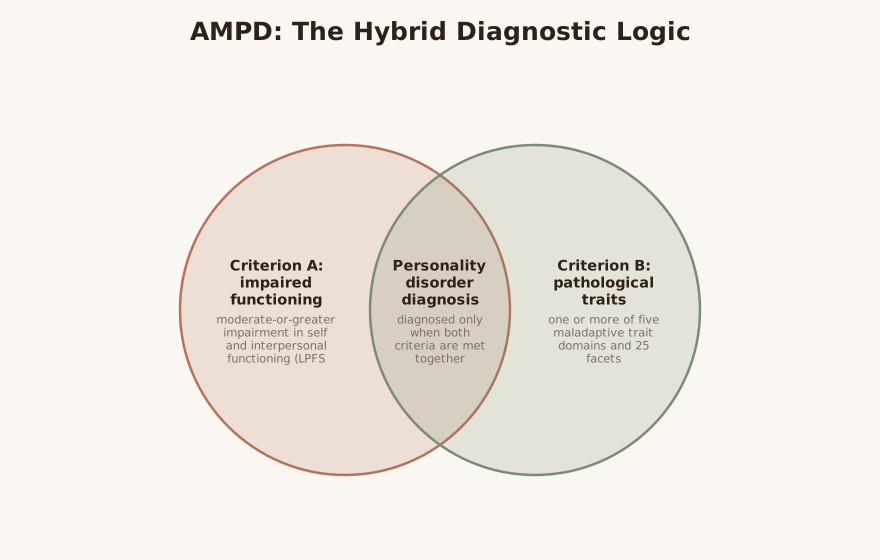
The model rests on a hybrid logic: personality disorder is diagnosed when there is (Criterion A) at least moderate impairment in personality functioning and (Criterion B) one or more pathological personality traits. 1
Criterion A — the Level of Personality Functioning Scale (LPFS). Functioning is rated across four elements grouped into self functioning (identity and self-direction) and interpersonal functioning (empathy and intimacy). 1 These are rated on a 5-point scale from 0 (little or no impairment) to 4 (extreme impairment), and the threshold for a personality disorder is moderate or greater impairment (a rating of 2 or higher) in at least two of the four elements. 1 Criterion A captures what is shared across personality disorders — the core disturbance in sense of self and capacity for relationships. 5
Criterion B — pathological personality traits. Trait pathology is organized into five broad domains — negative affectivity, detachment, antagonism, disinhibition, and psychoticism — which subdivide into 25 lower-order trait facets. 1 These five domains are the maladaptive-range analogues of the Five-Factor Model dimensions, providing continuity with the broader science of normal personality. 4 Criterion B captures what is distinctive about each presentation — the specific style of the pathology. 5
The remaining criteria require that impairments be relatively stable over time and across situations, not better explained by another mental disorder, substances, another medical condition, developmental stage, or sociocultural environment. 5
Interventions & Techniques
The AMPD is a diagnostic system, so its “techniques” are assessment and formulation procedures rather than therapeutic interventions. LLM
Assessing Criterion A. The LPFS can be rated from observation, history, interview, and psychological test data, and clinicians can draw on familiar instruments — the MMPI-2, the PAI, performance-based measures such as the Rorschach and the Social Cognition and Object Relations Scale — to inform functioning ratings. 3 A semi-structured interview, the SCID-5-AMPD Module I, is available for formal LPFS rating. 3
Assessing Criterion B. The Personality Inventory for DSM-5 (PID-5) is the dedicated self-report measure of the trait facets and domains, with a 100-item short form that retains reliable and valid facet and domain assessment, and a clinician-rated module (SCID-5-AMPD Module II). 31 Importantly, self-report and informant-report trait assessment compares favorably with interview-based assessment, so clinicians can synthesize multiple data sources into AMPD ratings without necessarily administering a structured interview. 3
Formulation. A completed AMPD assessment yields both a diagnosis and a psychometric profile simultaneously, integrating severity and trait style into a single conceptualization that can directly inform treatment targets. 3 In practice the model lends itself to specifying impairment first (“how disabled is this person’s self and relational functioning?”) and then describing the trait flavor that shapes the work. LLM
LLM-generated illustrative example (not a guideline): A clinician rates a new client at moderate impairment in identity (an unstable, easily collapsed self-image) and intimacy (relationships are intense and unstable), then notes elevated negative affectivity (emotional lability, separation insecurity) and disinhibition (impulsivity). Rather than simply recording “borderline traits,” the profile names the precise functioning deficits and trait facets to monitor across treatment. LLM
Evidence Base
The honest summary is that the AMPD is an established and heavily researched framework whose components are unevenly mature. LLM Since its 2013 introduction the model has generated a large and “impressive” body of validation research, and a 10-year retrospective concluded there is support for the validity, reliability, and clinical utility of both the functioning criterion and the trait criterion. 2 Studies show excellent convergence between Section III–defined disorder types and the traditional Section II categories, meaning the dimensional system does not lose the diagnoses clinicians already recognize. 2
The trait half (Criterion B / PID-5) is the most robust element — among the most replicated developments in contemporary personality science, with demonstrated reliability and validity across diverse samples, and evidence that the DSM-5 traits outperform Section II criterion counts in predicting psychosocial impairment. 34 Inter-rater reliability for trained raters can be excellent (one case example reported an intraclass correlation of 0.97 across 25 raters). 3
The cautions are real. Criterion A’s adequacy for capturing the core of personality disorder remains debated, the optimal degree of overlap between Criteria A and B is unsettled, and empirical work shows substantial correlation between functioning and traits, which complicates the claim that they are cleanly separate planes. 15 Measurement precision for both functioning levels and trait facets still needs optimization, most studies examine isolated components rather than the integrated two-step process, and research has not yet firmly demonstrated that AMPD-guided care produces outcomes at least equal to traditional approaches. 2 Reviewers nonetheless judge the model potentially ready to be moved from Section III to Section II. 2
Populations & Indications
The AMPD applies across adults presenting with personality pathology and is the natural framework when a clinician wants to describe severity and style rather than assign a single category. 1 It is particularly useful for the large clinical reality of mixed and subthreshold presentations — patients who do not cleanly meet one categorical disorder but carry significant impairment and identifiable trait elevations. LLM Because the trait domains are continuous with normal personality, the model can also describe emerging or sub-syndromal difficulties in adolescents and emerging adults, and it travels well into populations with heavy comorbidity (mood, anxiety, substance use) where categorical “comorbidity” often reflects shared underlying dysfunction. 4LLM Forensic and high-risk settings, where antagonism and disinhibition carry direct risk implications, are another fit. LLM The model retains six specified disorder types — antisocial, avoidant, borderline, narcissistic, obsessive-compulsive, and schizotypal — for clinicians who still want named diagnoses. 1
Problems-for-Work
The four Criterion A elements translate almost directly into treatment targets. LLM
- Identity disturbance — an unstable, contradictory, or poorly bounded sense of self; AMPD names this as an identity impairment to be tracked, not just a borderline checkbox. 1LLM
- Impaired self-direction — difficulty setting and pursuing coherent goals and standards; useful in clients whose lives stall despite ability. 1LLM
- Empathic failure — limited capacity to understand others’ experience or appreciate one’s effect on them, central in narcissistic and antisocial presentations. 1LLM
- Intimacy deficits — inability to sustain close, mutual relationships; appears as either avoidance or chaotic over-involvement. 1LLM
- Trait-level problems — negative affectivity (emotional lability, anxiousness), detachment (withdrawal, anhedonia), antagonism (grandiosity, deceitfulness), disinhibition (impulsivity, risk-taking), and psychoticism (eccentricity, unusual beliefs) each give a concrete, monitorable focus. 1LLM
For example, a client with prominent detachment and low intimacy capacity might have a problem-for-work framed as restricted relational engagement, whereas a client with high antagonism and empathy impairment would have interpersonal exploitation and empathic deficit as targets. LLM
Contraindications, Cautions & Cultural Humility
The AMPD is a descriptive system, so it carries no medical contraindication, but it carries several use-cautions. LLM Its own Criterion G requires that apparent personality pathology not be better explained by the person’s developmental stage or sociocultural environment — a built-in instruction to consider context before labeling. 5 Trait language can pathologize culturally normative styles: communal interdependence can read as “dependency,” reticence as “detachment,” and spiritually grounded experiences as “psychoticism” facets, so ratings must be calibrated to the client’s cultural reference group rather than a clinician’s default. LLM Self-report instruments like the PID-5 assume a degree of literacy, insight, and candor, and may be distorted by acute state, defensiveness, or response style — informant and interview data help triangulate. 3 Reliable LPFS rating requires training; without it, the functioning scale is vulnerable to clinician subjectivity, and the documented overlap between Criteria A and B means clinicians should not treat a high trait load as automatically establishing functional impairment. 15 Finally, because the model is in Section III, institutional and documentation systems may still require a Section II categorical diagnosis, so clinicians often hold both in parallel. 1
Treatment-Plan Suggestions & SMART Objectives
| Goal | SMART objective (example) | Mechanism |
|---|---|---|
| Strengthen identity coherence (Criterion A) | Over 12 weeks, client will articulate a stable self-description that survives interpersonal conflict in 3 of 4 sessions, per self-report and clinician rating | Reduces identity impairment by building a continuous, reflective self-narrative 1LLM |
| Improve self-direction | Within 8 weeks, client will set and complete one value-aligned weekly goal, logged and reviewed each session | Restores goal-directedness, lowering the self-direction element of the LPFS 1LLM |
| Increase empathic accuracy | Over 10 sessions, client will identify another person’s perspective in role-play with ≥70% clinician-rated accuracy | Targets empathy impairment, improving interpersonal functioning 1LLM |
| Build intimacy capacity | Within 12 weeks, client will sustain one mutually disclosed relationship interaction weekly without rupture-driven cutoff | Addresses the intimacy element by tolerating closeness and repair 1LLM |
| Reduce negative affectivity | Over 8 weeks, client will use a regulation skill at the first sign of emotional escalation in ≥4 logged instances/week | Lowers the negative-affectivity trait domain via emotion regulation 1LLM |
| Reduce disinhibition/impulsivity | Within 10 weeks, client will pause-and-plan before high-risk decisions in ≥80% of self-monitored urges | Targets the disinhibition domain through impulse-delay strategies 1LLM |
| Decrease detachment | Over 12 weeks, client will initiate two social contacts weekly and rate engagement, increasing by one tier on a 0–4 scale | Reduces the detachment domain by reversing withdrawal 1LLM |
| Translate profile into shared formulation | By session 4, client and clinician will jointly review the AMPD severity-and-trait profile and agree on two priority targets | Improves engagement and treatment focus via transparent, dimensional feedback 3LLM |
Common Misconceptions
“The AMPD is the official DSM-5 personality disorder system.” It is not — it lives in Section III as an emerging model, while the categorical system in Section II remains the default for routine diagnosis and most documentation. 1
“It throws out the familiar categories.” The hybrid model retains six specified disorder types and shows strong convergence with the traditional categories, so clinicians do not lose borderline, antisocial, or the others. 12
“Criterion B (traits) replaces categorical diagnosis entirely.” The model is hybrid by design: traits alone do not make the diagnosis without at least moderate functional impairment on Criterion A. 1
“It requires expensive structured interviews.” Self-report and informant measures perform comparably to interviews, and brief PID-5 forms exist, so the model is usable without lengthy formal interviewing. 3
“Criterion A and Criterion B measure entirely separate things.” Empirically they correlate substantially, so a high trait load does not automatically establish functional impairment, and clinicians should rate each deliberately. 51
Training & Certification
There is no proprietary certification to “practice the AMPD” — it is a diagnostic framework published in DSM-5, freely available to qualified diagnosticians, and operationalized through standard instruments. 1 Competent use does, however, require training in reliable LPFS rating and familiarity with the PID-5 and the SCID-5-AMPD modules, since untrained functioning ratings are vulnerable to subjectivity. 31 Clinicians typically build competence by studying the published criteria, using the freely available PID-5 forms, and rating practice cases against established profiles to calibrate reliability. 3LLM
Key Terms
- Criterion A — the requirement of at least moderate impairment in personality functioning, rated on the LPFS. 1
- Level of Personality Functioning Scale (LPFS) — the 0–4 scale rating identity, self-direction, empathy, and intimacy. 1
- Criterion B — the requirement of one or more pathological personality traits, organized into five domains and 25 facets. 1
- PID-5 (Personality Inventory for DSM-5) — the self-report inventory operationalizing Criterion B traits, with full and 100-item short forms. 34
- Trait domains — negative affectivity, detachment, antagonism, disinhibition, and psychoticism; the maladaptive analogues of the Five-Factor Model. 14
- Hybrid model — the combination of dimensional functioning and traits with six retained categorical types. 1
- Section III — the DSM-5 section for emerging models, where the AMPD is housed. 1
Resources & Further Reading
▶ Watch — a video introduction to this concept:
- Alternative DSM-5 model for personality disorders (Wikipedia)
- A 10-year retrospective on the DSM-5 alternative model of personality disorders (APA)
- Psychological Assessment with the DSM-5 AMPD: Tradition and Innovation (PMC)
- Initial Construction of a Maladaptive Personality Trait Model and Inventory for DSM-5 (Krueger et al.)
- An Overview of the DSM-5 Alternative Model of Personality Disorders (Karger)
- How Will Clinicians Utilize the Alternative DSM-5-TR Section III Model for Personality Disorders in Their Clinical Work? (FOCUS)
Reflective / Supervision Questions
- When I diagnose a personality disorder categorically, can I also articulate the client’s LPFS profile across identity, self-direction, empathy, and intimacy — and would doing so change my treatment targets? LLM
- Am I distinguishing trait elevation (Criterion B) from functional impairment (Criterion A), or am I letting a vivid trait picture stand in for evidence of disability? LLM
- How might my client’s cultural context reshape what looks like detachment, dependency, or psychoticism, and have I applied Criterion G before labeling? LLM
- If I shared the dimensional profile transparently with this client, how would it affect the alliance and their understanding of the work? 3LLM
- Where do I sit on the evidence: am I treating the AMPD as proven across the board, or am I holding the trait model as robust while staying appropriately tentative about functioning measurement and integrated outcomes? 2LLM