
Type & Discipline
The Harmful Dysfunction Analysis (HDA) is a theory — more precisely a conceptual analysis — within the philosophy of psychiatry, not a treatment modality LLM. It belongs to the family of accounts that try to answer a single deceptively simple question: what makes a condition a genuine mental disorder, as opposed to mere social deviance, eccentricity, or ordinary suffering? 1 Jerome Wakefield proposed that the proper analysis of disorder incorporates both value and scientific criteria, in contrast to most prior efforts that rested on either value criteria alone or scientific criteria alone 1.
For practicing therapists, the HDA is not something you “deliver.” It is a reasoning tool — a way of pressure-testing your own diagnostic intuitions and of articulating, to clients and to yourself, why a given presentation does or does not warrant a disorder label LLM. Its relevance is sharpest at the boundary cases where over-diagnosis and under-diagnosis both carry real cost LLM.
Creators & Lineage
The analysis is associated with Jerome Wakefield, who introduced it across a series of articles in the early 1990s, including one in the Journal of Abnormal Psychology and companion pieces in other journals 1. Wakefield argued that the central problem in psychiatric nosology “is not with the viability of the concept of mental disorder but with the inadequacy and misdirectedness of our attempts to operationalize that concept” 1.
The HDA sits downstream of a longer debate about whether “disease” and “disorder” can be defined value-free. Christopher Boorse’s biostatistical theory — which treats dysfunction as statistically subnormal performance of a biological function — is a key antecedent that Wakefield engages and departs from by insisting on an explicit value (harm) component LLM. Allan Horwitz, frequently a collaborator and ally of Wakefield, extended the framework into a sustained argument that contemporary psychiatry medicalizes normal sadness, treating context-appropriate distress as if it were disorder LLM.
The framework has generated an entire critical literature. The most influential early critique is Scott Lilienfeld and Lori Marino’s 1995 paper, which accepts the harm component but rejects Wakefield’s claim that dysfunction can be given a purely scientific definition 1. The maturity of this debate is reflected in a dedicated open-access edited volume, Defining Mental Disorder: Jerome Wakefield and His Critics, which collects supporting and opposing arguments 2 5. Wakefield’s own statements of the analysis and responses to critics have been catalogued and summarized in the academic literature 3 4.
Core Principles
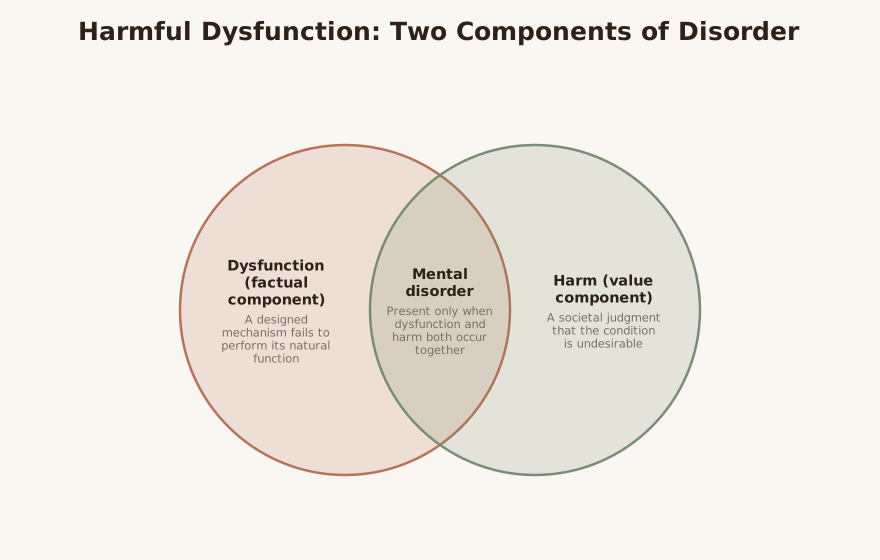
The HDA rests on two jointly necessary components 1:
-
Dysfunction (the factual / scientific component). A dysfunction is “the failure of a mechanism in the person to perform a natural function for which the mechanism was designed by natural selection” 1. The word function here is evolutionary: a heart’s function is to pump blood, an anxiety system’s function is to produce fear roughly proportional to danger 1. On this view, dysfunction is a fact about the world, in principle discoverable, not merely a social opinion 1.
-
Harm (the value component). “Harm” is a societal judgment regarding the undesirability of a condition 1. A dysfunction that produces no significant harm — and a harm that involves no underlying dysfunction — does not, on this account, constitute a disorder 1.
Three principles follow for clinical reasoning LLM. First, disorder is a hybrid concept: it requires a fact (a broken-down designed function) and a value (that the consequence is bad). Neither alone suffices. Second, not all suffering is disorder: distress that reflects an internal mechanism doing exactly what it was designed to do — grief after loss, fear in genuine danger — is harmful but not dysfunctional, and therefore not a disorder on this analysis 1. Third, deviance alone is not disorder: conditions that are merely socially disvalued, without any underlying functional failure, fall outside the definition 1.
Wakefield also allowed that dysfunction need not be all-or-none; in some cases it can represent a graded deviation from an evolutionarily designed level of functioning rather than a complete breakdown 1. This dimensional move matters clinically, because most presentations therapists see are matters of degree, not categorical switches LLM.
Interventions & Techniques
Because the HDA is a conceptual framework rather than a protocol, its “techniques” are habits of clinical reasoning rather than session activities LLM. The following are practical translations a clinician can apply:
- The two-question screen. For any presenting condition, ask separately: (1) Is some internal mechanism failing to do what it is “designed” to do? and (2) Is the result genuinely harmful to this person in their context? A disorder requires both yeses 1.
- Context-as-design-input. Wakefield’s own examples treat dysfunction as relative to situation — “a person with normal learning mechanisms can develop pathological behavioral dispositions that are outside the range that the learning mechanism was designed to produce” 1. Clinically, this licenses asking whether a reaction is proportionate to and explained by the person’s circumstances before labeling it a disorder LLM.
- The proportionality check for distress. Wakefield argued the fear system is “naturally designed to function so that fear is roughly proportional to the actual level of danger” 1. A practical heuristic: distress that is proportional to a real precipitant is a candidate for normal-range reaction; distress that is “dramatically out of proportion” or persists long after the precipitant resolves is a candidate for dysfunction 1.
- Disorder-status vs. clinical-need triage. A reaction can be non-disordered yet still warrant care. Separating “Is this a disorder?” from “Does this person need help?” prevents the framework from being used to deny services to suffering clients LLM.
LLM-generated illustrative example (not a guideline): A client presents three weeks after a parent’s death with tearfulness, poor sleep, and reduced appetite. Applying the HDA, the clinician notes the grief response is proportionate to a major loss and reflects an attachment system functioning as designed — harm without dysfunction — and frames support as accompaniment through normal grief rather than treatment of a depressive disorder, while remaining alert for trajectory markers (worsening, suicidality, function collapse) that would shift the formulation LLM.
Evidence Base
It is important to be precise about what kind of thing the HDA is, because “evidence base” means something unusual here LLM. The HDA is an established position in the philosophy of psychiatry — established in the sense that it is widely cited, has been debated for three decades, and anchors a dedicated scholarly volume 2 5. It is not established in the sense that a therapy is established by randomized trials, because it makes no treatment claim and predicts no clinical outcome LLM.
Its “evidence” is therefore conceptual and tested by the method of conceptual analysis: proposed accounts of a concept are “tested against relatively uncontroversial and widely shared judgments about what does and does not fall under the concept” 1. By this standard the HDA performs well on prototypical cases and is frequently “correct” — consonant with intuitive judgments of disorder — precisely because harm and dysfunction are two of the most salient features of conditions we call disorders 1.
The honest appraisal is mixed. Critics grant that the harm component is sound and that the boundaries of disorder are to some extent culturally relative 1. The contested claim is the scientific status of dysfunction. Lilienfeld and Marino argue that (a) many mental functions are not direct adaptations but adaptively neutral by-products; (b) natural selection produces substantial variability rather than a single designed set-point, so there is often “no natural point of demarcation” between normal and abnormal functioning; and (c) many consensual disorders are themselves evolutionarily adaptive reactions to danger or loss 1. They conclude that disorder is better modeled as a “Roschian” (prototype) concept with intrinsically fuzzy boundaries, and that Wakefield’s analysis “may only prolong scientific debate on a fundamentally nonscientific issue” 1. The broader literature continues to weigh these objections against Wakefield’s replies 3 4.
Populations & Indications
As a reasoning tool the HDA is population-general, but it earns its keep with specific groups where the disorder/non-disorder line is genuinely hard to draw LLM:
- Clients presenting with grief and loss, where the question is bereavement vs. depressive disorder LLM.
- Clients with situational or reactive distress — adjustment-type presentations driven by an identifiable stressor LLM.
- Trauma-exposed clients, where the framework asks whether a response is a designed danger reaction or has tipped into dysfunction; Wakefield used post-traumatic presentations that persist “months and even years after the danger is gone” and are “dramatically out of proportion” as his paradigm of dysfunction 1.
- Children and adolescents, where developmentally expectable behavior must be distinguished from disorder; Wakefield’s analysis has been applied to conduct presentations, including critique of arbitrary duration thresholds 1.
- General adult outpatients in whom subclinical, normal-range distress must be separated from diagnosable conditions LLM.
Problems-for-Work
- Distinguishing ordinary sadness from major depression. The HDA gives clinicians language for why a proportionate, context-bound low mood may be harm-without-dysfunction, while a pervasive, autonomous, out-of-proportion mood disturbance signals dysfunction 1. Application: documenting the precipitant, proportionality, and trajectory that justify a normal-reaction vs. disorder formulation LLM.
- Diagnostic over-pathologizing of normal distress. The framework’s central use is as a brake on false positives — labeling expectable suffering as disorder 1. Application: a clinician revisits a provisional diagnosis when the presentation turns out to be fully explained by circumstance LLM.
- False-negative under-recognition of disorder. Critics note the value component cannot capture conditions that are negatively valued yet not disorders, and that some genuine dysfunctions may be missed; clinicians must guard both directions 1. Application: not dismissing a persistent, disproportionate reaction as “just stress” when it reflects functional failure LLM.
- Grief vs. depressive disorder differentiation. Application: using proportionality and persistence as decision aids, while watching for danger markers that override the “normal grief” frame LLM.
- Culturally-bound judgments of abnormality. Because harm is a societal value judgment and boundaries are “relative across cultures, as well as within cultures over time,” the HDA itself foregrounds the need for cultural humility in any abnormality call 1.
Contraindications, Cautions & Cultural Humility
The HDA is a way of thinking, so the “contraindications” are misuses LLM. Do not use it to gatekeep care. A reaction can be non-disordered yet cause real suffering; concluding “not a disorder” must never become “not deserving of help” LLM. Do not treat its evolutionary claims as settled facts. The very premise that we can specify the “natural function” a mechanism “was designed by natural selection” to perform is the most contested part of the analysis; for many psychological capacities such functions may be unknowable or may not exist as single set-points 1. Clinicians who reify “evolutionary dysfunction” as if it were a measurable lab value mistake a philosophical hypothesis for a finding LLM.
On cultural humility, the analysis cuts in a useful direction: its own author concedes the harm component is a societal judgment and that disorder boundaries shift across cultures and over time 1. Historical controversies — over homosexuality, premenstrual dysphoria, and self-defeating personality, among others — are reminders that disorder labels have tracked sociopolitical as much as scientific considerations 1. A therapist using the HDA should therefore ask whose values define the “harm,” and whether a behavior judged abnormal in one cultural frame is adaptive or normative in the client’s own 1.
Treatment-Plan Suggestions & SMART Objectives
The HDA does not generate treatment goals on its own; it informs how a clinician frames whether and what to treat LLM. The objectives below illustrate goals that operationalize HDA-style reasoning within standard, established modalities LLM.
| Goal | SMART objective (example) | Mechanism |
|---|---|---|
| Differentiate normal reaction from disorder | Within 2 sessions, client and clinician will complete a written formulation distinguishing precipitant-proportional distress from autonomous symptoms, reviewed and revised at session 4 | Conceptual analysis / proportionality appraisal 1 |
| Reduce over-pathologizing self-talk | Over 4 weeks, client will reframe ≥3 self-labeling statements (“I’m broken”) into context-based appraisals in a thought log, ≥80% of entries | Cognitive restructuring LLM |
| Process proportionate grief without medicalizing it | For 6 weeks, client will attend weekly supportive sessions and rate grief intensity (0–10), with clinician monitoring for trajectory markers | Normalization + monitoring 1 |
| Identify true functional impairment | By session 3, client will list specific role/function losses, distinguishing harm from dysfunction, completed collaboratively | Functional analysis 1 |
| Address out-of-proportion trauma responses | Over 8 sessions, client will reduce avoidance behaviors that persist absent present danger by ≥50% on a self-report tally | Exposure-based change 1 |
| Build culturally-grounded appraisal of “abnormal” | Within 3 sessions, client and clinician will document which behaviors are disvalued by which reference group, and which are normative in the client’s culture | Cultural formulation 1 |
| Prevent premature diagnostic closure | Each session for 4 weeks, clinician and client will re-test the working hypothesis against new contextual information | Hypothesis-testing stance 1 |
Common Misconceptions
- “The HDA is a diagnostic test.” It is a conceptual definition of what disorder is, not an instrument that yields a diagnosis; it has no cutoffs, scales, or scoring LLM.
- “Dysfunction means statistical rarity.” Wakefield explicitly rejected purely statistical accounts; on his view a response could be common yet dysfunctional, or rare yet healthy 1.
- “If there’s harm, there’s disorder.” Harm is necessary but not sufficient — grief, fear in danger, and disvalued-but-normal traits (laziness, rudeness) are harmful or disvalued without being disorders 1.
- “The evolutionary part is hard science.” The claim that we can identify the function a mechanism “was designed by natural selection” to perform is the analysis’s most disputed element, not a settled empirical matter 1.
- “It tells you whom to treat.” It addresses disorder status, not clinical need; the two questions must be kept separate LLM.
Training & Certification
There is no certification in the Harmful Dysfunction Analysis; it is an idea, not a credentialed method LLM. Therapists encounter it through graduate coursework in abnormal psychology, psychopathology, and the philosophy of psychiatry, and through the primary literature LLM. The most efficient route to competence is reading the foundational critique and reply in tandem — Lilienfeld and Marino’s paper alongside Wakefield’s own formulations — to see the strongest case for and against 1. The edited volume Defining Mental Disorder: Jerome Wakefield and His Critics is the standard one-stop resource for the full debate 2 5.
Key Terms
- Harmful dysfunction: disorder defined as a designed-function failure (dysfunction) that is also socially disvalued (harm) 1.
- Dysfunction: failure of a mechanism to perform a natural function for which it was designed by natural selection 1.
- Harm (value component): a societal judgment about the undesirability of a condition 1.
- Natural function: the evolutionary purpose for which a mechanism was selected 1.
- Conceptual analysis: testing a proposed definition against widely shared judgments of what falls under the concept 1.
- Roschian / prototype concept: a category organized around a prototype with clear-cut and marginal members and intrinsically fuzzy boundaries — the critics’ proposed alternative model of disorder 1.
- Fact/value hybrid: the thesis that disorder requires both a factual (scientific) and an evaluative (social) criterion 1.
Resources & Further Reading
▶ Watch — a video introduction to this concept:
- Lilienfeld & Marino (1995), Mental Disorder as a Roschian Concept — critique of the HDA (PDF)
- Defining Mental Disorder: Jerome Wakefield and His Critics (MIT Press, open-access edited volume)
- The Harmful Dysfunction Analysis of Mental Disorder (Project MUSE summary)
- On Wakefield’s harmful dysfunction analysis of mental disorder (ScienceDirect)
- Defining Mental Disorder (MIT Press catalog page)
Reflective / Supervision Questions
- When you last labeled a client’s distress a “disorder,” could you articulate both the dysfunction and the harm — or were you relying on one alone? LLM
- In your caseload, where might proportionate, context-bound suffering be at risk of over-diagnosis, and where might persistent, disproportionate reactions be at risk of being dismissed as “just stress”? 1
- Whose values are defining “harm” in a given case — the client’s, the family’s, the referrer’s, or the dominant culture’s — and how would the formulation change if you shifted reference groups? 1
- If the “natural function” of a mechanism cannot be specified, how should that uncertainty change the confidence with which you assign a diagnosis? 1
- How do you keep the question “Is this a disorder?” from collapsing into the question “Does this person deserve care?” in your documentation and treatment planning? LLM