
The gunas are not a therapy. They are a roughly two-thousand-year-old philosophical account of how mind and matter behave, and clinicians encounter them mainly because clients who practice yoga, meditation, or Ayurveda use the vocabulary to describe their inner states LLM. This article treats the gunas the way a competent therapist should: as a culturally meaningful framework a client may bring to the room, useful as a phenomenological map and a values bridge, but with no modern outcome evidence and no standing as a billable modality on its own LLM.
Type & Discipline
The doctrine of the three gunas belongs to Samkhya, one of the classical systems (darshanas) of Indian philosophy, and is shared by the closely allied Yoga school and by Ayurvedic and Vedantic thought 2. It is a metaphysical and psychological theory rather than a treatment protocol or an empirical science LLM. In Samkhya the gunas are described as “physiopsychological factors,” meaning they are understood to operate simultaneously at the physical and the mental level — the same three forces that compose matter also compose the texture of mind 1. For the clinician, the relevant claim is the psychological one: that subjective experience can be read as a moving blend of three qualities LLM.
Creators & Lineage
Samkhya is traditionally traced to the sage Kapila, whose teachings were later systematized 2. The oldest surviving Samkhya text, the Samkhya-karika, was composed by Ishvarakrishna around the 2nd century CE; Ishvarakrishna presents himself as transmitting Kapila’s teaching through a lineage rather than inventing it 2. The framework also appears in older sources such as the Shvetashvatara Upanishad, which links the philosophy to yogic practice as a path to liberation 6. The concept of the gunas, though originally prominent in Samkhya, spread to become central across nearly all Hindu schools, and is elaborated in the Bhagavad Gita, which frames spiritual progress as moving beyond the three modes of existence 3. The Yoga school associated with Patanjali shares this cosmology, which is why the language reaches modern students through yoga and meditation traditions 3LLM.
The lineage relevant to a therapy practice runs: Samkhya cosmology, into Patanjali’s yoga philosophy, into Ayurvedic psychology, and from there into the contemporary mindfulness-based interventions and “holistic” wellness culture that many clients now inhabit LLM.
Core Principles
In Samkhya, reality is dualistic: purusha is pure, passive, witnessing consciousness, and prakriti is the active, creative, unconscious material principle that produces the entire phenomenal world, including mind, ego, intellect, emotion, and the senses 27. The three gunas are the innate constituents of prakriti 7. They are:
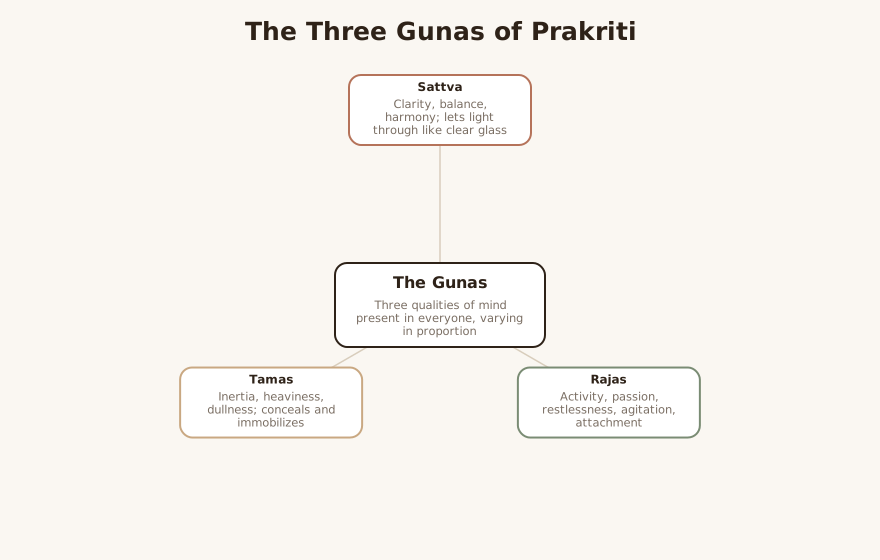
- Sattva — goodness, balance, harmony, purity, clarity, and illumination 3. Experientially it is described as a transparent pane of glass that lets light through, manifesting as calm, beauty, and contentment 4.
- Rajas — passion, energy, activity, emotion, and expansiveness, but also self-centeredness, restlessness, agitation, and attachment to sensory desire 134.
- Tamas — darkness, inertia, heaviness, dullness, ignorance, and lethargy; it conceals and immobilizes 134.
Two structural ideas matter clinically. First, all three gunas are present in everyone at all times, varying only in proportion; experience reflects whichever is momentarily dominant 6. Second, the gunas exist in equilibrium before manifestation, and it is the disturbance of that equilibrium — their “varying states of mutual preponderance” — that drives all change and differentiation 17. Mind states track this preponderance directly: rajas produces restlessness and attachment, tamas produces sleepiness and dullness, and sattva produces clarity and peace 6.
The soteriological aim — important context, not a therapy goal — is not to maximize any guna but to discriminate purusha from prakriti and ultimately transcend identification with all three 23. The Bhagavad Gita explicitly frames liberation as going beyond the three modes 3.
Interventions & Techniques
The gunas are a lens, not a procedure, so the “techniques” are observational and lifestyle-oriented rather than clinical LLM. Traditional and contemporary yoga sources describe a graded way of working with them. Practitioners are said to move through stages: first the gunas operate unconsciously, then one learns to recognize them externally, then to witness one’s own tendencies, and finally to deliberately cultivate sattva while using rajas and tamas in the service of appropriate stability and rest 4.
Concrete applications in the tradition include:
- State labeling. Noticing whether a given moment, mood, meal, or action is predominantly sattvic (clear, calm), rajasic (driven, agitated), or tamasic (heavy, dull) 4.
- Practice calibration. The same yoga posture can be performed sleepily and unfocused (tamasic), strained and competitive (rajasic), or calm and inwardly attentive (sattvic); the quality, not just the form, is the object of attention 4.
- Diet and lifestyle. Foods and activities are classified by guna, with sattvic food regarded as promoting health, rajasic food as overstimulating, and tamasic food as stale or impure 34.
For a therapist, the usable move is to treat these as the client’s existing self-monitoring system and to map it onto evidence-based skills, rather than to prescribe guna theory itself LLM.
LLM-generated illustrative example (not a guideline): A client who meditates describes her week as “all rajas — wired, can’t land.” Rather than teaching her the doctrine, the clinician borrows her word: “When ‘rajas’ shows up, what’s the earliest body cue?” This anchors a standard interoceptive-awareness and behavioral-activation conversation in language she already trusts LLM.
Evidence Base
Maturity: established as philosophy, absent as clinical science. The gunas are a well-attested, internally coherent, and historically deep philosophical framework with a clear textual lineage 26. That is the only sense in which they are “established.” There is no body of controlled clinical trials, validated assessment instruments, or mechanistic research within the provided sources establishing the gunas as an effective treatment for any disorder LLM. The provided sources are reference encyclopedias and yoga-tradition explainers describing the concept and its practice, not clinical outcome studies 1346. Clinicians should therefore present the gunas to clients as a meaning-making and self-awareness framework, and should locate any actual therapeutic mechanism in the recognized modality being delivered — mindfulness, behavioral activation, values work — not in the guna theory itself LLM.
Populations & Indications
The framework is most relevant to clients who already use it or are drawn to it: yoga and meditation practitioners, people seeking holistic or integrative care, clients in mindfulness-based therapy, and individuals exploring spirituality LLM. Because the gunas give plain words to high-energy versus low-energy versus settled states, they can also be a useful bridge for adults pursuing lifestyle change and for people with mood disturbance who respond well to a non-pathologizing, qualitative description of their internal weather 3LLM. The indication is for engagement and language, not for symptom treatment — the gunas help a culturally matched client describe and track experience, which can improve rapport and self-monitoring LLM.
Problems-for-Work
The gunas map intuitively onto several presenting concerns, which makes them a convenient descriptive scaffold LLM:
- Restlessness / agitation and anxiety read as rajasic preponderance — energy and activation without settling 14. Application: pair the client’s “rajas” label with arousal-reduction and grounding skills.
- Lethargy, amotivation, and low-energy depression read as tamasic preponderance — heaviness, dullness, inertia 14. Application: pair the “tamas” label with behavioral activation and sleep regulation.
- Mood instability reads as rapid shifting in which guna dominates, supporting psychoeducation that states are transient and proportional rather than fixed traits 6LLM.
- Stress and poor self-awareness are addressed by the witnessing stance — learning to notice one’s own tendencies before reacting 4.
- Sleep and energy dysregulation map onto the lifestyle/diet dimension of the framework 34.
LLM-generated illustrative example (not a guideline): A client with low-energy depression says mornings feel “thick, like tamas.” The clinician validates the metaphor, then co-designs a single small morning behavioral activation (“one rajasic act before coffee — open the blinds and step outside”) explicitly framed as nudging the balance, while the underlying intervention remains standard behavioral activation LLM.
Contraindications, Cautions & Cultural Humility
The chief caution is conceptual: do not let guna language replace clinical assessment LLM. Labeling depression as “tamas” or a panic surge as “rajas” can romanticize or spiritualize symptoms that require evidence-based care and risk screening; the framework has no diagnostic validity and was never intended for that purpose LLM. There is a real risk of spiritual bypass, where guna talk lets a client avoid affect or accountability rather than approach it LLM.
Cultural humility cuts both ways. The gunas are a living sacred framework within Hindu and yogic traditions, and their ultimate orientation is toward liberation and transcending all three qualities — not toward optimizing “more sattva” as a wellness product 23. Clinicians should avoid extracting and commodifying the vocabulary while ignoring its source, and should follow the client’s own meaning rather than imposing a textbook reading LLM. Conversely, do not assume a client of South Asian heritage uses or endorses this framework at all LLM. When a client offers the language, mirror it; when they do not, do not introduce it LLM.
Treatment-Plan Suggestions & SMART Objectives
The gunas are not a standalone billable therapy; the table below shows how the framework’s descriptive language can be folded into recognized, billable modalities LLM.
| Goal | SMART objective (example) | Mechanism |
|---|---|---|
| Increase self-awareness of internal states | Within 4 weeks, client will log a one-word state label (clear / driven / heavy) at 3 set times daily on 5+ days/week | Self-monitoring; interoceptive awareness using familiar vocabulary 4 |
| Reduce rajasic agitation / anxiety | Over 6 weeks, client will apply one paced-breathing or grounding skill within 5 minutes of noticing “rajas” cues, ≥4x/week | Arousal down-regulation paired with the client’s own activation label 41 |
| Counter tamasic lethargy / low mood | For 3 weeks, client will complete one scheduled morning activation task on ≥5 days/week | Behavioral activation reframed as shifting the balance away from inertia 4LLM |
| Stabilize sleep/energy rhythm | Within 4 weeks, client will keep a consistent wake time (±30 min) ≥6 days/week and rate morning state | Circadian and behavioral regulation mapped to lifestyle/diet dimension 3 |
| Build a non-reactive witnessing stance | Over 8 weeks, client will practice 10 min of mindfulness 5x/week and name the dominant quality without acting | Decentering / present-moment awareness; “witness” stage of practice 4 |
| Reduce all-or-nothing self-judgment | Client will reframe one self-critical statement per session as a transient state rather than a fixed trait | Cognitive restructuring using the impermanence-of-gunas idea 6LLM |
| Clarify values for lifestyle change | Within 2 sessions, client will identify 3 “sattva-aligned” valued actions and schedule one weekly | Values clarification / committed action 3LLM |
Common Misconceptions
- “Sattva is good, the others are bad — aim to be all sattva.” The tradition treats all three as necessary constituents of nature, and the actual goal is to transcend identification with all of them, not to maximize one 23. Rajas and tamas are even described as serving stability and rest when used appropriately 4.
- “The gunas are personality types.” They are dynamic, momentary proportions that shift continually, not fixed categories like a typology 61.
- “It’s an ancient evidence-based therapy.” It is an established philosophy; the provided sources contain no clinical outcome evidence 2LLM.
- “Guna and Ayurvedic dosha are the same thing.” They are related concepts within the broader tradition but are not interchangeable; conflating them oversimplifies both LLM.
- “Purusha is the mind.” In Samkhya the mind, intellect, and ego are all part of prakriti; purusha is the separate, passive witnessing consciousness 27.
Training & Certification
There is no clinical credential in “guna therapy,” and none is implied by the provided sources LLM. The concept is transmitted through yoga and Ayurveda education and through study of classical texts such as the Samkhya-karika and the Bhagavad Gita 23. A therapist wishing to work respectfully with clients who use this language is better served by grounding in the philosophy via primary and reference sources, and by competence in an actual evidence-based modality, than by any guna-specific certificate LLM. Yoga-teacher or Ayurvedic trainings convey the framework but do not confer mental-health scope of practice LLM.
Key Terms
- Guna — one of three fundamental qualities or tendencies constituting nature and mind 3.
- Sattva — the quality of clarity, harmony, balance, and illumination 34.
- Rajas — the quality of activity, passion, energy, and restlessness 14.
- Tamas — the quality of inertia, heaviness, dullness, and ignorance 14.
- Prakriti — the unconscious, creative material principle that produces mind and world; the gunas are its constituents 7.
- Purusha — pure, passive witnessing consciousness, distinct from prakriti 27.
- Equilibrium / preponderance — the gunas rest in balance until disturbed, after which their shifting dominance drives all experience and change 17.
Resources & Further Reading
▶ Watch — a video introduction to this concept:
- Guna | philosophy — Encyclopaedia Britannica
- Indian philosophy — The Samkhya-karikas — Encyclopaedia Britannica
- Guna — Wikipedia
- The Gunas: Nature’s Three Fundamental Forces — Yoga International
- Gunas: the Three Qualities of Matter — Embodied Philosophy
- Prakriti — Wikipedia
Reflective / Supervision Questions
- When a client uses guna language, am I mirroring their meaning, or imposing a textbook definition that may not be theirs? LLM
- Where is the actual therapeutic mechanism in my plan — in an evidence-based modality, or have I let the framework stand in for treatment? LLM
- Could naming a symptom as “tamas” or “rajas” be enabling spiritual bypass or delaying needed risk assessment? LLM
- Am I treating the gunas as a respected living tradition, or extracting the vocabulary while ignoring its sacred and liberatory context? 3LLM
- For a client of South Asian heritage, have I checked whether this framework is even part of their world, rather than assuming it is? LLM
- How would I document today’s session so the billable service is the clinical intervention, with the guna language clearly noted as engagement and psychoeducation? LLM