
Type & Discipline
Cognitive-Behavioral Couple Therapy (CBCT) is a structured, present-focused couple treatment situated within clinical psychology and the broader field of couples therapy 4. It applies the principles of cognitive-behavioral therapy to the dyad rather than the individual, treating the relationship itself as the unit of intervention 5. The model conceptualizes relationship distress as the product of reciprocal interactions among partners’ behaviors, cognitions, and emotional responses 3. Unlike purely behavioral predecessors, CBCT gives explicit attention to how each partner perceives, interprets, and evaluates relationship events 1. It is typically delivered in a time-limited, skills-based format with both partners present LLM.
Creators & Lineage
CBCT was developed primarily by Donald Baucom and Norman Epstein, who integrated cognitive theory into earlier behavioral couple therapy 2. Its immediate ancestor is behavioral couple therapy, grounded in social learning and social exchange principles that emphasized observable behavior exchange and reinforcement 3. As clinicians recognized that behavior change alone often failed to shift partners’ subjective experience, cognitive components drawn from individual CBT and schema theory were added 1. Baucom and Epstein later articulated an “enhanced” or contextual model that broadened the focus beyond discrete communication skills to include macro-level relationship themes and the environmental context surrounding the couple 2. CBCT sits alongside related lineages such as integrative behavioral couple therapy, which emphasizes emotional acceptance in addition to change LLM.
Core Principles
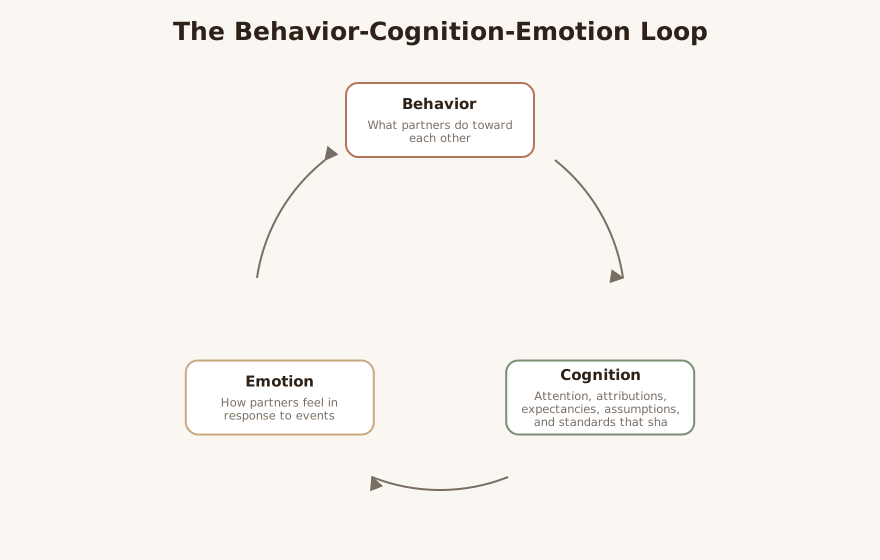
CBCT rests on the premise that distress is maintained by patterns linking what partners do, what they think, and how they feel, each influencing the others in a continuous loop 3. A central tenet is that cognitions are not merely passive reflections of relationship events but actively shape emotional and behavioral responses to them 1. Epstein and Baucom describe several distinct categories of relationship cognition that therapy targets: selective attention to particular partner behaviors, attributions about why events occur, expectancies about what will happen, assumptions about how relationships generally work, and standards about how relationships should be 1. Distorted or extreme cognitions in any of these categories can drive negative affect and maladaptive behavior even when objective circumstances are benign LLM. The model also holds that skill deficits in communication and problem-solving sustain conflict and erode satisfaction 5. The enhanced contextual model adds that individual histories, life stressors, and broader contexts must be considered alongside immediate interaction patterns 2.
Interventions & Techniques
CBCT employs a coordinated set of behavioral, cognitive, and affective interventions 5. On the behavioral side, clinicians use communication-skills training, including speaker-listener structured exchanges, and guided problem-solving to help couples address concrete disagreements 5. Behavioral contracts and the deliberate increase of positive exchanges aim to rebuild reciprocity and goodwill LLM. Cognitive interventions include identifying and testing automatic interpretations, examining the evidence for negative attributions, and re-evaluating rigid relationship standards that fuel disappointment 1. Therapists help partners recognize when standards are unrealistic and negotiate standards that both can endorse 1. Newer, more emotion-attentive directions within the cognitive-behavioral tradition incorporate deepened emotional self-disclosure and empathic listening, narrowing the historical gap between CBCT and more experiential approaches 3. Psychoeducation and structured homework between sessions reinforce in-session learning and promote generalization to daily life LLM.
LLM-generated illustrative example (not a guideline): A partner who interprets a forgotten errand as “she doesn’t care about me” is guided to consider competing explanations, test the attribution against recent caring behaviors, and articulate the underlying standard (“attentiveness equals love”) so the couple can negotiate a shared, realistic expectation. LLM
Evidence Base
CBCT is an established, empirically supported couple therapy with a substantial outcome literature 5. Controlled studies indicate meaningful improvement for a majority of couples, with one synthesis reporting roughly 70% of couples improving after CBCT and effect sizes ranging from approximately d = 0.53 to 1.74 across studies and follow-up periods 3. Comparative research finds CBCT broadly comparable to other leading approaches; notably, no significant differences in effect sizes were found between CBCT and emotion-focused couple therapy 3. Honesty about the evidence requires two caveats LLM. First, while the overall package is well supported, the incremental benefit of the cognitive components over purely behavioral interventions has been harder to demonstrate cleanly, and behavioral and cognitive elements are usually delivered together LLM. Second, gains are robust but not universal, and a meaningful subset of couples do not improve or relapse over longer follow-up 3. Overall, the maturity of the evidence base is best described as established rather than experimental LLM.
Populations & Indications
CBCT is indicated for distressed dyads across a range of constellations, including married, partnered, and cohabiting adults 4. It is applicable to premarital couples seeking to strengthen communication and clarify expectations before commitment LLM. The model is well suited to couples in whom one or both partners present with a comorbid individual disorder, where the contextual approach addresses how the relationship and the disorder mutually influence one another 2. Because it is structured and skills-oriented, CBCT fits couples who can tolerate a directive, present-focused format and engage in between-session practice LLM. It has been adapted for relationship problems intertwined with depression, anxiety, and other clinical concerns within the couple context 2.
Problems-for-Work
CBCT addresses a broad set of relationship problems-for-work. For relationship conflict and marital distress, the therapist targets the behavior-cognition-emotion loop sustaining escalation 3. For communication problems, structured speaker-listener and problem-solving skills are taught and rehearsed 5. For negative partner attributions, cognitive restructuring tests blaming interpretations against evidence 1. For unrealistic relationship standards, therapy surfaces and renegotiates rigid “shoulds” about partnership 1. Infidelity, anger and hostility, sexual dysfunction, and the couple-level expression of depression or anxiety are addressed by combining behavioral change, cognitive reappraisal, and emotional processing within the contextual frame 2.
LLM-generated illustrative example (not a guideline): For a couple presenting with chronic hostility, the clinician maps the recurring cycle (criticism, defensive withdrawal, escalation), introduces time-outs as a behavioral interrupt, and helps each partner reappraise the other’s withdrawal as self-protection rather than contempt. LLM
Contraindications, Cautions & Cultural Humility
CBCT is generally inappropriate as a first-line conjoint treatment when ongoing intimate partner violence creates safety risk, since structured conflict discussion can escalate danger and inhibit honest disclosure LLM. Untreated severe substance use or acute individual crises may need stabilization before couple work can proceed LLM. The directive, skills-based structure may not suit every couple, and rapport and timing matter for whether cognitive challenge feels collaborative rather than invalidating LLM. Cultural humility is essential because the relationship “standards” CBCT examines are culturally shaped; what one tradition treats as a dysfunctional expectation may be a valued norm in another, and the therapist must avoid imposing a single template of a healthy relationship LLM. Gender roles, family involvement, religious commitments, and immigration-related stressors all belong in the contextual assessment the enhanced model calls for 2.
Treatment-Plan Suggestions & SMART Objectives
| Goal | SMART objective (example) | Mechanism |
|---|---|---|
| Improve communication | Each partner will use the structured speaker-listener format in 3 of 4 weekly check-ins within 6 weeks | Communication-skills training 5 |
| Reduce blaming attributions | Partner will generate at least one alternative explanation for a distressing partner behavior in session each week for 4 weeks | Cognitive restructuring of attributions 1 |
| Renegotiate rigid standards | Couple will identify and revise two unrealistic relationship standards into mutually endorsed expectations within 8 weeks | Examination and modification of standards 1 |
| Increase positive exchanges | Couple will complete a daily “caring behavior” each day for 3 consecutive weeks | Behavioral reciprocity and reinforcement LLM |
| Improve conflict regulation | Partners will deploy an agreed time-out before escalation in at least 80% of heated discussions over 1 month | Behavioral interruption of escalation cycles LLM |
| Deepen emotional understanding | Each partner will disclose one underlying (primary) emotion during a guided exchange weekly for 5 weeks | Emotional self-disclosure and empathic listening 3 |
| Strengthen problem-solving | Couple will resolve one identified problem using the full problem-solving sequence within 6 weeks | Structured problem-solving training 5 |
Common Misconceptions
A frequent misconception is that CBCT is “all cognitive” and neglects emotion; in fact, the model treats emotion as one of three interacting domains and newer variants explicitly cultivate emotional disclosure and empathy 3. Another is that CBCT is merely behavioral couple therapy renamed, when its defining contribution is the systematic targeting of relationship cognitions 1. Some assume the approach simply teaches partners to think positively, whereas the actual aim is realistic, evidence-tested appraisal rather than forced optimism LLM. Finally, the structured format is sometimes mistaken for rigidity, but the enhanced contextual model individualizes treatment to the couple’s history and circumstances 2.
Training & Certification
There is no single proprietary certification governing CBCT in the way some branded couple therapies require LLM. Clinicians typically build competence through graduate training in cognitive-behavioral methods, supervised couple-therapy practice, and study of the foundational texts by Epstein and Baucom 2. Demonstration materials, including an APA video of enhanced CBCT led by Baucom, illustrate the model in practice and support skill development 6. Encyclopedia and chapter-length overviews provide accessible entry points for clinicians new to the approach 4. Ongoing consultation and review of session recordings remain the practical mechanisms for refining adherence and skill LLM.
Key Terms
Attributions are the explanations a partner generates for why relationship events occur, which strongly shape emotional reactions 1. Expectancies are predictions about what will happen in the relationship or in a specific interaction 1. Assumptions are beliefs about how relationships and partners generally function 1. Standards are beliefs about how relationships and partners should be, and rigid standards are a common driver of distress 1. Selective attention refers to the tendency to notice some partner behaviors while overlooking others, biasing the overall appraisal of the relationship 1. The behavior-cognition-emotion loop is the reciprocal interaction among these three domains that maintains distress 3. The enhanced contextual model broadens treatment to include individual histories, broader themes, and environmental context 2.
Resources & Further Reading
▶ Watch — a video introduction to this concept:
- Introduction to Cognitive-Behavioral Couple Therapy (Epstein & Baucom, Guilford excerpt)
- Enhanced Cognitive-Behavioral Therapy for Couples: A Contextual Approach (Epstein & Baucom, APA, 2002)
- Cognitive-Behavioral and Emotion-Focused Couple Therapy: Similarities and Differences (PMC)
- Cognitive Behavioral Couple Therapy (Springer Encyclopedia entry)
- Cognitive-Behavioral Psychotherapy for Couples (IntechOpen open-access chapter)
- Enhanced Cognitive-Behavioral Couple Therapy (APA demonstration video, Baucom)
Reflective / Supervision Questions
- When a couple presents with entrenched conflict, how do I decide whether to begin with behavioral change, cognitive work, or emotional processing? LLM
- Whose relationship “standards” am I implicitly treating as healthy, and how might my own cultural assumptions shape that judgment? LLM
- How do I distinguish a genuinely distorted attribution from an accurate perception of a real problem in the relationship? LLM
- What safety screening do I complete before recommending conjoint, conflict-focused work? LLM
- How do I keep a structured, skills-based format from feeling invalidating to a partner who most needs to feel emotionally heard? LLM