
Type & Discipline
Clinical versus statistical (actuarial) prediction is not a therapy modality or a technique you deliver in session; it is a framework from clinical decision science about how predictions should be made 4. It sits at the intersection of psychometrics, judgment-and-decision-making research, and applied ethics of assessment 3. The central question is procedural: once you have a set of data about a person, should the final prediction come from a clinician integrating that data in their head, or from a mechanical rule — a formula, table, or algorithm — that combines the same data the same way every time 2.
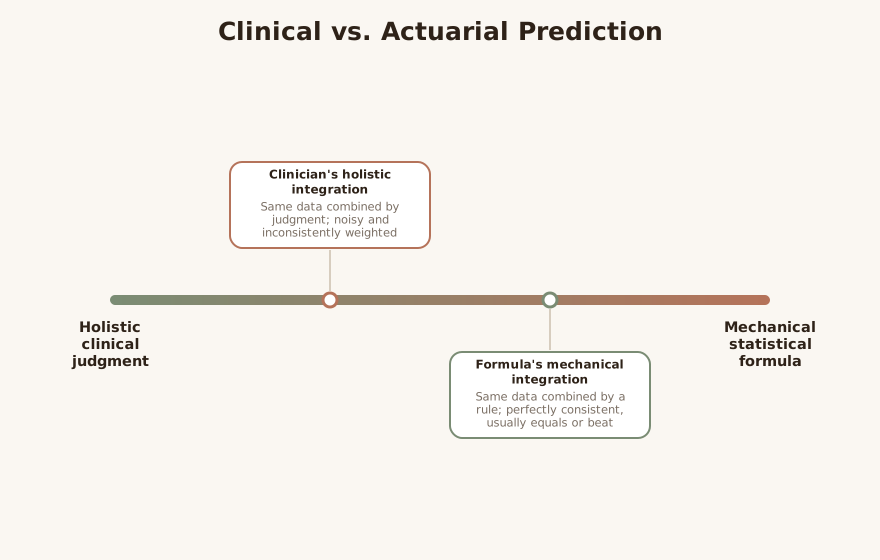
The crucial distinction, easily lost, is about the mode of data combination, not data collection 2. Both approaches can use interviews, history, and test scores. What separates them is the final step: the clinical method weights and integrates information through human judgment, while the actuarial (mechanical) method applies an empirically derived formula whose inputs and weights are fixed in advance 2. An actuarial instrument is “actuarial” because it predicts from established statistical relationships between predictors and outcomes, the way an insurer prices risk 57.
Creators & Lineage
The framework is inseparable from Paul E. Meehl, whose 1954 monograph Clinical versus Statistical Prediction reviewed roughly two dozen studies and reached a conclusion that unsettled the field: the mechanical method equaled or surpassed clinical judgment in nearly every comparison 4. Meehl framed the problem with unusual rigor and, characteristically, kept revisiting it across his career rather than declaring victory 3.
The line of work was extended and sharpened by Robyn M. Dawes, David Faust, and Meehl himself in their 1989 Science article, which restated the evidence for a broad scientific audience and addressed the standard objections clinicians raised 2. William M. Grove later led the definitive quantitative synthesis and authored a retrospective on Meehl’s contribution, cementing the lineage from Meehl’s narrative reviews to formal meta-analysis 13. This intellectual line also seeded the broader cognitive-bias and decision-aid literatures that clinicians draw on today LLM.
Core Principles
First principle: simple mechanical rules are surprisingly hard to beat. Across decades of studies, formulas have reliably matched or exceeded expert judgment given the same data 12. The advantage is partly that a formula is perfectly consistent — it never gets tired, distracted, or swayed by a vivid recent case — whereas human judgment is noisy and applies its own weights inconsistently from case to case 2.
Second principle: the comparison is fair only when both sides see the same information 2. The finding is not that data beats clinicians; it is that a clinician’s holistic integration of data tends to lose to a formula’s integration of that same data 2.
Third principle: this is a claim about aggregate predictive accuracy, not about the clinician’s whole role LLM. Meehl never argued that clinicians should be replaced — only that for the narrow task of combining data into a prediction, the formula usually wins, and that pretending otherwise harms the people we assess 34.
Interventions & Techniques
Because this is a framework rather than a treatment, its “techniques” are decision practices. The most direct application is using a validated actuarial instrument and following its output rather than overriding it on a hunch 2. A related practice is structuring the inputs: even when a final number isn’t computed, specifying in advance which variables matter and how they should be weighted reduces the noise that degrades unaided judgment 2.
A second technique is mechanical combination of clinically gathered data — the clinician collects rich information through interview and observation (a human strength), then feeds defined variables into a formula for the prediction step 2. This respects the data-collection/data-combination distinction and often captures the best of both 2.
A third, more honest practice is calibration: tracking whether one’s predictions actually come true over time, since clinicians rarely receive the corrective feedback that would let intuition improve 26. Where no validated instrument exists, building even a crude linear model of one’s own decision rules can outperform repeatedly applying them by feel LLM.
Evidence Base
The maturity here is established — this is one of the most replicated findings in applied psychology 13. Grove and colleagues’ 2000 meta-analysis is the anchor: across a large body of studies in psychology and medicine, mechanical prediction was on average about 10% more accurate than clinical prediction 1. Mechanical methods substantially outperformed clinical judgment in roughly 33–47% of studies, while clinical judgment was substantially superior in only about 6–16% 1.
The superiority of mechanical methods held broadly — across judgment tasks, types of judges, levels of judge experience, and kinds of data being combined 1. One notable moderator emerged: clinical prediction fared relatively worse when the predictors included clinical interview data, a sobering finding given how central the interview is to practice 1. The earlier narrative reviews by Meehl and the 1989 Science synthesis reached the same qualitative conclusion the meta-analysis later quantified 24.
Honest caveats: the effect is an average, individual instruments vary in quality, and a poorly validated formula is not automatically better than a thoughtful clinician LLM. The finding is robust, but it is about a tendency across many decisions, not a guarantee in any single case 1.
Populations & Indications
The framework is most consequential where predictions are high-stakes, repeated, and outcome-verifiable — classically forensic and risk-assessment populations, where validated actuarial tools for violence and recidivism are well developed 2. High-acuity intake and crisis settings are another natural fit, because decisions are frequent and consequential and the pull toward intuitive, anxiety-driven judgment is strong LLM.
More broadly, the principles apply to any psychological assessment context in which a clinician must turn data into a prediction or disposition — diagnostic formulation, prognosis, treatment selection, and level-of-care decisions 4. The indication is essentially universal: wherever a defensible prediction is required and a validated mechanical aid exists, the aid deserves serious weight 2.
Problems-for-Work
Suicide and violence risk estimation. Unaided clinicians tend to over-weight vivid, recent, or emotionally salient cues; a structured or actuarial approach anchors the estimate to variables with demonstrated predictive value 2.
LLM-generated illustrative example (not a guideline): A clinician feels acutely alarmed by a client’s intense affect in session and is tempted to predict imminent risk on that basis. Pausing to apply a structured risk framework reweights the estimate toward established factors — prior attempts, access to means, protective supports — rather than the vividness of the moment LLM.
Diagnostic and treatment-selection decisions. Specifying decision criteria in advance reduces the inconsistency that creeps in when the same clinician judges similar cases differently on different days 2.
Over-reliance on unaided clinical intuition. The work here is metacognitive: helping a clinician notice when confidence is being driven by case vividness or experience rather than by predictive validity 26.
Prognostic and disposition decisions. Where a validated tool exists, the problem-for-work is integrating its output without reflexively overriding it — and documenting the reasoning when an override genuinely is warranted 2.
Contraindications, Cautions & Cultural Humility
The framework has real limits. Meehl’s own “broken-leg” problem captures the chief one: if you know a specific, rare fact the formula cannot see — the classic example being that a person has just broken their leg and therefore cannot go dancing — the clinician should override the formula 24. The danger is that clinicians invoke broken-leg exceptions far too often, for ordinary cases where they have no special knowledge, which is precisely how unaided judgment loses its edge 2.
Base rates are another essential caution: predicting rare events is intrinsically hard, and ignoring how common an outcome actually is leads to overconfident, poorly calibrated predictions whether the method is clinical or actuarial 2LLM.
Cultural humility is paramount and is where actuarial tools demand the most scrutiny. A formula is only as fair as the data it was built on; instruments derived from samples that underrepresent certain groups can encode and then mechanize bias, applying it with a consistency that makes it look objective LLM. Mechanical does not mean neutral LLM. Clinicians should know an instrument’s validation population, treat outputs as one input rather than a verdict, and attend to how a “validated” tool may misfire for clients unlike those it was normed on LLM.
Treatment-Plan Suggestions & SMART Objectives
The framework rarely appears as a stated treatment goal; it operates underneath assessment and decision-making. The objectives below are illustrative ways the principle informs measurable clinical work LLM.
| Goal | SMART objective (example) | Mechanism |
|---|---|---|
| Reduce noise in risk estimation | Within 4 weeks, clinician documents a structured set of predefined risk variables for 100% of safety assessments | Fixed inputs reduce judgment inconsistency 2 |
| Improve calibration of predictions | Over 8 weeks, clinician records each disposition prediction and reviews actual outcomes monthly | Outcome feedback corrects miscalibrated intuition 26 |
| Appropriate use of actuarial tools | For every applicable case this quarter, clinician records the tool output and a written rationale for any override | Limits excessive broken-leg overrides 2 |
| Integrate base-rate reasoning | Within 6 weeks, clinician states the relevant base rate before each rare-event prediction in 90% of cases | Anchors estimates to outcome frequency 2 |
| Strengthen metacognition | Over 12 weeks, clinician logs the primary basis for high-confidence judgments in supervision biweekly | Surfaces vividness-driven reasoning 6 |
| Equity in tool use | This quarter, clinician verifies the validation population for each instrument used with a new client | Surfaces fit between norms and client LLM |
Common Misconceptions
“The research says clinicians are useless.” No — it says clinicians excel at gathering data and conducting the interview; the specific step where formulas win is combining data into a prediction 2. Replacing the clinician was never the claim 3.
“More data or more experience closes the gap.” The meta-analysis found mechanical superiority held regardless of the judges’ experience level 1. Seniority does not reliably convert into better predictive accuracy 1.
“It only applies to test scores, not real clinical work.” The opposite caution applies: clinical judgment fared relatively worse, not better, when interview data were among the predictors 1.
“Actuarial means cold and impersonal.” The method governs the prediction step, not the relationship; warm, skilled engagement still does the work of collecting valid information 2LLM.
Training & Certification
There is no credential in “actuarial prediction” itself; the competency lives inside broader assessment training LLM. Foundational exposure typically comes through graduate coursework in psychological assessment, psychometrics, and research methods, where the clinical-versus-statistical literature is standard reading 4LLM.
In practice, the relevant certification is instrument-specific — formal training in particular validated risk-assessment tools, often required before a clinician may administer or score them LLM. Supervision and continuing education that build calibration and bias awareness are the practical path to competence, rather than any single certifying body for the framework as a whole LLM.
Key Terms
Actuarial (mechanical) prediction — predicting an outcome by applying a fixed, empirically derived formula to defined inputs 57.
Clinical prediction — predicting an outcome by having a clinician integrate information through holistic human judgment 2.
Data combination vs. data collection — the distinction that the clinical/actuarial debate concerns how gathered data are combined, not how they are gathered 2.
Broken-leg problem — a rare, individuating fact the formula cannot capture, justifying an override; frequently over-invoked 24.
Base rate — the underlying frequency of an outcome in the population, essential context for any prediction 2.
Calibration — the correspondence between predicted and actual outcomes over many judgments 2.
Resources & Further Reading
▶ Watch — a video introduction to this concept:
- Grove et al. (2000), Clinical versus mechanical prediction: A meta-analysis
- Dawes, Faust, & Meehl (1989), Clinical versus actuarial judgment (Science)
- Grove (2005), Clinical versus statistical prediction: The contribution of Paul E. Meehl
- Meehl (1954), Clinical versus Statistical Prediction
- Actuarial Prediction — Oxford Reference
- Clinical vs. Actuarial Judgment — The Classroom
- Predictions Based on the Actuarial Method — Psych Web
Reflective / Supervision Questions
- In my last three high-stakes predictions, did the final estimate come from a formula or from my head — and would I make the same call again with the same data? 2
- When I overrode a structured tool, did I have a genuine broken-leg fact, or was I invoking an exception too readily? 2
- How often do I learn whether my predictions actually came true, and how would I tighten that feedback loop? 2
- For each instrument I rely on, do I know its validation population and where it might misfire for this client? LLM
- When I feel most confident, what is driving that confidence — predictive validity, or the vividness of the case in front of me? 26