
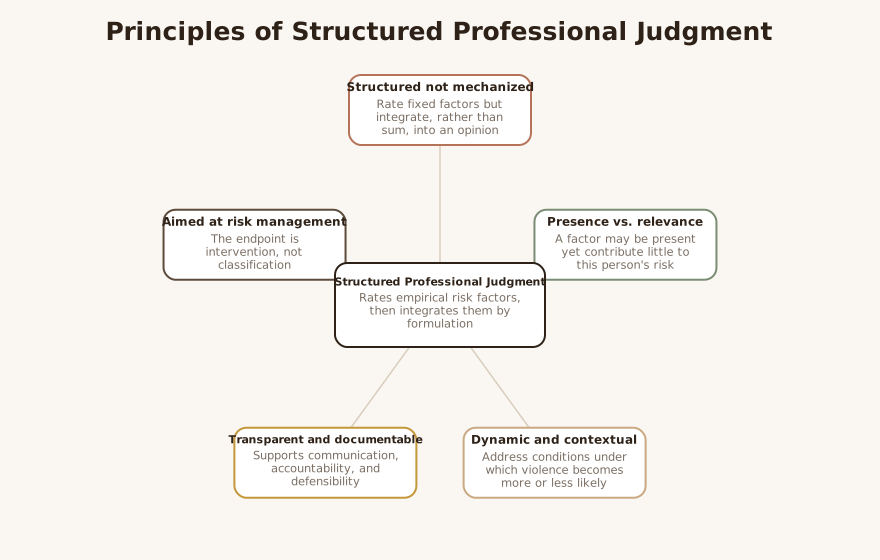
Structured Professional Judgment (SPJ) is the dominant contemporary framework for assessing risk of violence and harm in forensic and clinical settings, sitting deliberately between unstructured clinical opinion and fixed actuarial formulas. 4 Rather than producing a numeric probability, SPJ structures how a clinician gathers information, weighs empirically supported risk factors, formulates an individualized account of risk, and builds a management plan. 6 For practicing therapists, its appeal is that it makes risk reasoning transparent, defensible, and oriented toward intervention rather than prediction alone. LLM
Type & Discipline
SPJ is a methodological framework, not a treatment modality, originating in forensic psychology and forensic psychiatry. 4 It is operationalized through families of structured guidelines, of which the HCR-20 (for general violence risk) is the most extensively researched. 4 The approach is explicitly positioned as an alternative to algorithmic, formula-driven actuarial instruments, using the same evidence base on risk factors but leaving the final integrative judgment with the trained evaluator. 6 Because it governs how risk is appraised, SPJ is applied across psychiatric, correctional, civil-commitment, and general mental-health contexts. 4
Creators & Lineage
The HCR-20, the prototypical SPJ instrument, is associated with the Canadian and international forensic group of Christopher Webster, Kevin Douglas, Stephen Hart, and Henrik Belfrage. LLM Hart in particular has articulated the conceptual rationale for the SPJ approach to violence risk as a distinct paradigm. 1 The lineage runs from first-generation unstructured clinical judgment, through second-generation actuarial tools, to SPJ as a “third-generation” synthesis that retains empirical grounding while restoring clinical formulation and case management. LLM Sibling instruments extended the model to adolescents (the SAVRY) and to short-term inpatient risk and treatability (the START), reflecting a deliberate strategy of population- and context-specific guidelines built on a common method. LLM The same logic has since been adapted to suicide and self-directed violence. 5
Core Principles
The defining principle is that decisions should be structured but not mechanized: a fixed set of empirically supported risk factors is rated, yet the evaluator integrates them into a final opinion rather than summing them into a score. 6 A second principle is the separation of presence from relevance — a risk factor may be present but contribute little to a given individual’s risk, so the clinician judges how each factor actually bore on past violence and how it might in the future. 6 Third, risk is treated as dynamic and contextual, so assessment must address conditions under which violence becomes more or less likely. 6 Fourth, the process is transparent and documentable, supporting communication, accountability, and defensibility. 4 Finally, the endpoint is risk management, not classification: the assessment exists to guide intervention. LLM
Interventions & Techniques
In practice, SPJ proceeds through staged steps. The clinician first gathers comprehensive information from primary sources, collateral interviews, and record review. 6 Risk factors are then rated using a multi-level response format that captures the evaluator’s certainty about each factor’s presence. 6 Next, relevance is assessed — whether each factor contributed to past violence, influenced violent decision-making, impaired non-violent problem-solving, or requires active management. 6 The HCR-20 organizes 20 items across three domains: history (H), clinical presentation (C), and risk-management problems (R). 6 In Version 3, these are split into roughly ten historical, five clinical, and five risk-management items, and the instrument was expanded to include sub-items, explicit case formulation, scenario planning, and case prioritization. LLM Formulation links the rated factors into a coherent narrative of why this person poses risk; scenario planning anticipates plausible future pathways to harm; and a management plan specifies monitoring, treatment, supervision, and victim-safety steps. LLM
LLM-generated illustrative example (not a guideline): In assessing a forensic inpatient considered for expanded ground privileges, the clinician notes a history of violence under intoxication and recent treatment non-adherence (presence), judges that substance use was central to prior assaults (relevance), and formulates a scenario in which discharge plus unmonitored access to alcohol re-creates the conditions for harm — leading to a management plan of supervised leave contingent on negative screens. LLM
Evidence Base
The evidence base for SPJ is mature: the approach has demonstrated reliability and validity for assessing violence risk, and the HCR-20 is the most thoroughly researched SPJ tool. 4 The honest summary of predictive validity is that SPJ instruments perform comparably to actuarial tools rather than clearly outperforming them; promotional accounts claim the HCR-20 performs “as well as any other instrument, perhaps even better,” but this should be read as a vendor-side claim rather than a settled verdict. 6 The deeper scholarly debate concerns the clinical-actuarial conflict — whether structured judgment sacrifices predictive accuracy for the sake of clinical utility, and how predictive validity should even be valued when the goal is management. 2 Hart’s conceptual work frames SPJ’s contribution as residing less in marginal prediction gains and more in formulation, communication, and the link to intervention. 1 Clinicians should therefore present SPJ outputs as structured, defensible judgments, not as precise probabilities. LLM
Populations & Indications
SPJ guidelines were developed primarily for forensic and justice-involved adults and for psychiatric patients whose risk bears on placement, privileges, or discharge. 4 The canonical demonstration case is a psychiatric patient being considered for increased hospital privileges and community discharge — a decision context where structured, documentable reasoning is essential. 4 Dedicated instruments extend the method to adolescents (SAVRY) and to short-term inpatient risk and treatability (START). LLM Beyond forensic settings, the SPJ logic has been applied to suicide and self-directed violence, making it relevant to general mental-health clinicians who must assess and document suicide risk. 5 Indications include any situation requiring a defensible, intervention-oriented appraisal of violence or harm risk. LLM
Problems-for-Work
The framework most directly addresses risk of violence toward others, where the HCR-20 structures appraisal of historical, clinical, and management factors and yields a scenario-based plan for supervision and treatment. 6 It addresses risk of self-directed violence and suicide, where SPJ replaces checklist scoring with a formulation of why and under what circumstances a particular client is at risk, directly informing safety planning. 5 It supports risk-management and supervision planning, because the assessment culminates in concrete recommendations for monitoring and intervention rather than a static label. LLM
LLM-generated illustrative example (not a guideline): For a client with recurrent suicidal crises, the clinician uses SPJ logic to identify that risk consistently escalates around relationship ruptures and access to a specific means, then formulates a personalized risk narrative and builds a means-restriction and crisis-contact plan keyed to those triggers. LLM
Contraindications, Cautions & Cultural Humility
SPJ should not be presented as a precise actuarial probability, and clinicians must resist the temptation to convert a structured judgment into a falsely exact number. 2 Outputs depend heavily on evaluator training and the quality of collateral information; thin records or untrained raters degrade both reliability and defensibility. 6 The risk-factor base derives substantially from forensic and predominantly Western samples, so clinicians must apply cultural humility when extrapolating to populations underrepresented in the validation literature. LLM Structural factors — discrimination, poverty, prior justice-system contact — can load historical items in ways that risk pathologizing marginalization rather than the individual, and formulation should account for this. LLM Finally, SPJ informs but does not replace clinical and ethical decision-making about liberty, hospitalization, and coercive intervention. LLM
Treatment-Plan Suggestions & SMART Objectives
| Goal | SMART objective (example) | Mechanism |
|---|---|---|
| Complete a structured risk appraisal | Within 2 sessions, gather collateral and rate all HCR-20 history, clinical, and risk-management items with documented certainty | Structured information-gathering and multi-level rating 6 |
| Distinguish presence from relevance | By session 3, identify which present risk factors actually drove prior harm for this client | Relevance judgment links factors to behavior 6 |
| Develop an individualized risk formulation | Within 30 days, produce a written narrative explaining why and under what conditions risk arises | Formulation integrates rated factors into a causal account LLM |
| Build scenario-based plans | By session 4, articulate at least two plausible future pathways to harm and triggers for each | Scenario planning anticipates dynamic risk LLM |
| Specify a risk-management plan | Within 30 days, document monitoring, treatment, and safety steps tied to each priority factor | Management plan operationalizes the assessment LLM |
| Address self-directed-violence risk | Over 4 weeks, co-create a means-restriction and crisis-response plan keyed to the client’s identified triggers | Suicide-risk SPJ formulation informs safety planning 5 |
| Reassess on a defined cadence | Reassess dynamic clinical items at each level-of-care change or every 90 days | Dynamic factors require structured re-rating LLM |
Common Misconceptions
A frequent misconception is that SPJ produces a probability or a risk “score”; in fact it deliberately leaves final integration to clinical judgment and yields a categorical, formulation-based opinion. 6 Another is that SPJ is merely unstructured clinical opinion in disguise — but its fixed factor sets, multi-level ratings, and documented relevance judgments are explicitly structured. 6 Some clinicians assume SPJ is proven superior to actuarial tools; the more defensible position is comparable prediction with added value in formulation and management. 2 Finally, SPJ is sometimes treated as a one-time event, when its dynamic items are designed for repeated reassessment as circumstances change. LLM
Training & Certification
Competent SPJ use requires instrument-specific training, because reliability depends on standardized administration and the disciplined separation of presence from relevance. 6 Training is typically delivered by the instruments’ authors and authorized trainers and is paired with detailed published manuals for the HCR-20 and its siblings. LLM Clinicians should pursue formal training in the specific guideline relevant to their population — for example, the HCR-20 for general violence, the SAVRY for adolescents, or the START for short-term inpatient risk. LLM Forensic practitioners often supplement instrument training with broader supervised forensic-assessment experience to support court-defensible work. LLM
Key Terms
Structured Professional Judgment (SPJ): a risk-assessment method combining empirically supported factor guidelines with integrative clinical judgment and a management plan. 4 Actuarial assessment: the contrasting approach that derives a risk estimate from a fixed statistical formula. 6 HCR-20: the prototypical SPJ instrument for general violence risk, with Historical, Clinical, and Risk-management domains. 6 Relevance: the judgment of how much a present risk factor actually contributes to a given individual’s risk. 6 Formulation: the explanatory narrative linking rated factors into an account of why risk exists. LLM Scenario planning: the anticipation of plausible future pathways to harm to guide management. LLM
Resources & Further Reading
▶ Watch — a video introduction to this concept:
- The Structured Professional Judgement Approach to Violence Risk Assessment (Hart)
- Valuing Structured Professional Judgment: Predictive Validity, Decision-making, and the Clinical-Actuarial Conflict (Falzer)
- About the HCR-20 Version 3 (official HCR-20 site)
- Assessing Risk of Violence Using Structured Professional Judgment Guidelines (OJP / NCJRS)
- Suicide risk: structured professional judgement (Advances in Psychiatric Treatment)
- General Violence Risk: A Structured Professional Judgment Approach, HCR-20 V3 (Palo Alto University)
Reflective / Supervision Questions
- How confident am I that I have distinguished the mere presence of a risk factor from its actual relevance to this client’s behavior? LLM
- When I communicate my risk opinion, am I framing it as a structured judgment rather than a false precision the data cannot support? LLM
- Does my formulation explain why this individual poses risk, or have I merely listed factors? LLM
- Have I built a management plan that someone else could act on, or does the assessment end at classification? LLM
- Where might the validation evidence under-represent this client’s culture or circumstances, and how should that temper my conclusions? LLM
- At what points and on what cadence will I reassess the dynamic factors as this case evolves? LLM