
Type & Discipline
Miller’s Pyramid is a conceptual framework in health professions education, not a treatment modality or a therapeutic technique 1. Its domain is assessment: it answers the question of how to judge whether a learner is clinically competent, and which method of judgment is appropriate at which stage of development 1. George E. Miller introduced it in a 1990 paper in Academic Medicine that argued written testing of medical-science knowledge, however strong, does not by itself predict good patient care 1.
For practicing therapists the framework matters because it sits underneath nearly every training, supervision, and credentialing structure you have moved through or now administer LLM. Graduate practica, licensure examinations, role-play competency checks, live or recorded session review, and outcome monitoring each correspond to a different level of the pyramid, and the framework makes those relationships explicit LLM. It is a tool for thinking clearly about what a given assessment can and cannot tell you 1.
The discipline of origin is medicine, but the model has been adopted broadly across nursing, allied health, and the psychotherapies because the underlying problem — knowledge that does not reliably convert into skilled action — is shared across all clinical fields LLM.
Creators & Lineage
George E. Miller, a physician and a foundational figure in medical education, authored the 1990 paper that gave the framework its name and its four-level structure 1. The model is often dated to that single publication because Miller compressed the argument into one memorable image: a pyramid rising from knowledge at the base to action at the apex 1.
The framework did not remain static. A substantial line of work on work-based assessment, associated with Cees van der Vleuten, Val Wass, and colleagues, extended Miller’s apex — the “does” level — into a practical research program on how to assess what clinicians actually do in routine practice rather than under test conditions 2. This literature is where many of the now-standard cautions about the competence-performance gap originate 2.
Later authors proposed extensions to the pyramid itself. Cruess and colleagues (2016) added a fifth level, “is,” to foreground professional identity formation as the pinnacle of clinical development 4. Ten Cate and colleagues (2021) proposed an alternative fifth level, “trusted,” to align the model with entrustment-based decision-making 4. A separate critique from the clinical-reasoning literature argued that the pyramid’s upper tiers were designed to assess observable behavior and are therefore mismatched to the assessment of covert cognitive processes such as diagnostic reasoning 3.
Core Principles
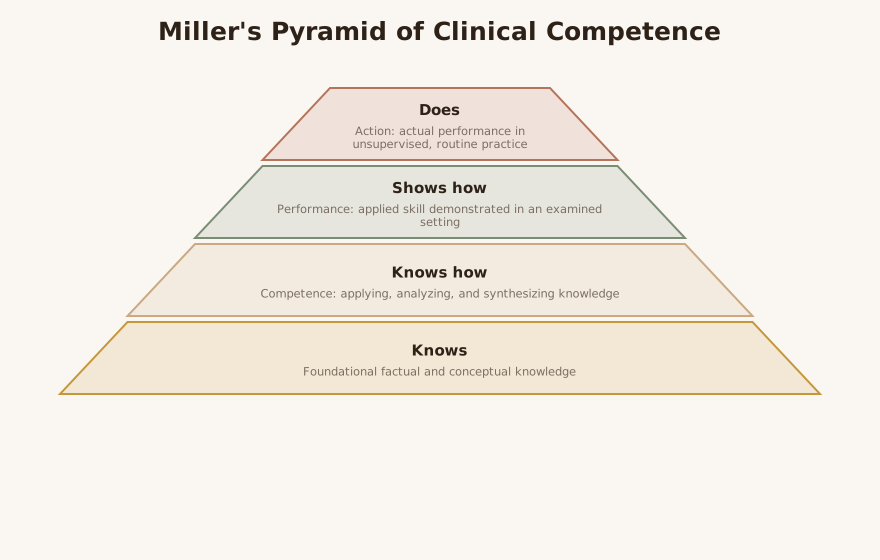
The central principle is a hierarchy of four ascending levels, each describing a deeper kind of competence than the one below it 1. The base is knows — the foundational factual and conceptual knowledge a clinician possesses 14. Above it sits knows how — competence, the ability to apply, analyze, and synthesize that knowledge rather than merely recall it 14.
The third level is shows how — performance, the demonstration of applied skill in a clinical scenario, typically a simulated or examined setting 14. The apex is does — action, the clinician’s actual performance in unsupervised, routine practice 14.
A second, equally important principle is that each level demands a different assessment method, and a method built for one level cannot validly substitute for another 1. A written examination can probe what a learner knows but cannot show whether they perform skillfully with a real client 1. Demonstrating skill under examination conditions does not guarantee that the same skill appears in the messy reality of daily practice 2.
The deepest and most debated principle is the assumption linking the levels: that what a clinician does in real practice is better reflected by observing real practice than by observing test performance 2. The work-based assessment literature treats this assumption as plausible and motivating but explicitly notes it remains unproved 2.
Interventions & Techniques
Although the pyramid is a framework rather than an intervention, it directly prescribes a toolkit of assessment techniques mapped to its levels LLM. At the knows level, objective written tests — multiple-choice questions and similar formats — are the standard instruments 24.
At the knows how level, assessment moves toward applied reasoning: structured problem-solving, case-based questions, and simulation tasks that require the learner to analyze data and synthesize a plan rather than recite facts 24.
At the shows how level, performance is examined through Objective Structured Clinical Examinations (OSCEs) and simulation-based assessment, in which the learner demonstrates skills against standardized stations or simulated patients 24. Healthcare simulation is explicitly positioned at this “shows how” tier, because it elicits observable performance in a controlled, repeatable environment 5.
At the does level, the appropriate tools are work-based assessments that gather information about performance in normal practice 2. These include outcomes measures, process measures, and review of clinical records, each of which the literature pairs with a specific limitation: outcomes are confounded because care is delivered within teams and systems, process adherence does not guarantee good outcomes, and records reflect only what was documented rather than what was done 2. Portfolios are usable at this level but require standardization, or there is no legitimate basis for comparison between clinicians 2.
One technique deserves special mention for therapists. Because observable performance at “shows how” captures only the distal outcome of reasoning and not the reasoning itself, the clinical-reasoning literature recommends pairing real or simulated practice with think-aloud protocols, in which the learner verbalizes their reasoning so it becomes assessable 3.
Evidence Base
The maturity of this framework is established: it is one of the most widely adopted organizing models in health professions education, and its four-level structure is treated as canonical across disciplines 14. Its influence is conceptual and structural rather than the product of a randomized evidence base, and it should be evaluated as a framework, not as a treatment with effect sizes LLM.
The framework’s enduring contribution is that it shifted assessment thinking away from knowledge-only testing toward performance- and action-based assessment, and this reframing is broadly accepted 3. Where the evidence is genuinely contested is at the upper tiers. The foundational assumption that assessing real practice better reflects routine performance than test-condition assessment is described in the work-based assessment literature as motivating but unproven 2.
There is also empirical tension at the boundary between behavior and cognition. Research cited in the clinical-reasoning critique reports that OSCE performance scores do not correlate with diagnostic reasoning ability, which the authors read as evidence that observation-based assessment cannot validly stand in for the assessment of reasoning processes 3. This is an honest limit: the pyramid tells you which method fits which level, but it does not by itself solve the problem of measuring the invisible cognitive work that underlies skilled performance 3.
Populations & Indications
The framework applies to any learner population progressing toward independent clinical competence LLM. In behavioral health this spans pre-licensure graduate trainees, therapy interns and practicum students, postgraduate residents and fellows in adjacent disciplines, supervisees within formal clinical supervision, and practicing clinicians undergoing continuing-competence or credentialing review LLM.
It is indicated whenever a program or supervisor must decide how to assess a competence and wants to ensure the method matches the claim being made about the learner 1. It is particularly useful when a training program suspects that its assessments cluster at the lower levels — testing what trainees know far more rigorously than whether they can do the work with real clients LLM.
LLM-generated illustrative example (not a guideline): A clinical training director notices that her interns pass every written exam on trauma-informed care yet freeze when a client dissociates in session. Mapping her assessments onto the pyramid, she sees that every measure sits at “knows” or “knows how,” with nothing at “shows how” or “does.” She adds a recorded-session review and a standardized role-play to capture the higher tiers LLM.
Problems-for-Work
The pyramid names and clarifies several recurrent training and supervision problems LLM.
Knowledge that fails to transfer to practice. When a supervisee can articulate a model flawlessly but cannot enact it, the pyramid locates the failure precisely: competence exists at “knows” and “knows how” but breaks down at “shows how” or “does,” directing the supervisor to performance-level work rather than more didactics 1LLM.
The competence-performance gap. A trainee who performs well in a structured role-play but reverts to old habits in routine sessions is exhibiting the gap between “shows how” and “does,” which the work-based assessment literature treats as a real and partially unmeasured phenomenon 2.
Method-to-level mismatch. A program that certifies readiness for independent practice on the basis of written tests alone has made a category error, judging a “does” claim with a “knows” instrument 1LLM.
Covert reasoning that resists observation. When a clinician reaches sound formulations but the supervisor cannot see how, the problem is the invisibility of reasoning, addressable through think-aloud methods layered onto observed practice 3.
Contraindications, Cautions & Cultural Humility
The framework carries no clinical contraindications because it is not administered to clients; the cautions are about misuse in assessment LLM. The first caution is treating the pyramid as a complete map of competence. The clinical-reasoning critique is explicit that the upper tiers were built to assess observable behavior, not cognition, so using OSCE-style observation as a proxy for reasoning quality is a misapplication 3.
A second caution concerns the apex. Because outcomes in real practice are produced by teams and systems rather than by the individual clinician alone, “does”-level outcome measures can unfairly attribute system failures to the practitioner 2. Process and records-based measures carry their own distortions and should not be read as transparent windows onto actual practice 2.
Cultural humility enters at every level LLM. What counts as competent performance at “shows how” and “does” is shaped by the cultural norms embedded in the assessment, the standardized scenarios, and the evaluator’s expectations, which can disadvantage trainees whose communication styles or clinical frameworks differ from the dominant norm LLM. Standardized portfolios and rubrics improve comparability but can also encode a narrow definition of good practice, so programs should examine whose practice their “competent” benchmark actually describes 2LLM. The extension of the pyramid toward professional identity (“is”) underscores that becoming a clinician is an identity-laden, culturally situated process, not merely the accumulation of demonstrable skills 4LLM.
Treatment-Plan Suggestions & SMART Objectives
The pyramid is an educational framework; the “plan” here is a supervision or training plan rather than a client treatment plan LLM. The objectives below illustrate how a supervisor might structure a supervisee’s development across the four levels LLM.
| Goal | SMART objective (example) | Mechanism |
|---|---|---|
| Build foundational knowledge (“knows”) | Within 4 weeks, supervisee correctly answers 90% of a written quiz on the target model’s core constructs | Objective written testing at the knowledge base of the pyramid 12 |
| Develop applied reasoning (“knows how”) | Within 6 weeks, supervisee produces a written case formulation that analyzes and synthesizes intake data for 3 of 3 assigned cases | Case-based applied-knowledge assessment at the “knows how” tier 24 |
| Demonstrate skill under controlled conditions (“shows how”) | Within 8 weeks, supervisee passes a standardized role-play / simulation station meeting all rubric criteria | OSCE-style simulation-based performance assessment 25 |
| Make reasoning visible | Within 8 weeks, supervisee completes 2 think-aloud walkthroughs of recorded sessions, verbalizing in-the-moment reasoning | Think-aloud protocol layered onto observed practice 3 |
| Transfer skill to routine practice (“does”) | Over 12 weeks, supervisee meets fidelity criteria in 4 of 5 directly observed live or recorded real sessions | Work-based assessment of performance in normal practice 2 |
| Calibrate self-assessment to observed performance | Within 10 weeks, supervisee’s self-rating falls within one rubric point of supervisor’s rating on 3 consecutive reviews | Direct observation reducing reliance on self-report 2LLM |
| Support emerging professional identity (“is”) | Across the placement, supervisee articulates an evolving professional identity statement in 3 reflective supervision sessions | Reflective supervision aligned with the “is” extension 4 |
Common Misconceptions
A frequent misconception is that the pyramid is a developmental theory of how clinicians learn, like a stage model of skill acquisition. It is primarily a framework for matching assessment methods to competence levels, not a mechanism of learning 1LLM.
A second misconception is that reaching “does” means a clinician has been validly shown to perform well in practice. The work-based assessment literature is careful here: assessing the “does” level is difficult, the assumption that real-practice assessment best reflects routine performance is unproven, and outcome measures at this level are confounded by team and system factors 2.
A third misconception is that higher always means better and that lower levels are disposable. The levels describe different things to assess, not a ranking in which knowledge ceases to matter; a deficit at any level is a real deficit 1LLM.
A fourth misconception, common when programs adopt OSCEs, is that observed performance demonstrates good clinical reasoning. Observed behavior captures the outcome of reasoning, not the reasoning itself, and OSCE scores have been found not to correlate with diagnostic reasoning ability 3.
Training & Certification
There is no certification in Miller’s Pyramid; it is a literacy that clinical educators, supervisors, and program designers acquire through faculty development rather than a credential one holds LLM. Familiarity with it is typically built through medical-education and health-professions-education training, supervisor training, and the assessment literature in which it is embedded 12.
Clinicians most likely to use it deliberately are training directors, supervisors, OSCE and simulation designers, and credentialing committees, who apply it to audit whether their assessment portfolio covers all four levels rather than clustering at the base 15. For an individual therapist, the practical “training” is learning to ask, for any assessment they administer or undergo, which level it actually measures and whether that matches the claim being made LLM.
Key Terms
Knows — the base level; foundational knowledge, assessed by written tests 14.
Knows how — competence; the ability to apply, analyze, and synthesize knowledge 14.
Shows how — performance; demonstrated skill in an examined or simulated clinical scenario, assessed by OSCE and simulation 15.
Does — action; actual performance in routine, unsupervised practice, assessed by work-based methods 12.
Work-based assessment — methods that gather information about performance in normal practice, including outcomes, process measures, and records 2.
Competence-performance gap — the difference between what a clinician can demonstrate under test conditions and what they routinely do in practice 2.
Think-aloud protocol — a method of making covert reasoning explicit and assessable by having the learner verbalize their reasoning during practice 3.
“Is” / “trusted” — proposed fifth levels extending the pyramid toward professional identity (Cruess et al., 2016) and entrustment (ten Cate et al., 2021) 4.
Resources & Further Reading
▶ Watch — a video introduction to this concept:
- Miller GE (1990), “The assessment of clinical skills/competence/performance,” Academic Medicine, 65(9 Suppl):S63-S67
- Wass, Van der Vleuten, Shatzer & Jones — Assessment of clinical competence / Work based assessment (PMC)
- Revisiting Miller’s pyramid in medical education: the gap between traditional assessment and diagnostic reasoning (IJME)
- Miller’s Pyramid of Skill Development — MedEdMentor
- Application of Miller’s Pyramid in Healthcare Simulation — HealthySimulation.com
Reflective / Supervision Questions
- For each assessment you currently administer to supervisees, which level of the pyramid does it actually measure, and does that match the competence claim you make on the basis of it? 1LLM
- Where in your training program do assessments cluster — and is the “does” level represented by anything other than self-report? 2LLM
- When a supervisee performs well in role-play but struggles in live sessions, how do you currently distinguish a “shows how” success from a “does” failure, and what would close that gap? 2LLM
- How do you make a supervisee’s clinical reasoning visible, given that observation alone captures only the outcome of that reasoning? 3LLM
- Whose definition of “competent performance” is embedded in your rubrics and standardized scenarios, and could it disadvantage trainees with different communication styles or frameworks? 2LLM
- If you adopted the “is” extension, how would you assess the formation of professional identity without reducing it to a checklist? 4LLM