
Type & Discipline
Immune neglect is a construct from social psychology, specifically the literature on affective forecasting — the prediction of one’s own future emotional states 4. It is not a therapy, a technique, or a diagnosis; it is a cognitive bias that describes a predictable error people make when they imagine how they will feel after an event 1. The term was introduced by Gilbert, Pinel, Wilson, Blumberg, and Wheatley in 1998 and names one specific mechanism behind a broader phenomenon called the durability bias: the tendency to overestimate how long an emotional reaction will last 12.
For clinicians, the value of immune neglect is conceptual rather than procedural. It supplies an evidence-anchored explanation for something we see daily in the room: clients who are confident that a feared outcome, a loss, or a decision will devastate them for far longer and far more intensely than it actually does LLM. It sits within the cognitive-behavioral and positive-psychology traditions as a target for cognitive work, but it originates as a basic-science finding about human judgment, not as a clinical intervention 4LLM.
Creators & Lineage
The construct comes directly from Daniel Gilbert and Timothy Wilson, who coined the term “affective forecasting” in the early 1990s, building on earlier work by Kahneman and Snell 4. The seminal paper, “Immune Neglect: A Source of Durability Bias in Affective Forecasting,” was authored by Gilbert, Elizabeth Pinel, Wilson, Stephen Blumberg, and Tom Wheatley and published in the Journal of Personality and Social Psychology in 1998 12. That paper coined the umbrella phrase “psychological immune system” to describe the set of cognitive mechanisms that ameliorate the experience of negative affect 2.
The lineage runs through affective forecasting as the parent field, with impact bias and durability bias as sibling constructs — impact bias being the tendency to overestimate the intensity of future emotion, and durability bias the tendency to overestimate its duration 45. Immune neglect is positioned as one cause of durability bias, alongside focalism, the tendency to fixate too narrowly on a single event while neglecting everything else that will fill one’s life 5. The construct was later extended empirically by Michael Hoerger, who supplied the first direct evidence linking specific coping strategies to immune neglect 3. In therapeutic terms, the construct’s natural relatives are cognitive-behavioral therapy and positive psychology, both of which treat distorted predictions about the future as workable material LLM.
Core Principles
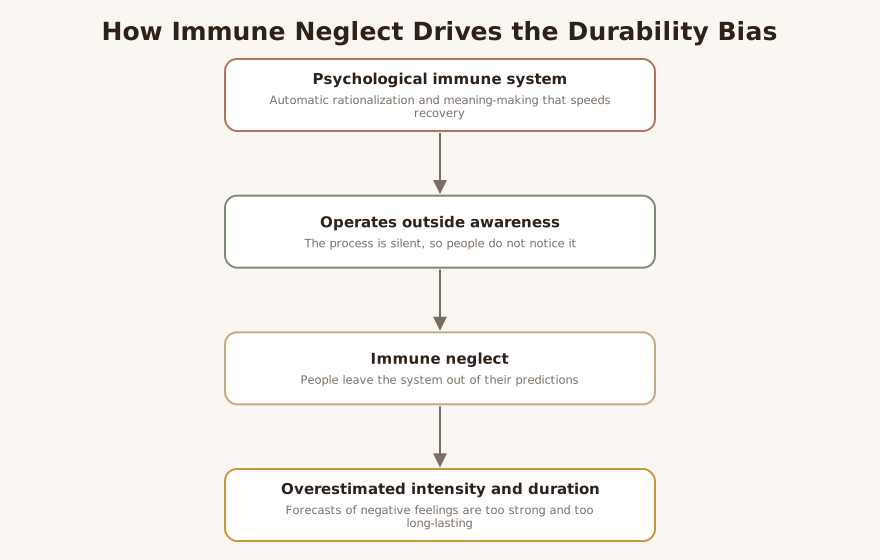
The central claim is that people possess a “psychological immune system” — a metaphor for the system of defenses that helps a person feel better when bad things happen 4. This system works largely outside conscious awareness, through sense-making, rationalization, and meaning-making that render a difficult circumstance more explicable and therefore more bearable 45. Because the process is automatic and silent, people do not factor it into their predictions, and so they neglect it — hence “immune neglect” 1.
A second principle is that this neglect produces a directional error. When people predict their reactions to negative events — romantic breakups, career failures, rejection — they forecast emotions that are too intense and too long-lasting relative to what they actually experience 2. A useful nuance from the field is that the error is mostly about intensity and duration, not direction: people are fairly accurate at predicting whether they will feel good or bad, but they systematically misjudge how strongly and how long 5.
A third principle concerns the boundary conditions. The psychological immune system speeds what is sometimes called hedonic adaptation, the return toward baseline mood after a change 5. But adaptation is faster and recovery more complete than people anticipate, which is precisely why the forecasting error appears 5. The system is engaged more readily by events for which a person can construct an explanation, which has the counterintuitive implication that some moderate negatives may resolve faster than minor irritations that never trigger sense-making LLM.
Interventions & Techniques
Immune neglect is a construct, not an intervention, so it does not come with a manual; clinical use means importing it into established frameworks as a target for cognitive and behavioral work LLM. The most direct translation is psychoeducation: naming the psychological immune system and the well-documented human tendency to forget it helps clients hold their catastrophic predictions more lightly 4LLM. Within cognitive-behavioral therapy, this maps cleanly onto examining the evidence for a feared prediction and generating alternative outcomes LLM.
A second technique is structured forecasting calibration. Clinicians can ask a client to record a prediction — how bad, on a 0-100 scale, and for how long — before a feared event, then revisit the actual reaction afterward LLM. This mirrors the prospective designs used in the original research and exploits the finding that people remember the role of coping more accurately than they forecast it; the comparison makes the gap concrete and personally owned 3. Hoerger’s data showed coping strategies correlated strongly with actual emotional reactions but barely at all with predicted reactions, so surfacing a client’s real coping repertoire is itself corrective 3.
A third technique is “de-focalizing” — deliberately widening attention from the single feared event to the rest of life that will continue around it, which counteracts the focalism that feeds durability bias 5LLM. A caution attaches here: at least one randomized study found that prompting a particular emotion-regulation strategy did not reliably reduce forecasting errors, so clinicians should treat technique selection as empirical rather than assured 6.
LLM-generated illustrative example (not a guideline): A client paralyzed about leaving a stable but draining job predicts she will feel “destroyed and lost for at least a year.” The clinician invites a numbered forecast, then a list of how she has actually coped with past losses — reaching out to friends, reframing, throwing herself into projects. The list surprises her; she has never counted it as part of the prediction LLM.
Evidence Base
The evidentiary maturity here is best described as established for the origin phenomenon and mixed for translation 16. The foundational 1998 paper reported six studies across naturalistic and laboratory settings, examining reactions to breakups, career failures, and rejection, and consistently found durability bias attributable to immune neglect 2. This work is widely cited and reproduced and anchors the affective-forecasting literature as a robust body of findings 5.
Direct evidence for the coping mechanism arrived with Hoerger’s 2012 study of 325 young adults’ Valentine’s Day reactions 3. Using a prospective design — predict, then report, then recall — he found that coping strategies (social problem solving, behavioral activation, and the absence of negative rumination and isolative withdrawal) correlated with actual emotional reactions but not with predicted ones, the signature pattern of immune neglect 37. Notably, the bias was stronger for immediate reactions than for enduring ones and disappeared when participants recalled emotions days later, suggesting people learn from experience even though they fail to forecast it 3.
The applied literature is appropriately cautious. A research synthesis notes that effects vary by event importance, by individual differences in coping, age, culture, and anxiety, and by measurement scale, and that broad contextual thinking can even reverse typical biases — so the construct is robust but bounded 5. A 2026 randomized controlled trial of 173 participants found that cognitive reappraisal and suppression instructions produced similar forecasting errors to no strategy at all, directly challenging the assumption that engaging emotion regulation makes people aware of their immune system 6. The honest summary: the phenomenon is solid; the clinical levers for correcting it are still being characterized 56.
Populations & Indications
The construct is most clinically relevant to adults facing major life transitions, where forecasts about a divorce, relocation, job change, or retirement drive avoidance or premature decisions 4LLM. People with anticipatory anxiety are a natural fit, because the bias inflates exactly the dimension — how bad and how long — that anxiety amplifies 4LLM. People prone to worry and those meeting criteria for generalized anxiety disorder may find their dreaded forecasts directly contradicted by the immune-neglect literature LLM.
People facing illness or loss are a population the field itself highlights: patients reliably underestimate how well they will adapt to disability and changed circumstances 4. Grieving adults likewise often predict an unrecoverable future state that the psychological immune system, given time, partially revises 4LLM. Finally, people experiencing decision paralysis — stuck because every option seems to carry intolerable future regret — are candidates, since the construct suggests their imagined post-decision misery is systematically overstated LLM.
Problems-for-Work
Anticipatory anxiety and fear of future events are the cleanest applications: the clinician can name that the client’s mind is forecasting an emotional storm without crediting the recovery machinery that will quietly run underneath it 4LLM. Catastrophizing is addressed similarly, by treating the catastrophic forecast as a testable prediction about intensity and duration rather than a fact 5LLM.
Affective forecasting errors are the problem-for-work in the most literal sense, and the prediction-then-check technique targets them directly 3LLM. For decision paralysis, the construct reframes the stuck point: the client is not choosing between a happy future and a ruined one but between two futures both subject to faster-than-expected adaptation 5LLM. For avoidance, immune neglect explains why the avoided situation looms larger in prospect than it proves in fact, supporting graded exposure LLM. For grief and generalized worry, the construct supports gentle, non-dismissive psychoeducation that recovery tends to outpace prediction without minimizing present pain 4LLM.
Contraindications, Cautions & Cultural Humility
The gravest misuse is invalidation. Telling a person in acute grief or trauma that “you’ll adapt faster than you think” can land as dismissal, and the construct is descriptive of an average tendency, not a promise to any individual 4LLM. Immune neglect should never be deployed to rush a client past necessary mourning or to imply that genuine adversity does not warrant distress LLM.
The evidence itself counsels caution: forecasting accuracy and the relevant coping strategies vary by individual differences, including culture, age, and anxiety level, so the construct cannot be applied uniformly 5. Meaning-making, the engine of the psychological immune system, is culturally shaped, and what constitutes adaptive sense-making in one cultural frame may not transfer to another, which demands genuine cultural humility rather than a universal script 5LLM. Additionally, the 2026 trial reminds us that intuitively appealing techniques to “activate” the immune system may simply not work, so a clinician should not promise correction they cannot deliver 6. Finally, some events are genuinely durable in their impact, and the bias literature concerns prediction errors, not a claim that all suffering is transient 5LLM.
Treatment-Plan Suggestions & SMART Objectives
| Goal | SMART objective (example) | Mechanism |
|---|---|---|
| Reduce anticipatory dread before a feared event | Client will record a 0-100 intensity-and-duration forecast before 3 upcoming feared events and compare each to the actual outcome within 1 week, over 6 weeks | Surfacing the forecast-vs-reality gap exposes neglected recovery and recalibrates predictions 3 |
| Build awareness of personal coping repertoire | Client will generate a written list of 5 coping strategies that have worked in past adversities by session 3 | Coping strategies predict actual reactions but are absent from forecasts; naming them is corrective 37 |
| Decrease decision paralysis | Client will make and act on 2 previously avoided decisions within 4 weeks after de-focalizing each anticipated outcome | Widening attention from the focal event counters focalism-driven durability bias 5 |
| Reduce catastrophic predictions | Client will reframe 1 catastrophic forecast per session into a testable intensity/duration prediction across 8 sessions | Treating forecasts as hypotheses enables disconfirmation of overestimated duration 5 |
| Support adaptive grief processing | Client will articulate one emerging meaning or area of continuity each session over 6 weeks without minimizing present pain | Sense-making engages the psychological immune system that speeds hedonic adaptation 45 |
| Reduce avoidance of feared situations | Client will complete 1 graded exposure weekly and rate predicted vs. actual distress for 6 weeks | Predicted distress reliably exceeds experienced distress, supporting approach behavior 1LLM |
| Increase tolerance of uncertainty about the future | Client will practice a “this too will be metabolized” reframe at the onset of worry, logging 4 instances weekly | Recognizing automatic recovery loosens the grip of duration-focused worry 4LLM |
Common Misconceptions
A frequent misconception is that immune neglect means people are bad at predicting whether an event will feel good or bad. They are not; the error is concentrated in intensity and duration, not valence 5. A second is that the psychological immune system is a conscious coping plan a person can simply choose to remember — in fact, much of it runs automatically and outside awareness, which is exactly why it gets neglected in forecasts 4.
A third misconception is that teaching emotion regulation will straightforwardly fix the forecasting error; a randomized trial found instructed reappraisal and suppression did not reduce errors relative to no strategy 6. A fourth is that the bias is permanent and unlearnable; Hoerger’s data show people recall the role of coping accurately after the fact, so the deficit is specific to prediction, and experience corrects it 3. Finally, some clinicians assume the construct implies adversity does not matter — it does not; it concerns the calibration of forecasts, not the legitimacy of distress 5LLM.
Training & Certification
There is no certification in immune neglect; it is an academic construct rather than a credentialed modality 4LLM. Clinicians acquire competence by studying the primary affective-forecasting literature and by integrating the construct into frameworks they are already trained in, principally cognitive-behavioral therapy and positive psychology 1LLM. The foundational reading is the Gilbert et al. 1998 paper, supplemented by Hoerger’s coping-strategies study for the direct mechanistic evidence and by the more recent emotion-regulation trial for an honest view of translational limits 136. Practitioners already credentialed in cognitive-behavioral approaches can apply the construct within their existing scope of practice without additional formal training LLM.
Key Terms
- Immune neglect — failing to anticipate the influence of one’s own psychological immune system on future wellbeing 5.
- Psychological immune system — the system of cognitive mechanisms that ameliorate the experience of negative affect, largely automatically 24.
- Affective forecasting — the prediction of one’s future emotional states 4.
- Durability bias — overestimating how long an emotional reaction will persist 1.
- Impact bias — overestimating the intensity of a future emotional reaction 4.
- Focalism — concentrating too narrowly on a single event while neglecting other contextual factors, a co-cause of durability bias 5.
- Hedonic adaptation — the tendency to return toward an emotional baseline after a change, faster than people predict 5.
Resources & Further Reading
▶ Watch — a video introduction to this concept:
- Gilbert et al. (1998), Immune Neglect: A Source of Durability Bias in Affective Forecasting (full paper)
- Immune neglect: a source of durability bias in affective forecasting (PubMed record)
- Hoerger (2012), Coping strategies and immune neglect in affective forecasting (full text)
- Hoerger (2012), Coping strategies and immune neglect in affective forecasting (PubMed record)
- Patel & Urry (2026), Everything is going to be okay: emotion regulation and immune neglect (PubMed record)
- Affective forecasting (Wikipedia overview)
- Happier Lives Institute, Affective forecasting (research report)
Reflective / Supervision Questions
- When a client makes a catastrophic forecast, how do I distinguish validating their present distress from colluding with an overestimated prediction of its duration? LLM
- Where in my own practice do I rush clients toward “you’ll adapt” in ways that could read as dismissal, and how would I know? 4LLM
- Given that one randomized trial found emotion-regulation prompts did not reduce forecasting errors, how do I hold my favored techniques as hypotheses rather than certainties? 6
- How does a particular client’s cultural and personal context shape what counts as adaptive meaning-making, and am I imposing my own frame? 5LLM
- For a client in decision paralysis, how might surfacing their actual coping history change the choice they are stuck on? 3LLM