
Type & Discipline
Flashbulb memory is a construct within memory science, specifically the study of autobiographical and episodic memory 1. It is not a therapy, a modality, or an intervention — it is a descriptive label for a kind of memory, and understanding what it is (and is not) changes how a clinician should listen to a client’s vivid recollections LLM. The term names the vivid, detailed, and confidently held memory a person forms for the circumstances in which they learned about a surprising and highly consequential event 13. Classic examples include learning of the JFK assassination, the Challenger explosion, the death of Princess Diana, September 11th, and the COVID-19 pandemic declaration 45.
For therapists, the construct sits at the intersection of cognitive memory science and clinical practice: it explains why a client can be both completely sincere and partly inaccurate about a pivotal moment — a distinction that matters for trauma work, grief, eyewitness situations, and family conflict over “what really happened” LLM.
Creators & Lineage
The term was coined by Roger Brown and James Kulik in their 1977 Cognition paper, “Flashbulb memories” 1. They drew the metaphor from photography: a surprising, consequential event seems to trigger a mental snapshot, illuminating and freezing the surrounding scene “as if one had taken a photograph” 21. Brown and Kulik proposed a special biological encoding mechanism they called “Now Print!” — the idea that, above a critical threshold of surprise and consequentiality, the brain lays down a near-permanent, detailed record 23.
The lineage that followed is largely a story of refinement and refutation LLM. Ulric Neisser mounted the most influential early challenge: his study of memories for the 1986 Challenger disaster (later with Harsch) showed that participants who were highly confident years later were frequently inaccurate, with fewer than roughly a third retaining genuinely detailed, correct memories 53. Jennifer Talarico and David Rubin (Duke, 2003) tested 54 students the day after 9/11 and again at intervals, finding that flashbulb memories declined in accuracy at the same rate as everyday memories — but confidence in them stayed high 24. William Hirst, Elizabeth Phelps, and colleagues ran a decade-long, multi-site 9/11 consortium study, and Tali Sharot added neuroimaging evidence on the amygdala’s role 254. The cumulative result: the construct is real and well-replicated, but the original “special mechanism” claim has largely not survived 2.
Core Principles
Several principles are now well established LLM.
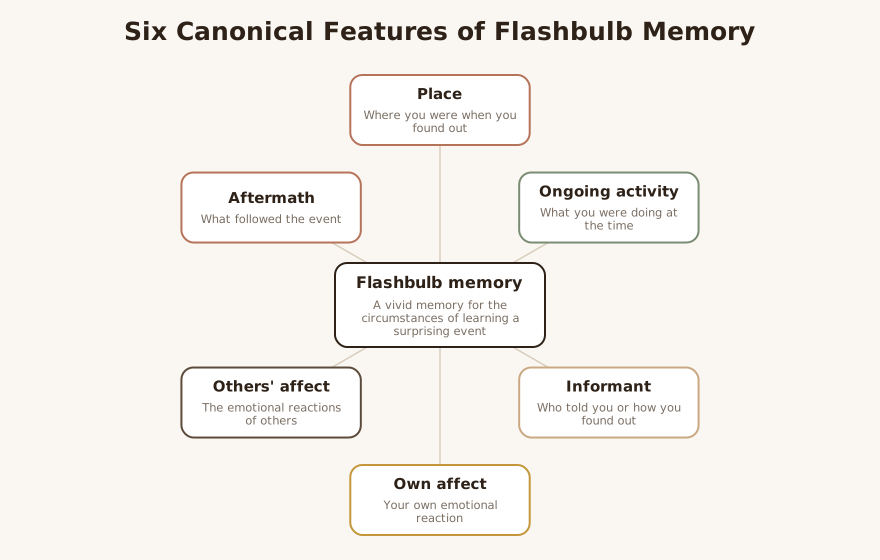
The six canonical features. Brown and Kulik described flashbulb memories as organized around six recurring elements: place (where you were), ongoing activity (what you were doing), informant (who told you or how you found out), own affect (your emotional reaction), others’ affect (others’ reactions), and aftermath (what followed) 153. Clinicians often hear these six elements spontaneously when a client narrates a pivotal moment LLM.
Subjective vividness, not objective accuracy. The defining clinical fact is the confidence–accuracy dissociation: people hold flashbulb memories with extraordinary confidence and phenomenological vividness even as their consistency declines over time, whereas confidence in ordinary memories declines alongside accuracy 25. They are “vivid without being reliably correct” 3.
Distortions get locked in early. Longitudinal work shows that once an inconsistency appears — usually within the first year — it tends to be repeated thereafter, becoming a stable feature of the narrative rather than a passing error 2. The memory does not keep degrading randomly; it crystallizes around its early distortions 2.
Formation factors. The most consistently cited determinants are surprise, consequentiality, emotional arousal, and rehearsal (repeated retelling and media exposure) 35. None appears strictly necessary on its own — surprise and distinctiveness have both been shown to be dispensable in some studies — but together they predict whether a flashbulb memory forms and how durable the feeling of vividness becomes 2.
Interventions & Techniques
Flashbulb memory is a construct, not a treatment, so it has no intervention protocol of its own LLM. Its clinical utility is as psychoeducation and a stance for listening that can be embedded within established modalities LLM. Practically, clinicians use the construct in several ways LLM:
- Normalizing memory variability. Explaining that vivid, confident memories are not necessarily complete or accurate can reduce a client’s distress about discrepancies — for example, when their account differs from a relative’s 23.
- Cognitive restructuring around overconfident appraisals. When a client treats a vivid memory as proof (“I remember it perfectly, so it must mean I’m to blame”), the confidence–accuracy dissociation provides a gentle evidence-based wedge for examining that appraisal, consistent with cognitive behavioral therapy methods 2LLM.
- Validating affect while loosening certainty about detail. The emotional truth of “this mattered enormously to me” can be fully honored even while the factual details are held more lightly 2LLM.
- Contextualizing rehearsal effects. Because retelling and media exposure shape the memory, clinicians can help clients notice how repeated rumination or doom-scrolling consolidates a particular (possibly distorted) version 35.
These are framing techniques, not a manualized treatment; the actual therapeutic work happens within a host modality such as cognitive behavioral therapy, narrative therapy, or grief-focused therapy LLM.
Evidence Base
The evidence base is established and mature, and it is worth being precise about what is established LLM. The phenomenon itself — that people form unusually vivid, confidently held memories for learning about consequential public events — is robustly replicated across decades, events, and cultures 25.
What is not supported is the strong original claim. Multiple converging lines of research — McCloskey, Wible, and Cohen (1988); Neisser and Harsch’s Challenger work; Talarico and Rubin (2003); and Hirst and colleagues’ decade-long 9/11 studies — indicate that ordinary memory processes are sufficient to explain flashbulb memories and that they are subject to the same forgetting and distortion as everyday memories 235. Talarico and Rubin’s conclusion is often quoted: flashbulb memories “are not special in their accuracy but only in their perceived accuracy” 5.
The neuroscience is suggestive but does not rescue the special-mechanism claim LLM. Sharot and colleagues’ fMRI study three years after 9/11 found selective amygdala activation during recall in a majority of participants who had been physically close to the World Trade Center, versus a minority of those farther away — implicating emotional-memory systems in the recollective experience, not in superior accuracy 45. Persistent amygdala engagement years later has been documented even in people without direct trauma exposure 2.
Honest bottom line for clinicians: high confidence and vividness are not evidence of accuracy, and errors can appear within weeks and then persist confidently for years 23.
Populations & Indications
Flashbulb memory as a clinical lens is relevant across a broad range of populations because nearly everyone forms such memories LLM. It is particularly useful with:
- Trauma-exposed clients and clients with PTSD, where a vivid “moment I found out” memory can become an anchor for intrusive recollection and overgeneralized appraisals 2LLM.
- Grief and bereavement clients, who frequently carry an intensely detailed memory of the moment they learned of a death 4LLM.
- Older adults recalling generational events, for whom these memories carry identity and meaning 2LLM.
- Clients in eyewitness or disclosure situations, where confidence in a vivid memory may outrun its reliability 3LLM.
The construct is “indicated” not as a treatment target but as a frame to deploy whenever a client’s certainty about a vivid memory is driving distress, conflict, or rigid appraisals LLM.
Problems-for-Work
LLM-generated illustrative example (not a guideline): A client who learned of a parent’s sudden death by phone insists she “should have known something was wrong that morning.” Her memory of the call is vivid and she treats that vividness as proof of a missed warning. Using the confidence–accuracy dissociation as psychoeducation within cognitive behavioral therapy, the clinician validates the emotional weight of the memory while gently testing the appraisal that vividness equals foreknowledge LLM.
Common problems-for-work where the construct applies LLM:
- Overconfidence in distorted memory driving self-blame or rigid conclusions 2.
- Memory-related rumination, where repeated retelling consolidates and entrenches a painful version 35.
- Intrusive recollection of the “moment I found out” in trauma and grief 2LLM.
LLM-generated illustrative example (not a guideline): Two adult siblings argue bitterly because each is certain of a different account of the night their family received devastating news. Psychoeducation that both memories can be sincerely held yet partly reconstructed helps de-escalate the “one of us is lying” frame 2LLM.
Contraindications, Cautions & Cultural Humility
There are no contraindications to a construct, but there are real cautions in how it is used LLM. The central caution: never use flashbulb-memory science to invalidate a client’s experience LLM. Telling a distressed trauma survivor that their memory is “probably wrong” is clinically harmful and misapplies the research, which concerns peripheral detail accuracy, not the reality of the event or the legitimacy of the emotion 2LLM. The emotional truth — “this was devastating and it changed me” — is not in question; only the certainty about specific reconstructed details is held more lightly 2.
Timing matters: introducing memory-fallibility psychoeducation during acute distress or active grief can feel dismissive, and is usually better reserved for a stabilized, collaborative phase LLM. In any forensic or disclosure context, clinicians should be especially careful, as the confidence–accuracy dissociation has serious implications for testimony 3LLM.
Cultural humility is essential. Flashbulb memories are shaped by community-level consequentiality: French citizens formed durable memories of President Mitterrand’s death while French-speaking Belgians did not, illustrating that which events “print” depends on cultural and group identity 2. Collective memory can also be reshaped by group attitudes — elderly Danes recalled the weather on WWII invasion versus liberation dates in line with national sentiment rather than meteorological fact 2. Clinicians should respect that a client’s flashbulb memory may be bound to communal and cultural meaning, not only personal experience 2LLM.
Treatment-Plan Suggestions & SMART Objectives
| Goal | SMART objective (example) | Mechanism |
|---|---|---|
| Reduce distress tied to a vivid memory | Within 6 sessions, client will report a 3-point reduction (0–10 SUDS) in distress when recalling the “moment I found out,” in 3 consecutive sessions | Affect regulation; decoupling vividness from threat appraisal 2 |
| Loosen overconfident self-blame appraisal | Within 8 weeks, client will generate and rate ≥2 alternative interpretations of the remembered event in 4 of 5 sessions | Cognitive restructuring of confidence-as-proof reasoning 23 |
| Decrease memory-focused rumination | Within 4 weeks, client will reduce daily retelling/checking of the memory from “most days” to “≤2 days/week” per self-monitoring log | Interrupting rehearsal-driven consolidation 35 |
| Increase tolerance of memory uncertainty | By session 10, client will verbalize acceptance that the memory can be both emotionally true and factually incomplete, on ≥3 occasions | Psychoeducation; cognitive flexibility 2 |
| De-escalate relational conflict over discrepant accounts | Within 5 sessions, client and partner will complete one structured conversation about differing memories without escalation | Externalizing the memory science from blame 2 |
| Support grief meaning-making | Over 8 sessions, client will integrate the “moment I learned” into a coherent narrative rated as “less stuck” on a 0–10 scale, improving by ≥3 points | Narrative integration of an emotionally salient memory 4 |
| Strengthen present-focused coping during intrusions | Within 6 weeks, client will apply a grounding skill within 2 minutes of an intrusive flashbulb recollection in ≥70% of logged instances | Attention reallocation away from rehearsal 23 |
Common Misconceptions
“If a memory is vivid and detailed, it must be accurate.” This is the single most consequential error; vividness and confidence are dissociated from accuracy, and flashbulb memories are as prone to distortion as ordinary ones 25.
“Flashbulb memories are permanent recordings.” The original “Now Print!” snapshot model has not held up; these memories decay and, importantly, lock in their early distortions 23.
“There is a special brain mechanism for these memories.” The weight of evidence favors ordinary memory processes; amygdala involvement explains the feeling of vivid recollection, not superior accuracy 24.
“Emotional intensity guarantees a strong, lasting memory.” Studies found no reliable correspondence between emotional state at encoding and later consistency for 9/11 memories 2.
“Flashbulb memory is the same thing as traumatic memory.” They overlap but are distinct; flashbulb memories concern learning about an event, often a public one, and high confidence does not equal accuracy in either case 2LLM.
Training & Certification
There is no certification in “flashbulb memory” — it is a research construct, not a credentialed therapy LLM. Competence comes from grounding in the cognitive science of autobiographical and episodic memory and from applying that knowledge within whatever evidence-based modality the clinician is already trained in, such as cognitive behavioral therapy or grief-focused work LLM. Familiarity with the primary literature — Brown and Kulik’s original paper and the longitudinal critiques by Neisser, Talarico and Rubin, and Hirst and colleagues — is the relevant preparation 125.
Key Terms
- Flashbulb memory — a vivid, detailed, confidently held memory for the circumstances of learning about a surprising, consequential event 1.
- “Now Print!” mechanism — Brown and Kulik’s hypothesized special encoding process, largely unsupported by later research 23.
- Confidence–accuracy dissociation — high subjective confidence persisting while objective accuracy declines 25.
- Six canonical features — place, ongoing activity, informant, own affect, others’ affect, aftermath 15.
- Consequentiality — the perceived importance/impact of an event, often at the community level 2.
- Rehearsal — repeated retelling and media exposure that shapes (and can distort) the memory 35.
- Special-mechanism vs. ordinary-memory hypothesis — the central debate, now resolved largely in favor of ordinary memory processes 2.
Resources & Further Reading
▶ Watch — a video introduction to this concept:
- Brown, R., & Kulik, J. (1977). Flashbulb memories. Cognition.
- Flashbulb Memories — review (PMC/NIH National Library of Medicine)
- Flashbulb Memory In Psychology: Definition & Examples — Simply Psychology
- Flashbulb Memories: How Emotion Influences Cognition — PsychCentral
- Flashbulb memory — Wikipedia
Reflective / Supervision Questions
- When a client narrates a vivid “moment I found out,” how do I distinguish honoring the emotional truth from implicitly endorsing the factual accuracy of every detail? LLM
- Am I ever tempted to use memory-fallibility science to subtly discount a client’s distressing recollection, and what would more humane timing look like? LLM
- How might a client’s flashbulb memory be bound to cultural or communal meaning rather than purely personal experience, and have I asked about that? 2
- Where in my caseload is a client’s confidence in a vivid memory — rather than the event itself — the actual driver of distress or conflict? LLM
- How do I notice when rumination or media exposure is consolidating a distorted version of a memory, and how do I name that without invalidating the person? 35