
Bionian psychoanalysis is the body of theory and clinical sensibility derived from Wilfred Bion (1897–1979), an English psychoanalyst who trained under Melanie Klein and served as president of the British Psychoanalytical Society from 1962 to 1965 5. For practicing clinicians, its enduring contribution is a model of how the mind comes to think — and what happens to people for whom that capacity has failed to develop or has broken down 1. This article orients therapists to the core concepts, their clinical uses, and an honest account of what the evidence does and does not support.
Type & Discipline
Bionian work is a theoretical framework within clinical psychology and psychiatry, not a manualized, time-limited intervention 1. It belongs to the depth-psychotherapy tradition and is most often expressed through long-form psychoanalysis and psychoanalytic psychotherapy 5. Its central concern is epistemological: Bion proposed an account of thinking itself as a developmental achievement that emerges from emotional contact between minds, rather than as a faculty the infant simply possesses 5. Clinicians encounter it less as a set of techniques and more as a stance toward the patient’s communications and toward the analyst’s own mind in the room 1.
Creators & Lineage
The framework is principally the work of Wilfred Bion, who reoriented psychoanalysis after extraordinary early life experience, including service as a tank commander in the First World War 5. He studied under Melanie Klein and extended her object-relations theory and her concept of projective identification, working alongside contemporaries such as Hanna Segal and Herbert Rosenfeld on the analysis of psychotic states 5. The intellectual lineage runs from Freud’s drive theory, through Klein’s relational reframing, to Bion’s deepening of that relational turn — Bion took Freud’s dual-drive theory largely for granted while shifting the emphasis decisively toward thinking as a capacity that emerges from interpersonal contact 6. In his later years he relocated to Los Angeles (1968–1977), mentoring analysts in Kleinian approaches before returning to England 5. He is regarded by many in the field as among the most important psychoanalytic thinkers after Freud 5.
Core Principles
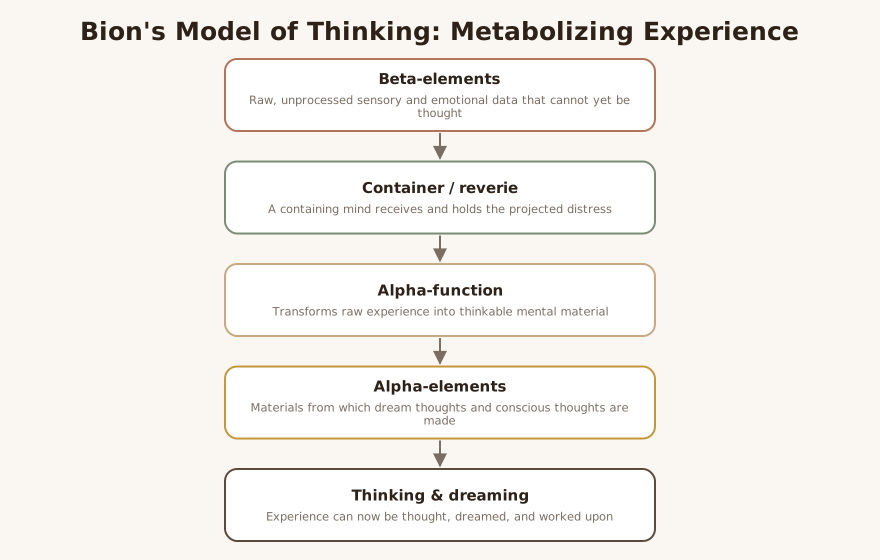
The cornerstone idea is alpha-function: the psychological process by which a caregiving mind converts raw sensory and emotional data into manageable mental material 4. Bion termed the raw, unprocessed sensory and emotional data beta-elements — “nascent sensory data, including emotional data” that cannot yet be thought 4. Alpha-function transforms these into alpha-elements, the materials out of which dream thoughts and conscious thoughts are made 4. Without this transformation, in Bion’s account, the patient cannot dream and therefore cannot properly sleep, because there is nothing thinkable to work upon 5.
Closely linked is the container/contained relationship, which Bion developed out of Klein’s projective identification 4. The infant projects primitive fears and unbearable feelings into the mother (the container), who, through a dreamlike receptivity Bion called reverie, metabolizes that distress and returns it in a more bearable form 4. When this relationship is internalized, it becomes the elementary apparatus for thinking — the mind learns to contain and process its own experience 4. Difficulties arise when reverie is deficient, or when the infant’s omnipotence or envy interferes with taking in what the container offers 4.
Bion further proposed the contact-barrier, a kind of internal membrane formed as alpha-elements cohere, marking the point of contact and separation between conscious and unconscious mental life 3. Where this barrier fails to form or is ruptured, psychotic fragmentation ensues 3. Alpha-function, on this reading, is what continuously generates and maintains the unconscious mind as a working part of the psyche 2.
Two further principles round out the clinical attitude. First, K (knowledge) denotes genuine “learning from experience” — an openness to emotional truth — while −K denotes the active avoidance of knowing, stemming partly from envy 5. Bion held that the mind grows through exposure to truth, which makes the avoidance of truth pathogenic in its own right 5. Second, Bion famously advised the analyst to approach each session “without memory, desire, or understanding,” a disciplined receptivity meant to keep preconception from contaminating perception of what is emerging 5.
Interventions & Techniques
Bionian theory shifts the clinician’s emphasis from interpretation-as-explanation toward the relational processing of affect itself 6. The therapist’s primary instrument is the capacity to receive the patient’s unformulated, primitive experience, tolerate it, and metabolize it — effectively lending the patient an alpha-function until the patient can internalize the process 6. In practice this looks like sustained, non-defensive attention to what the patient evokes in the clinician (countertransference treated as data), and a willingness to hold disturbance without prematurely discharging it through explanation or reassurance 6.
Reverie is itself a technique as much as a concept: the analyst’s somewhat dreamlike, freely receptive state allows beta-elements that the patient cannot yet think to take shape as something communicable 4. The injunction to work “without memory or desire” operationalizes this — the clinician suspends the pull to remember the case history or to want a particular outcome, so that the present emotional reality of the session can register 5. Where earlier technique might have aimed to decode unconscious content, Bionian technique aims first to make experience thinkable — to convert proto-emotive chaos into affectively meaningful representation that the patient can eventually own 3.
LLM-generated illustrative example (not a guideline): A patient who cannot say what is wrong falls into a flat, pressured silence; the clinician notices a creeping dread and a wish to fill the air with questions. Rather than interpreting or reassuring, the clinician stays with the dread, eventually saying, “There’s something here that feels unbearable and hard to put into words — let’s not rush it.” Naming the unthinkable as unthinkable is itself a containing act LLM.
Evidence Base
Honesty about maturity matters here. Bionian psychoanalysis is established in the sense that it is a foundational, widely taught, and clinically influential framework that has shaped how generations of analysts work 51. It is not established in the sense of a manualized therapy validated by randomized controlled trials; it was developed and elaborated through clinical case study and conceptual reasoning rather than experimental method 1. Clinicians should not present “Bionian psychoanalysis” to patients or payers as an empirically supported treatment in the way that, for example, a manualized protocol can be LLM.
Contemporary work has sought convergence with neuroscience and cognitive science rather than clinical-trial validation. One line of argument maps Bion’s contact-barrier onto Friston’s “Markov blanket” and reframes alpha-function in terms of predictive processing and the minimization of free energy, suggesting the mind binds dispersing sensory data much as a biological system resists entropy 3. That paper also cites adjacent clinical findings — for instance avatar therapy data in which some participants reported a complete absence of voices at a week-12 assessment, and survey work indicating around 70 percent of voice-hearers link their voices to trauma or powerlessness 3. These are best read as theoretical bridges and supportive analogues, not as direct outcome evidence for Bionian treatment 3LLM.
Populations & Indications
Bion’s framework was forged substantially in work with the most disturbed patients. He pioneered the analysis of psychotic states, deepening Klein’s concepts of projective identification and countertransference in that work 5. The model is therefore particularly drawn upon with people who have psychotic disorders and with the “psychotic parts of the personality” and infantile states once considered unanalyzable 6. It is also applied with patients in long-term psychoanalysis, with clients whose central difficulty is in symbolization and thinking, and with people carrying trauma histories whose experience has remained unmetabolized 63. More broadly, the container/contained model informs work with adults across the severity spectrum whenever the clinical problem is one of unthinkable affect rather than conflict over thinkable wishes 1.
Problems-for-Work
The framework speaks most directly to problems of failed mentalization — states in which emotional experience cannot be represented and so cannot be regulated 1. In psychotic disorders and schizophrenia, the relevant deficit is described as a failure or rupture of the contact-barrier, leaving conscious and unconscious mental life fused and experience fragmenting 3. In severe trauma, overwhelming events arrive as beta-elements that were never metabolized; the therapeutic task is to provide the containing function that was absent at the time of injury 3. In difficulties with mentalization, alexithymia, and emotional dysregulation, the clinical reading is that alpha-function is weak, so feelings remain raw sensation rather than nameable states 46.
LLM-generated illustrative example (not a guideline): A client with marked alexithymia reports only “feeling sick” before panic attacks. Framed in Bionian terms, the bodily sensation is a beta-element with no alpha-processing attached. Over months, the clinician’s repeated naming of the affective context (“this came up right after your sister called”) helps the client begin to convert sensation into a thinkable feeling LLM.
In borderline and severe personality disorders, the recurring use of projective identification and the patient’s reliance on the clinician to hold and process states the patient cannot tolerate map directly onto the container/contained model 4. Bion’s concept of attacks on linking — the destruction of connections between thoughts — also illuminates fragmented, disorganized thinking and the slide toward paranoid-schizoid functioning 6.
Contraindications, Cautions & Cultural Humility
Bion himself approached psychotic patients with “unmodified” analytic technique, but this is demanding, specialist work that should not be undertaken casually or without supervision and appropriate training 5LLM. The receptive, non-directive stance — and the deliberate suspension of memory and desire — can be destabilizing or frankly contraindicated for acutely psychotic, suicidal, or unsafe patients who need structure, reality-orientation, and active safety planning before any exploratory work 5LLM. Bionian theory is not a substitute for risk assessment, crisis management, medication evaluation, or evidence-based first-line care for serious mental illness LLM.
The framework’s universalizing claims about mothers, reverie, and infant development carry culture-bound assumptions about caregiving that clinicians should hold lightly rather than impose 4LLM. “Container” and “reverie” describe a function, not a particular family structure or gendered role; treating the theory’s idiom as literal anthropology risks pathologizing culturally varied caregiving LLM. Because the model trades in highly inferential constructs (beta-elements, −K, O), clinicians should guard against using its vocabulary to override a patient’s stated experience — the danger is interpreting at rather than thinking with 6LLM.
Treatment-Plan Suggestions & SMART Objectives
| Goal | SMART objective (example) | Mechanism |
|---|---|---|
| Build affect-labeling capacity | Client will name one specific emotion (beyond “fine”/”bad”) in 3 of 4 sessions over 8 weeks | Strengthens alpha-function by converting beta-elements into thinkable alpha-elements 4 |
| Increase tolerance of distressing affect | Client will remain with a distressing feeling for 2 minutes before acting on it, reported via log, in 6 of 8 weeks | Internalizes container/contained function so affect can be held rather than discharged 4 |
| Reduce reliance on projection | Client will identify one instance per week where a feeling attributed to others is “owned” as their own | Reworks projective identification toward self-containment 4 |
| Improve linking between events and feelings | Client will connect a bodily sensation to a precipitating event in 4 of 6 sessions | Counters attacks on linking; restores associative thinking 6 |
| Develop reflective (“dreaming”) capacity | Client will report and reflect on one dream or daydream per fortnight over 12 weeks | Supports formation of alpha-elements and the contact-barrier 25 |
| Strengthen openness to emotional truth (K) | Client will articulate one previously avoided truth about a relationship by mid-treatment review | Moves from −K (avoidance) toward learning from experience 5 |
| Stabilize before depth work (psychosis/crisis) | Client will use an agreed grounding/safety plan during 100% of escalations over 4 weeks | Establishes a functional contact-barrier and safety before exploratory work 3 |
Common Misconceptions
A frequent error is treating “containment” as soothing or simply holding the patient calm; in Bion’s sense it is an active metabolic process — receiving, transforming, and returning experience in thinkable form, not merely absorbing it 4. A second misconception is that the analyst is a passive blank screen; “without memory or desire” describes a disciplined, effortful receptivity, not detachment or indifference 5. Third, beta- and alpha-elements are sometimes read as bad-versus-good feelings; they are not — beta-elements are unprocessed data, regardless of valence, and the work is conversion, not elimination 4. Fourth, the grid — Bion’s early attempt to mathematize psychoanalytic categories — is often taken as central, but Bion himself moved away from it toward more intuitive approaches in his later work 5. Finally, clinicians sometimes assume Bionian ideas constitute an evidence-based treatment protocol; they are a generative framework whose support is clinical and conceptual rather than trial-based 1LLM.
Training & Certification
There is no certification in “Bionian psychoanalysis” as such; the concepts are transmitted within formal psychoanalytic training, supervision, and the broader Kleinian and post-Kleinian tradition 5. Bion’s own formation came through analysis with and study under Melanie Klein and collaboration with senior analysts of his generation, and his later years were spent mentoring analysts in these approaches 5. Practitioners typically encounter the material during institute-based psychoanalytic or psychoanalytic-psychotherapy training, where it is learned through close reading of primary texts, intensive case supervision, and personal analysis 15. Because the clinical stance depends on the analyst’s own metabolizing capacity, ongoing supervision is regarded as integral rather than optional 6LLM.
Key Terms
- Alpha-function — the mental process that transforms raw sensory and emotional data into thinkable material 4.
- Beta-elements — raw, unprocessed sensory and emotional data that cannot yet be thought 4.
- Alpha-elements — the transformed materials of dream thoughts and conscious thoughts 4.
- Container/contained — the relationship in which one mind receives and metabolizes another’s unbearable experience 4.
- Reverie — the dreamlike receptive state through which the container processes projected distress 4.
- Contact-barrier — the internal boundary, formed by alpha-elements, between conscious and unconscious mental life 3.
- Projective identification — the (Kleinian) process by which unbearable feelings are projected into another and felt as the other’s 5.
- K / −K — learning from experience versus the active avoidance of knowing 5.
- Without memory or desire — the analyst’s disciplined suspension of preconception to perceive present emotional reality 5.
- Attacks on linking — the destruction of connections between thoughts, fragmenting reality-testing 6.
- Basic assumptions — recurrent group states (dependency, fight-flight, pairing) that interfere with task-focused work 5.
- O — Bion’s later term for the unknowable, ultimate reality beyond sensory knowledge 5.
Resources & Further Reading
▶ Watch — a video introduction to this concept:
- Bion, W. R. (1962). Learning from Experience — Karnac/Routledge
- Abel-Hirsch, N. (2016). Bion, Alpha-Function and the Unconscious Mind. British Journal of Psychotherapy, 32(2), 215–225
- Making Worlds in a Waking Dream: Where Bion Intersects Friston (PMC6171158)
- Alpha Function — International Dictionary of Psychoanalysis (Encyclopedia.com)
- Wilfred Bion (Wikipedia)
- Wilfred Bion’s Theory of Thinking — Ryan O’Millian, LPC
Reflective / Supervision Questions
- When a patient evokes a strong, hard-to-name feeling in me, do I metabolize it as data, or discharge it through interpretation, reassurance, or activity? 6
- Where in my caseload am I lending a patient my alpha-function, and what would internalization of that function look like for this person? 4
- Can I notice when I am operating in −K — subtly avoiding an emotional truth in the room because it is uncomfortable for me, not only the patient? 5
- How do I hold “without memory or desire” against my legitimate responsibilities for risk, structure, and safety with more disturbed patients? 5LLM
- Am I using Bionian vocabulary to think with the patient, or to interpret at them in ways that override their own account? 6LLM
- For this culturally specific patient, am I treating “container” and “reverie” as a universal template, or as a function realized in many legitimate ways? 4LLM