
Type & Discipline
AVATAR Therapy is a brief, manualized, digitally-mediated psychological intervention for distressing auditory verbal hallucinations (AVH) in people with psychosis 1. It belongs to the family of relating-focused and technology-assisted interventions for psychosis and serious mental illness, sitting alongside cognitive behavioural and relating approaches to voices rather than replacing them 4. The core procedure is distinctive: the client co-creates a computerized audiovisual embodiment — an “avatar” — of the entity they believe is persecuting them, then engages in a live, facilitated dialogue with that avatar across sessions 4. The therapist operates the avatar in real time, voicing it (with pitch and tone matched to the client’s experienced voice) while also speaking as themselves, coaching the client toward a more empowered stance 1.
The intervention was developed within UK clinical psychology and psychiatry, principally for adults whose voices persist despite antipsychotic medication 5. It is delivered individually by trained clinicians and is explicitly time-limited — historically six sessions — making it a “brief intervention” in both design and intent 6. LLM
Creators & Lineage
AVATAR Therapy originated with Julian Leff and colleagues, who described the method and its early pilot in the 2014 paper “Avatar therapy for persecutory auditory hallucinations: What is it and how does it work?” 4. Leff, a social psychiatrist long associated with research on expressed emotion and the social environment of psychosis, conceived the avatar as a way to externalize the persecutor so that the relationship to it could be reworked in vivo 4. The original pilot reported significant reductions in the frequency and intensity of voices and in their rated omnipotence and malevolence, with several individuals showing dramatic responses — voices ceasing entirely after a few sessions — and an average effect size near 0.8 4.
The work was then scaled and rigorously tested by Tom Craig, Philippa Garety, Mar Rus-Calafell and colleagues at King’s College London, who led the first adequately powered single-blind RCT, published in Lancet Psychiatry in 2018 1. Garety subsequently led the larger phase 2/3 AVATAR2 trial, which migrated the intervention to a more flexible digital platform and tested two dose formats 3. The lineage thus runs from a clinically intuitive, hand-built pilot toward a more systematized, manualized, and digitally robust intervention, while remaining within the broader tradition of psychosocial work on the person’s relationship to their voices 4. LLM
Core Principles
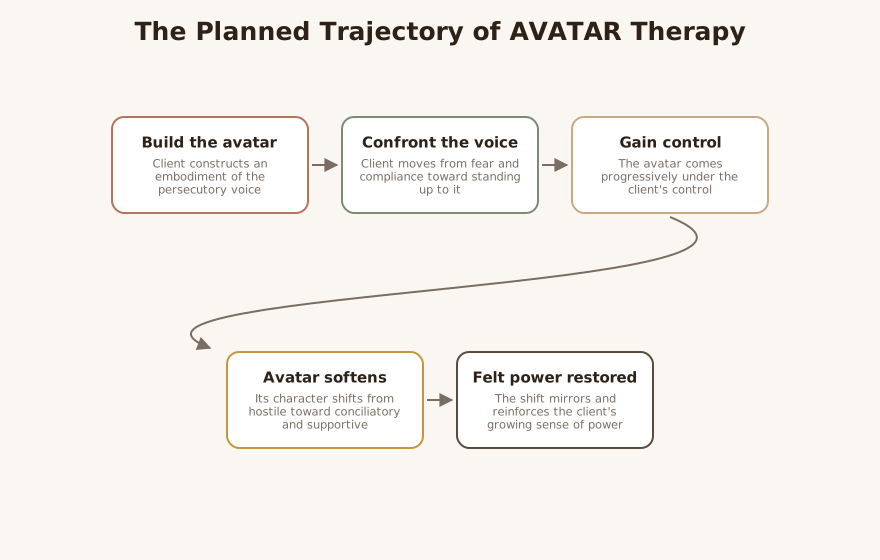
The conceptual heart of AVATAR Therapy is that distress from voices is driven less by their mere presence than by the relationship the person holds with them — specifically by the voice’s perceived omnipotence, malevolence, and the person’s subordination to it 4. By giving the persecutor a face and a controllable embodiment, the therapy makes that relationship visible and workable in real time 4. The client is supported to move from a position of fear and compliance toward assertiveness, standing up to the avatar and asserting control 1.
A defining structural feature is the planned trajectory of the avatar itself. Across sessions the avatar comes progressively under the client’s control and shifts in character — from abusive and hostile toward conciliatory, friendly, and even supportive — mirroring and reinforcing the client’s growing sense of power 4. The therapist, voicing both the avatar and themselves, acts as a kind of director: titrating the avatar’s hostility, modeling assertive responses, and ensuring the encounter remains tolerable 1.
A second principle is dose-bounded brevity. The intervention was designed as a small number of short sessions, with only a portion of each session spent in direct avatar dialogue, the remainder in preparation and processing 1. The original protocol delivered roughly six sessions of about 30-50 minutes, with 10-15 minutes of face-to-face avatar work per session 1. LLM
Interventions & Techniques
Avatar creation. In the first phase the client and therapist build a digital representation of the persecuting entity — human or non-human — selecting a face and adjusting the voice’s pitch and tone until it approximates the experienced voice 4. This collaborative construction is itself therapeutic, externalizing and concretizing something previously private and overwhelming 1.
Facilitated dialogue. In subsequent sessions the therapist speaks the avatar’s lines through voice-transformation software while the client responds 1. The therapist seamlessly switches between speaking as the avatar and speaking as themselves to coach, encourage, and debrief 1. In some implementations the therapist works from a separate room with computer-transformed voices, and clients may receive a recording of the session to listen to between appointments 5.
Graded assertiveness. The dialogue is structured so the client progressively gains the upper hand; the therapist softens the avatar’s tone as the client’s confidence grows, scripting the avatar’s eventual shift from hostility toward conciliation 4. LLM
Digital and VR extensions. The approach has been adapted to virtual reality and, in the AVATAR2 program, to a more flexible digital platform allowing wider customization and a broader range of dialogue content than the original system 53.
LLM-generated illustrative example (not a guideline): A client whose voice repeatedly calls them “worthless” builds an avatar with a matching face and a low, sneering tone. In early dialogue the therapist (as avatar) says, “Nobody could ever care about you.” The therapist then steps out of role to help the client rehearse a reply — “You don’t get to decide that.” Over later sessions the avatar’s lines are softened until it concedes the client’s worth, and the client reports speaking back more readily when the voice intrudes outside session. LLM
Evidence Base
The evidence base is best characterized as emerging: encouraging, replicated in part, but with effects that attenuate over follow-up 2. LLM
The pivotal first trial (Craig, Garety et al., Lancet Psychiatry 2018) randomized 150 adults with persistent AVH to AVATAR Therapy or supportive counselling, each delivered over a matched schedule of sessions 1. The primary outcome — reduction in PSYRATS-AH total score at 12 weeks — favoured AVATAR Therapy with a mean difference of about -3.82 and a Cohen’s d near 0.8, a large effect 1. Notably, that between-group advantage was not statistically significant at 24 weeks, because the supportive counselling group continued to improve and the gap narrowed 1. The Dartmouth review summarizes this same pattern: short-term superiority that converges with the comparator by six months 5.
AVATAR2 (Garety et al., Nature Medicine 2024) was a larger phase 2/3 trial of 345 participants comparing two formats — AVATAR-brief and AVATAR-extended — each added to treatment as usual, against treatment as usual alone, with voice-related distress as the primary outcome at 16 and 28 weeks 3. Both formats reduced distress at 16 weeks (AVATAR-brief d ≈ 0.38; AVATAR-extended d ≈ 0.58), but these improvements diminished by 28 weeks 3. The extended format reduced voice frequency at both timepoints and met thresholds for clinically meaningful change, leading the authors to give “partial support” to their hypotheses and to favour the extended protocol for future work 3. No serious adverse events were attributed to the therapy 3.
Taken together, the data support AVATAR Therapy as a credible, generally safe intervention with reliable short-term benefit on distress and severity, a likely dose-response advantage for longer protocols, and an honest caveat that durability beyond a few months is not yet established 21. LLM
Populations & Indications
The primary indication is persistent, distressing auditory verbal hallucinations — particularly persecutory or command voices — in people with schizophrenia-spectrum psychosis whose voices have continued despite antipsychotic medication 5. Both pivotal trials enrolled adults with enduring voices, and the original development work focused explicitly on persecutory hallucinations experienced as powerful and malevolent 41. The Dartmouth review describes the target population as adolescents, young adults, and adults with persistent medication-resistant hallucinations, though the empirical base sits mainly in adults within UK services 5. LLM
Indications are strongest where the person experiences a clear, personifiable persecutor and where voice-related distress, perceived omnipotence, or subordination are prominent treatment targets 4. LLM
Problems-for-Work
- Voice-related distress and disability. The central target across both trials; AVATAR Therapy reliably reduces distress in the short term 3. Application: a client overwhelmed by a daily abusive voice uses graded dialogue to lower its felt threat. LLM
- Perceived omnipotence and malevolence of voices. The original work specifically reduced rated omnipotence and malevolence 4. Application: reworking the avatar’s character so the client experiences the voice as less all-powerful. LLM
- Powerlessness and subordination in the voice relationship. Assertiveness coaching shifts the client from compliance to control 1. Application: rehearsing assertive replies the client can transfer outside session. LLM
- Command voices. Externalizing the commanding entity allows safe practice of refusal 4. LLM
- Low perceived control over voices. The avatar coming under the client’s control directly addresses controllability 4. LLM
Contraindications, Cautions & Cultural Humility
There are no formally established absolute contraindications in the cited literature, and the trials reported no serious adverse events attributable to the therapy 3. That said, several cautions follow from clinical reasoning. Directly confronting a persecutor can be distressing, so the therapist’s titration of the avatar’s hostility and careful pacing are essential safety features rather than optional refinements 1. LLM Clients in acute crisis, with high risk linked to command hallucinations, or who cannot tolerate the confrontational frame may need stabilization first or an alternative relating approach. LLM
Implementation evidence remains concentrated in UK research settings, so generalizability to other service contexts, languages, and cultural framings of voice experience is not yet established and should be treated cautiously 5. LLM Cultural humility is particularly relevant because the meaning, identity, and spiritual significance of voices vary widely across cultures; the avatar’s appearance, voice, and the very premise of “defeating” a persecutor should be negotiated collaboratively rather than imposed, and clinicians should be alert to framings in which the voice is not experienced as an adversary at all. LLM Finally, the field has questioned what actually changes in AVATAR Therapy — whether the shift lies in the voice itself, in the person’s relationship to it, or in the therapeutic relationship enacted through the avatar — a humility-inducing reminder that mechanism is not fully settled 7.
Treatment-Plan Suggestions & SMART Objectives
| Goal | SMART objective (example) | Mechanism |
|---|---|---|
| Reduce voice-related distress | Within 12 weeks, reduce self-rated voice distress (PSYRATS-AH distress item) by ≥2 points across 6 avatar sessions | Repeated facilitated exposure and reappraisal of the persecutor 1 |
| Increase perceived control over voices | Over 6 sessions, client reports moving from “no control” to “some/moderate control” on a standardized voice measure | Avatar progressively comes under client’s control 4 |
| Build assertive responding | By session 6, client independently voices ≥3 assertive replies to the avatar without therapist prompting | In-session assertiveness rehearsal and modeling 1 |
| Lower perceived omnipotence of the voice | Within 12 weeks, reduce rated voice omnipotence by a clinically meaningful margin on a voice-power scale | Restructuring the power balance via the controllable embodiment 4 |
| Reduce voice frequency | Over an extended protocol, achieve a measurable reduction in voice frequency by 16 and 28 weeks | Extended-dose AVATAR work reduced frequency at both timepoints 3 |
| Generalize gains to daily life | Within 8 weeks, client applies an assertive response to an intruding voice outside session on ≥3 occasions (diary-logged) | Transfer of in-session learning to lived experience 1 |
| Maintain engagement and tolerability | Complete the planned session course with no therapy-attributed adverse event | Therapist titration of avatar hostility and pacing 3 |
Common Misconceptions
“It makes the voices disappear.” Although a minority of early-pilot clients had voices cease entirely, the reliable, replicated benefit is reduced distress and severity — and even that advantage narrows over months 43. LLM
“It’s just exposure therapy for voices.” Exposure is part of it, but the defining move is relational restructuring — shifting the power balance and the avatar’s character — not desensitization alone 4. LLM
“The avatar is AI that talks back on its own.” In the original and pivotal trials the therapist voices the avatar in real time; it is a therapist-operated tool, not an autonomous agent 1. LLM
“Effects are durable and clearly superior to other therapies.” The first RCT lost its statistical edge over supportive counselling by 24 weeks, and AVATAR2’s effects diminished by 28 weeks — durability and comparative superiority are not yet established 13. LLM
“More sessions are unnecessary.” AVATAR2 suggested the extended format produced larger and somewhat more sustained effects than the brief format, so dose appears to matter 3. LLM
Training & Certification
The cited sources do not specify a formal certification pathway; the published trials emphasize delivery by experienced clinicians with expertise in the psychological treatment of psychosis 1. The Dartmouth review likewise provides no detailed training or certification requirements 5. LLM In practice, competent delivery presupposes facility with the technical platform (avatar construction and voice transformation), skill in pacing a confrontational dialogue safely, and grounding in psychological models of voices; clinicians should seek protocol-specific training and supervision from established AVATAR programs rather than improvising the method. LLM
Key Terms
- Auditory verbal hallucinations (AVH): Experiences of hearing voices in the absence of external speech; the core target of the therapy 1.
- Avatar: The client-constructed audiovisual embodiment of the persecuting entity, voiced by the therapist 4.
- Persecutory voice / persecutor: The hostile entity the client believes is tormenting them, given form as the avatar 4.
- Omnipotence and malevolence: Dimensions of how powerful and how ill-intentioned a voice is perceived to be — key outcome targets 4.
- PSYRATS-AH: The Psychotic Symptom Rating Scales — Auditory Hallucinations, the primary outcome measure in the first RCT 1.
- Voice-related distress: The emotional distress attributable to voices; the primary outcome of AVATAR2 3.
- Treatment as usual (TAU): The comparator in AVATAR2 against which the two AVATAR formats were tested 3.
Resources & Further Reading
▶ Watch — a video introduction to this concept:
- AVATAR therapy for auditory verbal hallucinations in people with psychosis: a single-blind, randomised controlled trial (Craig et al., Lancet Psychiatry 2018)
- Digital AVATAR therapy for distressing voices in psychosis: the phase 2/3 AVATAR2 trial (Garety et al., Nature Medicine 2024)
- AVATAR2 trial — PubMed record (PMID 39468363)
- Avatar therapy for persecutory auditory hallucinations: What is it and how does it work? (Leff et al.)
- Avatar Therapy — Center for Technology and Behavioral Health (Dartmouth)
- AVATAR Therapy for Refractory Auditory Hallucinations — Brief Interventions for Psychosis (NCBI Bookshelf)
- Understanding AVATAR therapy: who, or what, is changing? — Commentary (Lancet Psychiatry)
Reflective / Supervision Questions
- For a given client, what is the actual treatment target — the voice’s frequency, its perceived power, or the client’s relationship to it — and does AVATAR Therapy’s evidence base match that target? LLM
- Given that the between-group advantage attenuated over follow-up in both trials, how will you plan for maintenance, booster work, or integration with longer-term care? LLM
- How will you titrate the avatar’s hostility so the encounter is therapeutic rather than re-traumatizing, and what are your stopping rules? LLM
- When you voice the persecutor, what is happening in the therapeutic relationship and in your own countertransference, and how do you process it in supervision? 7
- How does this particular client understand the identity and meaning of their voice culturally or spiritually, and does the adversarial “gain power over it” frame fit — or clash with — that understanding? LLM
- If a controllable digital avatar platform is unavailable, which adjacent relating-to-voices methods could deliver a comparable relational shift? LLM