
Affective forecasting is the act of predicting how we will feel in the future, and the impact bias is the well-replicated discovery that we are reliably wrong about it in a particular way: we overestimate how strongly and how long future events will move us emotionally 1. For a practicing therapist this is not a parlor-game curiosity. A large share of the clinical material we work with — anticipatory dread, catastrophic prediction, avoidance, hopeless certainty that “I could never survive that” — consists of affective forecasts, and the research literature tells us those forecasts are systematically miscalibrated in a direction we can use therapeutically LLM.
Type & Discipline
Affective forecasting and the impact bias are constructs from affective science and behavioral economics, situated within the broader study of judgment and decision-making 1. They are not a therapy, a diagnosis, or a treatment protocol; they are descriptions of how the predicting mind works LLM. Affective forecasting is the umbrella process — predicting future emotion — and researchers decompose any such forecast into four components: whether we will feel an emotion at all, which emotion it will be, how intense it will be, and how long it will last 3. People are generally accurate about the first two (they correctly predict that a breakup will feel bad rather than good) and systematically inaccurate about the last two 7.
The impact bias is the name for that second kind of error: the tendency to overestimate the intensity and the duration of future emotional reactions 8. The durability bias is its most-studied sub-form, referring specifically to overestimating how long an emotional reaction will persist 7. Because these are constructs rather than interventions, their clinical value is as a lens that reframes a patient’s predictions as testable hypotheses rather than facts LLM.
Creators & Lineage
The research program is most associated with Timothy Wilson (University of Virginia) and Daniel Gilbert (Harvard), whose collaborative work from the late 1990s onward defined the field and coined much of its vocabulary 2. Gilbert’s trade book Stumbling on Happiness and his widely viewed TED talk brought the ideas to a general audience and are useful, accessible entry points for psychoeducation 56.
The intellectual lineage runs through several streams. It grows out of affective science’s interest in how emotion is generated and regulated, and out of behavioral economics’ broader catalogue of systematic prediction errors and heuristics that bias human judgment 1. It is tightly bound to hedonic adaptation research — the finding that people return toward an emotional baseline after both good and bad events, which is precisely the resilience that forecasters fail to anticipate 8. And it has a natural affinity with cognitive behavioral therapy, which already treats thoughts and predictions as hypotheses to be examined against evidence rather than accepted as truth LLM.
Core Principles
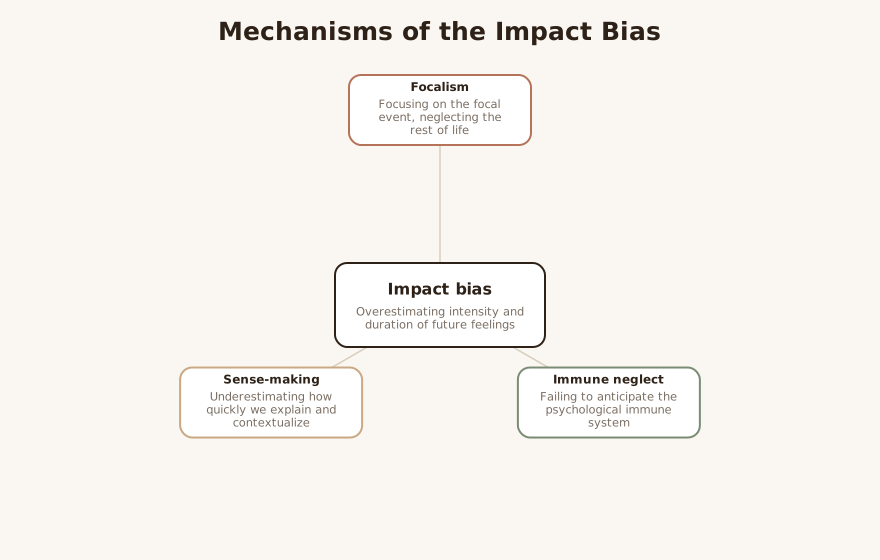
The central principle is that the direction of our emotional predictions is usually right while the magnitude and persistence are usually wrong 7. Wilson and Gilbert identify several mechanisms that produce this error, and understanding them is what makes the construct clinically actionable 2.
Focalism is the tendency to focus narrowly on the focal event while neglecting all the other things that will fill our lives and influence our mood 2. When a patient imagines life after a divorce, the divorce occupies the entire mental frame; the ordinary texture of future days — work, friends, meals, weather, small pleasures — drops out of view, so the predicted feeling is dominated by the single event 8.
Immune neglect is the failure to anticipate our own psychological immune system: the largely automatic, unconscious processes of rationalization, reframing, and meaning-making that cushion negative events 7. People are generally unaware of these processes and therefore leave them out of their forecasts, predicting more lasting distress than they will actually feel 7.
Sense-making is closely related: people underestimate how quickly they will explain, contextualize, and psychologically “metabolize” an event, which decelerates the emotional reaction faster than predicted 3. Misconstrual rounds out the set — our subjective image of a future event often diverges from what the event will actually be like, so the forecast is built on a faulty mental simulation in the first place 7. A fifth practical contributor is simple importance: when people rate an event as highly important, they make more extreme predictions, inflating the bias even when their actual emotional response is similar to others’ 4.
Interventions & Techniques
Although affective forecasting is not itself a treatment, its mechanisms map cleanly onto techniques therapists already use LLM.
Defusing the forecast. The first move is simply naming a prediction as a prediction — “you’re forecasting how you’ll feel a year from now” — which converts an apparent certainty into a hypothesis LLM. This is standard cognitive defusion and Socratic work, now with an empirical rationale: the research says such forecasts are reliably overestimated 1.
De-focalizing. Because focalism drives much of the bias, having a patient deliberately enumerate the rest of their future life is a direct countermeasure. In one experimental manipulation, simply asking people to list their other daily activities reduced the bias, especially for those who listed more or more time-consuming activities 4.
Correcting immune neglect. Reviewing the patient’s own history of recovering from past adversity makes the psychological immune system visible and credible LLM. This is closely tied to building a “coping evidence” log: a person who can point to prior rebounds is better positioned to discount a catastrophic forecast 7.
Surrogation. A counterintuitive but well-supported debiasing strategy is to base a prediction on how a comparable person actually felt rather than on one’s own imagination, because others’ real experience is a better guide than our own faulty mental simulation 3. Clinically this can take the form of consultation with peers who have faced the same decision, or structured psychoeducation about typical recovery trajectories LLM.
Behavioral experiments. The most powerful application is to test a forecast against reality: predict the feeling and its duration in advance, run the exposure or behavioral activation task, then compare the prediction to what actually happened LLM. This is ordinary CBT methodology, sharpened by the expectation that the prediction will likely have overshot 1.
Evidence Base
The maturity of this body of work is best described as established. The phenomenon has been demonstrated across many domains and time intervals, and the original researchers have published a direct defense titled “The Impact Bias Is Alive and Well” responding to methodological critiques 3. In a classic demonstration, participants anticipating job rejection predicted strong unhappiness, yet shortly afterward felt much better than they had forecast 7. Comparable patterns appear in studies of elections, sports outcomes, romantic breakups, tenure decisions, and medical events, and in the much-cited (though more complex) comparisons of lottery winners and people with serious disability who adapt more than observers expect 7.
Honesty about the evidence requires noting the live debate. Critics have argued that some apparent impact bias is a methodological artifact — questions about appropriate baselines, how intensity is measured over time, and demand characteristics 3. Wilson and Gilbert respond that the effect holds across diverse designs and reflects genuine psychological processes rather than measurement quirks, but the cautious clinical reading is that the direction of the effect (overestimation, particularly of duration) is robust while its size varies with method, event, and person 3. There is also evidence that affective forecasting interacts with mood: depression and dysphoria are associated with their own biased forecasts, so the magnitude and even shape of the error is not uniform across patients 4.
Populations & Indications
The bias appears in the general adult population, which makes it a broadly applicable psychoeducational frame rather than a niche tool 8. It is particularly relevant for people facing major life decisions, where overestimated emotional consequences distort the choice itself 1. Patients facing medical decisions are a well-studied group: forecasts of how unbearable a diagnosis, treatment, or change in physical function will feel routinely exceed the lived reality, which has direct implications for informed, values-based decision-making 7.
People experiencing grief or loss often hold the forecast that the pain will never diminish — a durability-bias prediction that the data on adaptation gently contradicts, though this must be handled without dismissing present suffering 8. And individuals with depression are a special case worth flagging: depressive cognition can carry its own affective-forecasting distortions, so the construct is both more relevant and more delicate in this group 4.
Problems-for-Work
Anticipatory anxiety. Anxiety lives in the future, and its fuel is a forecast of how catastrophic the feared moment will feel. Naming the impact bias gives a patient a reason to test, rather than obey, that forecast 1.
Avoidance and decision paralysis. When every option is predicted to feel intolerable, action stalls; de-focalizing and surrogation can shrink the predicted cost of moving 3.
Catastrophizing. Catastrophizing is, structurally, an extreme intensity-and-duration forecast, and the literature provides a direct empirical counterweight 8.
Grief and hopelessness. Both can rest on durability bias — “this will never get better.” The therapeutic task is to make room for current pain while loosening the certainty of the permanent forecast 7.
Rumination about the future and maladaptive decision-making both improve when forecasts are treated as data to be checked rather than facts to be acted on 1.
LLM-generated illustrative example (not a guideline): A patient avoids applying for a promotion, certain that “if I don’t get it, I’ll be devastated for months.” The therapist names this as a forecast, then asks the patient to list everything else that fills an ordinary week (de-focalizing) and to recall how long the sting of a past rejection actually lasted (correcting immune neglect). The patient predicts in writing that not getting it would leave them “an 8/10 low for three months,” applies, and — whatever the outcome — has a concrete prediction to compare against reality LLM.
Contraindications, Cautions & Cultural Humility
The largest caution is that this is a frame, not a cudgel. Used clumsily it becomes invalidation — telling a grieving or frightened person that “you’ll feel better than you think” can land as dismissal of real, present suffering LLM. The bias concerns the prediction of future feeling, not the legitimacy of current feeling, and that distinction must be protected in session LLM.
The construct should not be applied to minimize objectively serious or ongoing harm. Adaptation findings describe statistical tendencies, not guarantees, and some events do produce lasting, severe distress; immune neglect is a bias, not a promise of recovery 8. With depressed patients in particular, forecasting distortions run in their own direction, so the standard “you’re overestimating the bad” message may not fit and can be experienced as one more way they are “getting it wrong” 4.
Culturally, the original research base is heavily Western and college-sampled, and what counts as an event, how meaning is made, and which coping resources are available all vary across communities LLM. The mechanisms of sense-making and the psychological immune system are shaped by culture, religion, and social context, so surrogation and recovery norms should be drawn from people the patient regards as comparable, not from a generic average LLM.
Treatment-Plan Suggestions & SMART Objectives
| Goal | SMART objective (example) | Mechanism |
|---|---|---|
| Reduce anticipatory anxiety before a feared event | Within 4 weeks, the patient will record a written intensity-and-duration prediction before 3 feared events and compare each to actual experience in session | Makes forecasting error explicit and testable 1 |
| Counter focalism in a major decision | By session 6, the patient will produce a written inventory of “the rest of my life” surrounding a focal decision before finalizing it | De-focalizing reduces inflated impact estimates 4 |
| Build awareness of resilience | Within 5 weeks, the patient will log 3 past adversities and how long distress actually lasted, summarizing the pattern aloud | Corrects immune neglect / surfaces the psychological immune system 7 |
| Loosen catastrophic forecasting | Over 6 weeks, the patient will rate predicted vs. actual distress for 5 avoided tasks, computing the average gap | Behavioral test of intensity/duration overestimation 8 |
| Improve values-based decision-making | Before the next medical or life decision, the patient will consult 2 comparable others about their actual emotional experience | Surrogation outperforms imagined forecasts 3 |
| Address grief-related hopelessness without invalidation | Within 8 weeks, the patient will distinguish in writing between present pain (validated) and the prediction “it will never ease” (examined) | Separates current affect from durability-bias forecast 7 |
| Reduce future-focused rumination | Daily for 2 weeks, when a “how I’ll feel” prediction arises, the patient will label it “forecast” and note one omitted life factor | Defusion plus focalism correction 1 |
Common Misconceptions
“It means feelings don’t matter or won’t be that bad.” No — it concerns the accuracy of predictions about future feeling, not the validity of present feeling, and the error is mainly about intensity and duration, not direction 7.
“People can’t predict emotions at all.” People are typically accurate about which emotion and its valence; the failure is in magnitude and persistence 7.
“Everyone always overestimates equally.” The size of the bias varies with event importance, method, and mood; depression in particular carries its own forecasting distortions 4.
“The whole effect was debunked.” Methodological critiques exist and are worth knowing, but the original authors mounted a direct, sustained defense, and the overestimation-of-duration finding remains robust 3.
“Telling patients about it will fix the forecast.” Knowing about a bias does not automatically dissolve it; durable change comes from behavioral testing, de-focalizing, and surrogation, not from the fact alone 3.
Training & Certification
There is no certification in affective forecasting; it is a research construct, not a credentialed therapy LLM. Competence comes from familiarity with the source literature and from skill in the host modalities that operationalize it LLM. Clinicians can ground themselves in Wilson and Gilbert’s review chapters and their 2013 defense for the mechanisms and the debate, use Gilbert’s Stumbling on Happiness and TED talk as accessible overviews and patient-facing psychoeducation, and consult the cognitive-determinants literature for how the bias interacts with mood and attention 23564. The applied competencies — Socratic questioning, behavioral experiments, exposure, and behavioral activation — are trained within standard CBT and ACT pathways LLM.
Key Terms
- Affective forecasting — predicting one’s future emotional states, decomposable into whether, which, intensity, and duration 3.
- Impact bias — overestimating the intensity and duration of future emotional reactions 8.
- Durability bias — the sub-form: overestimating how long an emotional reaction will last 7.
- Focalism — over-focusing on the focal event while neglecting the rest of life 2.
- Immune neglect — failing to anticipate one’s own rationalizing, mood-protecting psychological immune system 7.
- Sense-making — underestimating how quickly one will explain and metabolize an event, decelerating the reaction 3.
- Misconstrual — mispredicting what a future event will actually be like, biasing the forecast at its source 7.
- Surrogation — forecasting from a comparable person’s actual experience rather than from imagination 3.
- Hedonic adaptation — the return toward emotional baseline after good or bad events that forecasters underestimate 8.
Resources & Further Reading
▶ Watch — a video introduction to this concept:
- Wilson & Gilbert (2005), “Affective Forecasting,” Current Directions in Psychological Science
- Wilson & Gilbert, “Affective Forecasting” (Advances in Experimental Social Psychology) — author PDF
- Wilson & Gilbert (2013), “The Impact Bias Is Alive and Well” — author PDF
- Cognitive determinants of affective forecasting errors (PMC)
- Daniel Gilbert, Stumbling on Happiness
- Dan Gilbert: The surprising science of happiness — TED Talk
- Impact bias — Wikipedia
- Impact Bias — The Decision Lab
Reflective / Supervision Questions
- When a patient states a future feeling as a certainty, do I routinely hear it as a forecast — and do I have a habit for testing it? LLM
- How do I introduce the impact bias without sliding into invalidation of a patient’s present pain? LLM
- For my depressed patients, am I accounting for the possibility that their forecasting distortion runs in a different direction than the general pattern? 4
- Where in my caseload is avoidance being sustained by an overestimated emotional forecast that a behavioral experiment could test? LLM
- Whose “comparable experience” am I offering when I use surrogation, and is that person genuinely comparable to this patient’s culture and circumstances? LLM
- Am I presenting hedonic adaptation as a statistical tendency rather than a guarantee, leaving room for the events that genuinely do not fade? 8