
Type & Discipline
Social Stories are a narrative-based technique developed within the field of autism intervention and special education 1. A Social Story is a short, individualized text that accurately describes a context, skill, achievement, or concept according to ten defining criteria, written to be descriptive, meaningful, respectful, and physically, socially, and emotionally safe for its audience 2. The technique sits inside the broader family of social narratives, which is itself recognized in autism practice as an evidence-based practice category 5. Clinically, Social Stories are best understood as a structured psychoeducational and self-regulation tool rather than a standalone therapy: they make implicit social information explicit so that a person can anticipate what is likely to happen, what others may do or feel, and what a workable response might look like 1. Because the technique is content rather than a treatment system, it is most defensibly deployed within a broader modality such as social skills training or a behaviorally informed plan 6. LLM
Creators & Lineage
Social Stories were created by Carol Gray in 1991 as a way to help autistic individuals navigate social complexity by sharing information through description of the events occurring around them and the reasons behind those events 7. The original approach was aimed at individuals with at least basic language ability and was subsequently adapted for those with more significant support needs 7. Gray’s method established defined sentence types and ratios and was later codified in The New Social Story Book and successive criteria revisions 7. Gray is also credited with Comic Strip Conversations, a complementary visual technique that represents social interaction and others’ thoughts through simple drawings, which sits alongside Social Stories in the same lineage 7. The current standard is the Social Stories 10.2 criteria set, which formalizes the philosophy, voice, sentence structure, and implementation guides that distinguish a genuine Social Story from a generic “social script” 2. The originator continues to maintain official definitions, criteria, and training resources through her organization 1.
Core Principles
Every Social Story rests on a five-part philosophy. It abandons assumptions in favor of gathering accurate information about how a situation is actually perceived; it regards the “social impairment in autism” as shared — the equal responsibility of all parties in an interaction; it treats the perspectives of autistic and non-autistic people as equally valid though sometimes different; it never argues perception; and it treats curiosity as “confusion with a good attitude” rather than concluding that everything has been tried 2. This stance is clinically important because it reframes the work as collaborative meaning-making rather than behavior correction 2. LLM
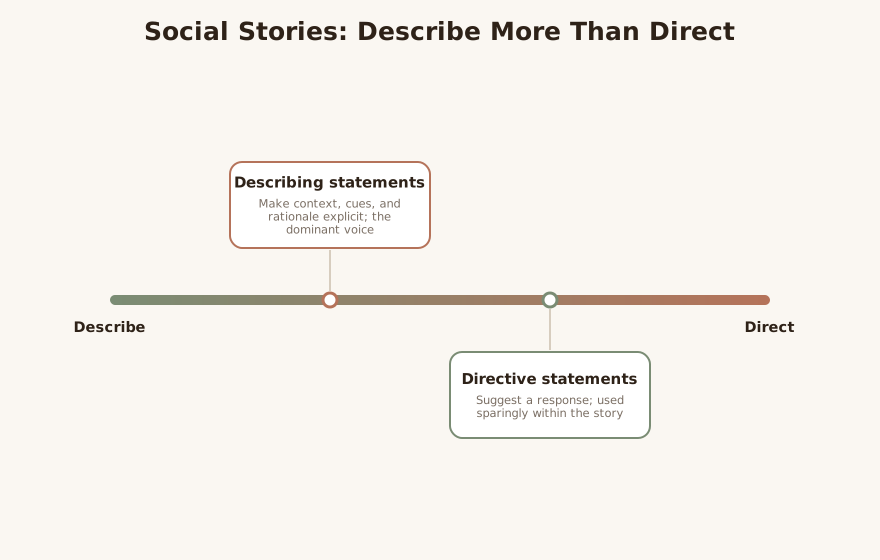
The defining commitment of the technique is that a story describes more than it directs 2. A Social Story uses a patient and supportive voice defined by five factors: exclusive use of first- and/or third-person statements (never second person), appropriate tense, a positive and patient tone, literal accuracy, and accurate meaning 2. It answers the relevant “WH” questions — where, when, who, what, how, and why — so that context, cues, and rationale are all made explicit 2. The story has a clear three-part structure (a title and introduction that identify the topic, a body that adds detail, and a conclusion that reinforces it) and is formatted to fit the individual’s abilities, attention span, learning style, and interests 2. Notably, the criteria require that at least 50% of all Social Stories applaud achievements, anchoring the technique in affirmation rather than deficit 2.
Interventions & Techniques
The mechanics of authoring a Social Story are concrete and criteria-bound. Two sentence types do the work. Descriptive sentences accurately describe relevant external and internal aspects of a context and are required to be free of assumption, bias, judgment, devaluation, or unidentified opinion 2. Coaching sentences gently guide behavior by describing effective team or audience responses, or by structuring audience self-coaching 2. The relationship between them is governed by the “Gr-eight” formula: the total number of descriptive sentences divided by the total number of coaching sentences must be greater than or equal to two (using 1 in the denominator if there are no coaching sentences) 2. This ratio operationalizes the core principle and is the single most useful quality check a clinician can apply to any draft 2. LLM
Development follows a “two-step discovery” process: the author first gathers information to understand the audience in relation to the situation, then identifies the specific topic and the most critical information to convey 2. A first draft is rarely the final draft — the criteria require review by relevant caregivers and revision until all criteria are met 2. Implementation is itself structured by ten guides, including planning for comprehension, planning support and review, providing a positive introduction, monitoring, organizing stories, and using “re-runs and sequels” to tie past, present, and future together 2. The technique is explicitly distinguished from social scripts, skill checklists, or any “social story” that does not meet the current ten-criteria definition 1.
LLM-generated illustrative example (not a guideline): For a child who becomes distressed during fire drills, an author gathers information about what the child notices (the alarm’s pitch, classmates standing up), then drafts mostly descriptive sentences — “Sometimes a loud bell rings to help everyone practice leaving the building safely. Many children cover their ears. My teacher walks with my class to a safe spot outside.” — with one coaching sentence: “I can try to walk with my class and wait for the bell to stop.” The descriptive-to-coaching ratio stays at or above two-to-one. LLM
Evidence Base
The evidence picture is genuinely mixed, and clinicians should hold the “established” label carefully. The National Standards Project classified the broader category of story-based interventions — which includes Social Stories — as an established procedure for increasing social skills, and that category-level rating is the strongest support claim available 6. Crucially, this is a rating of the category for social-skills outcomes, not a blanket verdict that Social Stories work as an isolated intervention across all outcomes 6. Social narratives as a class are also recognized as an evidence-based practice in autism intervention reviews 5. LLM
Against that, independent appraisal is cautious. ASAT characterizes the supporting evidence as limited, notes that multiple reviews found support that is “low or questionable,” and stresses that many studies combine Social Stories with other techniques — making it “impossible to determine whether the change in behavior was a result of the prompting, the Social Story, or the combination” 6. ASAT’s practical conclusion is that Social Stories “may work in some instances and not others,” that researchers cannot yet identify who benefits or under what conditions, and that families should be encouraged to consider procedures with more solid scientific support — while acknowledging minimal risk in using a Social Story alongside another evidence-based treatment as a behavioral cue 6. A 2025 pragmatic randomised controlled trial (ASSSIST-2) has evaluated Social Stories delivered in schools, contributing higher-quality design to a literature historically dominated by small single-case studies 3. A systematic review by Qi and colleagues has also examined the effects of Social Stories interventions for individuals with autism 4. The honest summary for a clinician: a respected category-level “established” rating for social-skills targets, coexisting with weak, confounded, and inconsistent primary-study evidence at the level of the specific technique 6.
Populations & Indications
Social Stories are intended for autistic individuals of all ages — children, adolescents, and adults — and were designed to support the safe and meaningful exchange of information among parents, professionals, and autistic people 1. The technique fits best where the difficulty is one of information: a person does not have ready access to the implicit cues, sequence, or rationale of a situation 1. In practice this most often means concrete or literal learners who benefit from explicit, predictable description and who have enough receptive language (or supported comprehension) to engage with a short text 7. LLM
Indications a clinician will recognize include preparation for novel or changing routines, recurring situations that reliably produce distress, situations where a person misreads others’ perspectives, and contexts where a clear “what happens and why” reduces uncertainty 1. Because the format is tailored to ability, attention span, and interest, the technique can be adapted across a wide range of cognitive and language profiles 2. It is equally a tool for the team — the philosophy positions the social difficulty as shared, so writing the story often clarifies the adults’ own assumptions 2. LLM
Problems-for-Work
The technique maps onto several discrete, plannable problems. LLM
- Transition and change-related anxiety. A story that describes an upcoming change — a new classroom, a substitute teacher, a medical appointment — and answers the WH questions can lower uncertainty before the event 2.
- Difficulty anticipating expected behavior in a routine. Descriptive sentences make the implicit sequence and cues of a recurring activity explicit, so the person can predict what is likely to happen 1.
- Misreading social cues or others’ perspectives. Because the criteria require accurate, non-judgmental description of internal and external factors, a story can surface what others may be thinking or feeling without arguing the person’s own perception 2.
- Distress in a specific recurring situation. A targeted story addresses one concrete situation at a time, consistent with the topic-focused two-step discovery process 2.
- Reinforcing and applauding emerging skills. With at least half of stories designed to applaud achievement, the technique doubles as a structured affirmation tool 2.
LLM-generated illustrative example (not a guideline): An autistic adult anxious about an upcoming job interview co-authors a story describing the room, the likely order of events, and the interviewer’s probable goals (“The interviewer wants to learn about my skills”), with a single self-coaching line (“I can pause and think before I answer”). The story is read several times beforehand as rehearsal, embedded in a broader skills-coaching plan. LLM
Contraindications, Cautions & Cultural Humility
There are few absolute contraindications, and the documented risks of a well-constructed Social Story used as a cue alongside an evidence-based treatment are minimal 6. The more serious cautions are about misuse and overclaiming. Because the evidence at the technique level is weak and confounded, a Social Story should not be presented to families as a primary or sufficient treatment, and clinicians should be candid that effects are inconsistent and not yet predictable 6. A common failure mode is drafting something that violates the criteria — too directive, written in the second person, or laden with assumption and judgment — which is no longer a Social Story and may read as a behavioral command 2. LLM
Cultural humility is essential here. A Social Story always encodes someone’s model of “expected” behavior, and that model can quietly privilege neurotypical norms; written carelessly, the technique risks teaching masking or compliance rather than genuine understanding and safety 7. The originating philosophy itself guards against this by treating autistic and non-autistic perspectives as equally valid and refusing to argue perception — a stance clinicians should honor by writing stories with the person and their values, not at them 2. The aim is shared comprehension and self-determination, not conformity, and a neurodiversity-affirming author will check whether a given “expected response” is genuinely in the person’s interest. LLM
Treatment-Plan Suggestions & SMART Objectives
| Goal | SMART objective (example) | Mechanism |
|---|---|---|
| Reduce transition-related distress | Within 8 weeks, client will engage with a personalized Social Story before 4 of 5 known transitions, with caregiver-rated distress reduced by one level | Explicit description lowers uncertainty by answering where/when/who/what/how/why 2 |
| Increase predictability of a recurring routine | Within 6 weeks, client will independently reference the relevant story before the target routine in 3 consecutive opportunities | Descriptive sentences make implicit sequence and cues explicit 1 |
| Build perspective-taking around one situation | Over 8 weeks, client will identify one likely thought or feeling of another person in the target situation in 4 of 5 trials | Accurate, non-judgmental description of others’ internal factors 2 |
| Support self-coaching in a known trigger | Within 8 weeks, client will use the story’s self-coaching line in 3 of 5 occurrences of the trigger | Coaching sentence structures audience self-coaching within the descriptive-heavy formula 2 |
| Reinforce an emerging skill | Across 4 weeks, client and team will co-review an achievement-applauding story weekly, with client naming the skill each time | At least 50% of stories applaud achievement, anchoring affirmation 2 |
| Improve team consistency | Within 4 weeks, all team members will introduce and review the story per the same implementation plan | Ten implementation guides standardize introduction, support, and review 2 |
| Strengthen comprehension of the story itself | Within 2 weeks, client will answer 2 comprehension checks about the story correctly | “Plan for comprehension” guide ensures the audience understands the content 2 |
Common Misconceptions
A frequent misconception is that any short narrative about a social situation is a “Social Story”; in fact the term refers specifically to a text meeting all ten defining criteria, and scripts or checklists that do not meet the definition are not Social Stories 1. A second is that the purpose is to direct behavior — but the criteria deliberately require the story to describe more than it directs, enforced by the descriptive-to-coaching ratio of at least two-to-one 2. A third is that Social Stories are a strongly evidence-backed standalone treatment; the more accurate view is that the broader story-based category has an established rating for social-skills outcomes while the technique’s own primary-study evidence is mixed and confounded 6. A fourth is that the story tells the person how they “should” feel — the voice must be literally accurate and free of unidentified opinion, describing rather than prescribing internal states 2. Finally, some assume a first draft is final, when the criteria require caregiver review and revision before use 2. LLM
Training & Certification
Carol Gray’s organization maintains the official definition, the 10.2 criteria, and training resources for authors who want to write Social Stories that meet the standard 1. The criteria document itself functions as a practical training instrument, laying out the philosophy, the five voice factors, the sentence types, the formula, and the ten implementation guides in a form clinicians can apply directly 2. Beyond fidelity to the published criteria, there is no single regulatory credential required to use the technique, and clinicians should be wary of overstating any certification claim 7. The most defensible competency standard is demonstrable adherence to the current criteria — including the descriptive-over-directive formula and the collaborative discovery and review process 2. LLM
Key Terms
- Social Story — a text that accurately describes a context, skill, achievement, or concept according to ten defining criteria, in a safe and supportive voice 2.
- Descriptive sentence — a sentence that accurately describes relevant external or internal aspects of a context, free of assumption, bias, or judgment 2.
- Coaching sentence — a sentence that gently guides behavior by describing effective responses or structuring self-coaching 2.
- The Gr-eight formula — the rule that descriptive sentences must outnumber coaching sentences by at least two-to-one 2.
- Two-step discovery — gathering information to understand the audience, then identifying the story’s specific topic and focus 2.
- Comic Strip Conversations — Gray’s complementary visual technique representing interaction and others’ thoughts through drawings 7.
- Social narratives — the broader evidence-based-practice category in which Social Stories sit 5.
Resources & Further Reading
▶ Watch — a video introduction to this concept:
- What is a Social Story? — Carol Gray (official site)
- Social Stories 10.2 Criteria — Carol Gray (PDF)
- ASSSIST-2: a pragmatic randomised controlled trial (Child and Adolescent Mental Health, 2025)
- A Systematic Review of Effects of Social Stories Interventions for Individuals With ASD (Qi et al.)
- Social Narratives — National Professional Development Center on ASD (ERIC ED595405)
- Social Stories — Association for Science in Autism Treatment
- Carol Gray — Wikipedia
Reflective / Supervision Questions
- When I draft a Social Story, whose model of “expected behavior” am I encoding, and have I checked it against the client’s own interests and values rather than convenience? LLM
- Does my draft actually meet the descriptive-over-directive formula, or have I written a behavioral command dressed as a story? 2
- Am I presenting this technique to the family with honest framing about its mixed evidence, or am I implying more certainty than the literature supports? 6
- Have I treated the social difficulty as shared — examining my own and the team’s assumptions — or located the problem solely in the client? 2
- Is the Social Story embedded within a coherent broader plan, or am I relying on it as a standalone fix? 6
- How will I know it is working, and what will I do if, consistent with the evidence, it does not help this particular person? 6