
Type & Discipline
Interpersonal Process Recall (IPR) is a video- or audio-assisted supervision and training technique in which a therapist reviews a recording of a session and, guided by a non-evaluative “inquirer,” pauses at specific moments to recall the covert thoughts, feelings, bodily sensations, and intentions that were present but unspoken in the room 43. The American Psychological Association describes it as “a method used for understanding the processes of psychotherapy and for the training of counselors and therapists,” which places it squarely in the disciplines of counselor education and clinical supervision rather than among the modalities applied directly to clients 4. It is, in other words, a method for working on the clinician, with the client’s care as the ultimate beneficiary LLM.
The defining structural feature is the separation of roles LLM. One person — the supervisee or counselor — re-experiences the recorded interaction; another — the inquirer — facilitates that re-experiencing through open-ended questions while deliberately withholding instruction, interpretation, and evaluation 43. This is what distinguishes IPR from ordinary tape review or didactic supervision: the recording is not used to grade technique but to recover the practitioner’s own moment-to-moment inner experience as primary data 3LLM.
Because IPR is a technique rather than a freestanding model of therapy, it is almost always nested inside a larger supervisory or training relationship and is explicitly cautioned against as a sole approach 4. It also has a client-facing variant — “mutual recall” — in which the client joins the recall session, but the dominant and original use is dyadic supervision focused on the counselor’s experience 4LLM.
Creators & Lineage
IPR was developed by Norman Kagan and colleagues at Michigan State University in the 1960s, formalized in the 1967 research monograph Studies in Human Interaction: Interpersonal Process Recall Stimulated by Videotape (Kagan, Krathwohl, et al.) 41. The method grew directly out of the then-new technology of videotape: the foundational insight was that “if a subject is given enough cues and clues to help him relive an experience, his feelings and thoughts could be explored in depth and with reasonable accuracy of recall” 1. The structured sequence the team built — “first the video taping of an interaction[;] the video tape is then replayed in a recall interview” — remains the core procedure used today 1.
Kagan’s later writing, including work with David Krathwohl and with Paul Schauble, refined IPR specifically as a counselor-training and supervision tool over the following two decades 4LLM. The technique was given a theory of why clinicians need it at all. Kagan proposed that human interaction is shaped by two facts — that people need each other and that people also learn to fear each other — and that early experience leaves “inexplicit feelings of fear and helplessness” that produce avoidance even in trained counselors 4. He named two characteristic avoidant moves: “feigning clinical naivete” (pretending not to understand what a client is signaling) and “tuning out” (retreating into one’s own thoughts) 4. IPR was designed to make those normally invisible moves visible to the practitioner 4LLM.
The method’s reach extended beyond supervision almost immediately LLM. The original 1967 program reported applications across counselor education, the study of nonverbal communication, teaching-learning dynamics, the acceleration of client progress, the measurement of emotional sensitivity, and the development of interpersonal-behavior theory 1. Decades later it was adapted as a qualitative research-interviewing method, using video-cued recall to help participants articulate experience that ordinary interviewing leaves tacit (Larsen, Flesaker & Stege, 2008) 5. That cross-over signals how durable the underlying premise has proven: people are often the best source of their own in-the-moment experience, if given the cues to relive it 5LLM.
Core Principles
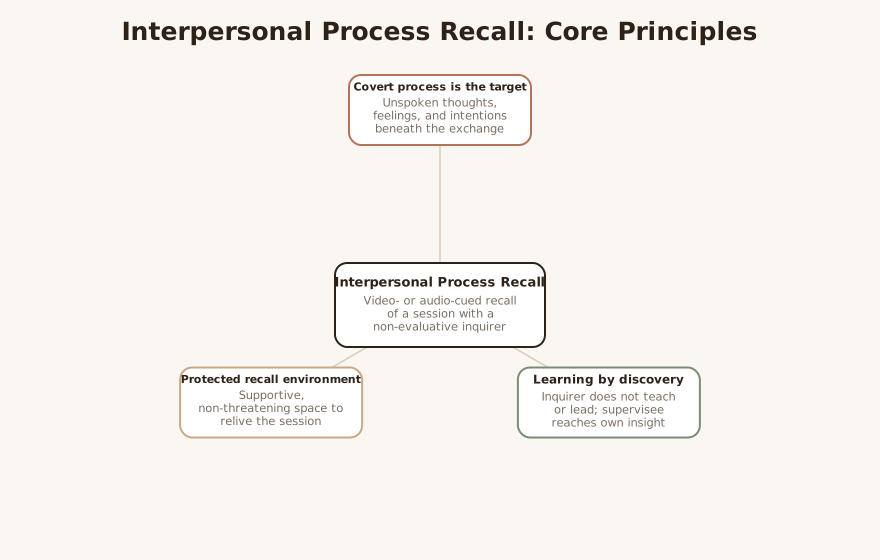
The first principle is that covert process is the target 3. IPR is built to “increase counselor awareness of covert thoughts and feelings of client and self” — the layer of reactions, wishes, fears, and bodily states that runs underneath the spoken exchange and ordinarily goes unnoticed 3. The recording exists to cue access to that layer, not to document behavior for critique 3LLM.
The second principle is learning by discovery 3. The inquirer “does not attempt to teach the counselor or ask leading questions,” operating instead from a stance that lets the supervisee arrive at their own insight 3. This is a deliberate inversion of instruction-led supervision: the assumption is that an insight the practitioner reaches themselves, while reliving the moment, has more durable effect than the same observation delivered as feedback 4LLM.
The third principle is the protected, non-threatening recall environment 3. The supervisee is invited to “reexperience the counseling session via videotape or audiotape in a supervision session that can be characterized by a supportive and nonthreatening environment,” because the material being surfaced — fear, helplessness, avoidance — only emerges when it is safe to admit 3. The fourth is the here-and-now orientation: IPR practices expressing previously hidden thoughts directly, which is itself rehearsal for doing so with clients 4. Underpinning all of these is the recall premise inherited from 1967 — that with enough cues, a person can relive an experience and explore its feelings and thoughts “with reasonable accuracy of recall” 1.
Interventions & Techniques
The mechanics are deliberately simple LLM. A session is recorded; the supervisor or supervisee pre-selects the segments “that are the most interpersonally weighted,” since full review is usually impractical; the tape is played and paused at significant moments while the inquirer asks the supervisee to recover what was happening inside them at that instant 34. A working convention is that when the tape is stopped the supervisee speaks first, with the inquirer facilitating rather than leading 4.
The inquirer’s craft lies almost entirely in the questions, which cluster into recognizable types LLM. Exploratory and “honest labeling” leads invite the unsaid: “What do you wish you had said?”, “What would have been the risk in saying that?”, “What did you want him/her to tell you?” 4. Cognitive and affective leads reach for parallel inner tracks: “Were there any other thoughts going through your mind?”, “Were you aware of any feelings?”, and the somatic prompt “Were those feelings located physically somewhere?” 43. Image and expectation leads probe relational perception and transference-like material: “How did you want the other person to perceive you?”, “Did he/she remind you of anyone in your life?”, “What do you think he/she wanted from you?” 4. Throughout, the inquirer attends to incongruence between verbal and nonverbal channels and helps the supervisee notice it without supplying the interpretation 4.
A useful way to frame the inquirer’s value is what the recall makes possible that unaided reflection does not: “cueing memories or processes that would not have come to mind unassisted” and “slowing down clinical interactions in order to give time to reflect” 2. The stance is paradoxical — non-judgmental yet, when needed, “assertive and even confrontive” — and holding it without sliding into teaching is, in the field’s own words, “often more difficult than it seems” 3.
IPR is delivered in individual, group, and peer-supervision formats, and the original “mutual recall” variant brings the client into the recall session to improve the counselor and client’s shared understanding of their interaction dynamics 4.
LLM-generated illustrative example (not a guideline): A supervisee reviews tape of a session in which a client described a loss and the supervisee responded with a quick reassurance. The inquirer pauses the tape there and asks only, “What was going through your mind right then?” After a silence the supervisee says she felt a flash of dread and wanted to change the subject. The inquirer asks where she felt the dread; she names her chest. He asks what the risk would have been in staying with the client’s grief. She realizes she had been protecting herself, not the client — an insight she reached by reliving the moment, not by being told LLM.
Evidence Base
The honest label for IPR’s maturity is established: it is a venerable, field-defining training and supervision method, in continuous use since the late 1960s and embedded in counselor education, but its controlled outcome evidence is old and thin, and a clinician should hold both halves of that sentence at once 14LLM. IPR’s longevity and influence are not in question; its standing as an empirically validated intervention with modern controlled data is LLM.
The original 1967 Michigan State program was a large, ambitious body of work — the monograph runs to nearly six hundred pages — and reported that IPR could be used to accelerate both counselor development and client progress 1. Later summaries point to studies by Kagan and Krathwohl (1967) and Kingdon (1975) suggesting that “clients of counselors being supervised with an IPR format fared better than clients of counselors supervised by other methods,” with apparent benefit across experience levels — experienced counselors, entry-level trainees, and paraprofessionals 4. These are meaningful historical results, but they are also decades old, and they should be read as the foundation of IPR’s reputation rather than as a current, replicated empirical endorsement 4LLM.
What can be said with more confidence is about mechanism and reach than about controlled effect size LLM. IPR reliably does what it is built to do — surface covert process and slow interaction down for reflection — and that face-valid mechanism is consistent across the supervision literature and the method’s adaptation into qualitative research, where the same recall premise has held up well enough to be used as a data-gathering technique (Larsen et al., 2008) 25. The fair stance for practice is to treat IPR as a well-justified, long-standing standard tool of counselor training whose immediate effects on practitioner awareness are clear, while being candid that its downstream effects on client outcomes rest largely on dated studies 4LLM.
Populations & Indications
IPR’s direct “population” is the practitioner: counselors-in-training, supervisees at every level, and the clinical supervisors who facilitate the recall 43. The original work was explicit that the method served entry-level trainees and paraprofessionals as well as experienced counselors, which makes it unusually flexible across the developmental span of a clinician’s training 4. In the mutual-recall variant the client also enters the frame, becoming a participant in examining the dyad’s process rather than a subject being discussed in their absence 4.
The indication is essentially universal within training rather than diagnostic LLM. Any supervisee whose work brings them into emotionally loaded contact with clients is a candidate, because that contact reliably triggers the avoidance — the feigned naivete, the tuning out — that IPR exists to surface 4. It is particularly indicated when a supervisee seems unable to articulate what happened in a difficult session, when nonverbal cues hint at reactions the supervisee is not reporting, or when countertransference is suspected but not yet conscious 2LLM.
IPR also has a research indication outside supervision entirely: it has been adapted as a qualitative interviewing method for studying lived experience, where video-cued recall helps participants recover and describe tacit, in-the-moment experience (Larsen, Flesaker & Stege, 2008) 5. For the practicing supervisor this matters mainly as evidence of how robust the recall premise is across contexts 5LLM.
Problems-for-Work
The problems IPR addresses sit at the practitioner level, and naming them concretely matters because they are the documented targets of the technique LLM. Countertransference is the most directly named: IPR “can be applied in clinical supervision to assist counselors in becoming more attuned with interpersonal relational dynamics in therapeutic alliances, including countertransference,” and its discovery-oriented questions are designed to surface the covert reactions that drive a counselor’s avoidance of, or over-involvement with, a client 2.
Interpersonal avoidance in session is a second target — the “feigning clinical naivete” and “tuning out” that let a counselor sidestep what a client is signaling 4. IPR makes these moves visible by pausing on the exact moment they occurred and asking what the counselor was actually thinking and feeling 4.
LLM-generated illustrative example (not a guideline): On tape, a supervisee laughs lightly when a client mentions a frightening symptom and then redirects to logistics. In recall, the inquirer pauses there and asks what the laugh was about. The supervisee recognizes it as a “tuning out” move — a way to avoid the client’s fear, which had echoed his own — and can now choose differently next time LLM.
Eroded in-session awareness — the loss of access to one’s own moment-to-moment experience under the pressure of doing therapy — is addressed by the recall structure itself, which cues “memories or processes that would not have come to mind unassisted” 2. Unspoken wishes and unexpressed reactions are surfaced through the honest-labeling leads (“What do you wish you had said?”), turning silent material into something workable 4. And in mutual recall, misunderstanding within the counselor–client dyad becomes the explicit problem-for-work, with both parties examining how each experienced the interaction 4.
Contraindications, Cautions & Cultural Humility
The clearest caution comes from the literature itself: IPR “should not be used in isolation” and should not serve as “the sole approach to supervision,” because intense focus on the dyad can “magnify the interpersonal dynamics between the counselor and client to the point of distortion” 24. The technique is a lens that amplifies, and amplification can mislead as well as illuminate; it belongs inside a fuller supervisory relationship and is often paired with other reflective practices such as written reflection 2LLM.
A second caution is about the inquirer’s discipline LLM. The whole method depends on the inquirer refraining from teaching, leading, or interpreting — and the field is candid that holding this stance is “often more difficult than it seems” 3. An inquirer who slides into instruction collapses IPR back into ordinary directive supervision and loses the discovery mechanism that is its reason for being 3LLM. There is also a boundary hazard worth naming: IPR can rapidly open a supervisee’s personal material — fear, helplessness, memories of who a client “reminds you of” — and the supervisor must keep the work oriented to professional development rather than letting it become therapy for the supervisee 4LLM.
Cultural humility is implicit in the method’s machinery LLM. Because IPR works by surfacing covert affect and inviting disclosure of fear and avoidance, it carries culturally specific assumptions about emotional expressiveness, hierarchy, and what a “good” recall conversation sounds like; a supervisor should be wary of treating willingness to verbalize private feeling as a neutral competence rather than a culturally shaped one LLM. The image and expectation leads — “Did he/she remind you of anyone in your life?” — also touch identity and relational history, terrain that demands the inquirer hold their own assumptions lightly 4LLM.
Treatment-Plan Suggestions & SMART Objectives
| Goal | SMART objective (example) | Mechanism |
|---|---|---|
| Establish a safe recall frame | In the first recall session, the inquirer introduces IPR non-threateningly and the pair agrees the review is for discovery, not evaluation, before any tape is played | A supportive, nonthreatening environment is the precondition for surfacing covert material 3 |
| Surface covert thoughts and feelings | Across a defined number of sessions, at each pause the supervisee first names a previously unspoken thought, feeling, or bodily sensation from that moment | IPR is built to increase awareness of covert thoughts and feelings of self and client 3 |
| Identify and work countertransference | The pair names at least one countertransference reaction per reviewed session — a wish, fear, or avoidance toward the client — and traces its effect on the work | IPR assists counselors in becoming attuned to relational dynamics including countertransference 2 |
| Reduce in-session avoidance | Over the supervision period, the supervisee identifies recurring “tuning out” or feigned-naivete moments on tape and rehearses an alternative response | Making avoidant moves visible at the moment they occur enables deliberate choice 4 |
| Strengthen the inquirer’s nondirective stance | In a defined proportion of pauses, the inquirer uses only open, past-tense discovery questions and refrains from teaching or interpreting | Learning by discovery depends on the inquirer not teaching or leading 3 |
| Practice expressing the unsaid | Using honest-labeling leads, the supervisee articulates what they wished they had said and the perceived risk of saying it, in each reviewed segment | Rehearsing here-and-now expression transfers to direct work with clients 4 |
| Repair dyadic misunderstanding (mutual recall) | In a mutual-recall session, counselor and client each describe how they experienced a selected moment and compare perceptions | Mutual recall improves shared understanding of the interaction’s dynamics 4 |
Common Misconceptions
The first misconception is that IPR is just watching tape with a supervisor LLM. It is a structured technique with a specific division of roles — the supervisee relives, the inquirer facilitates without teaching — and a specific target, the covert layer of in-session experience, which makes it distinct from ordinary recording review 34. A second is that the inquirer is a coach giving feedback; in fact the inquirer “does not attempt to teach the counselor or ask leading questions,” and treating the role as feedback delivery dismantles the method 3.
A third misconception is that IPR is a complete supervision approach that can stand alone LLM. The literature is explicit that it “should not be used in isolation,” precisely because its intensity can distort the dynamics it examines 24. A fourth is that recall is unreliable guesswork; the method’s working premise, validated enough to anchor sixty years of use, is that with sufficient cues a person can relive an experience and explore its feelings “with reasonable accuracy of recall” 1.
A fifth, and the most consequential for an honest field, is that IPR’s effectiveness rests on a robust modern evidence base LLM. Its reputation is built substantially on studies from 1967 and 1975, and while those results are real, IPR is best presented as a long-established, mechanism-sound training method rather than as a treatment with current, replicated controlled evidence for client outcomes 41.
Training & Certification
There is no single license or certifying body that owns IPR; it is a technique taught within counselor education and clinical supervision and used by appropriately prepared supervisors 4LLM. The core competency to be trained is the inquirer role — learning to ask open, discovery-oriented questions in the past tense, to attend to verbal–nonverbal incongruence, and to resist the strong pull toward teaching, interpreting, or reassuring 34. Because holding that stance is “often more difficult than it seems,” supervised practice as an inquirer, not just exposure to the question lists, is what builds the skill 3LLM.
Training also covers the practicalities: how to select the most interpersonally weighted tape segments, how to set a supportive frame, how to pause and let the supervisee speak first, and how to move toward closure and resolution rather than leaving raw material open 34. The recognized question typologies — exploratory, honest-labeling, cognitive, affective, image, and expectation leads — function as a teachable repertoire that a developing inquirer can draw on 4. For those extending IPR beyond supervision into research interviewing, the method has a documented adaptation with its own procedural literature (Larsen, Flesaker & Stege, 2008) 5.
Key Terms
Interpersonal Process Recall (IPR) — Kagan’s video- or audio-assisted method in which a practitioner relives a recorded interaction, guided by an inquirer, to recover covert thoughts and feelings 41. Inquirer — the facilitator of recall who asks open discovery questions while deliberately not teaching, interpreting, or leading 34. Recall session / recall interview — the replay-and-pause meeting in which the recorded interaction is re-experienced and explored 14. Covert process — the unspoken layer of thoughts, feelings, bodily sensations, and intentions present during a session, which is IPR’s primary target 3. Learning by discovery — the principle that insight reached by the supervisee themselves outlasts insight delivered as instruction 3. Feigning clinical naivete / tuning out — Kagan’s two named avoidant moves by which counselors sidestep difficult client material 4. Honest-labeling leads — inquirer questions (“What do you wish you had said?”) that invite the previously unspoken into words 4. Mutual recall — the variant in which the client joins the recall session to examine the dyad’s shared dynamics 4. Trigger event — a recorded moment that is surprising, upsetting, or confusing and is therefore worth pausing on 2.
Resources & Further Reading
▶ Watch — a video introduction to this concept:
- Interpersonal Process Recall (Kagan & Schauble) — Semantic Scholar
- Studies in Human Interaction: Interpersonal Process Recall Stimulated by Videotape (Kagan & Krathwohl, 1967) — ERIC
- Utilizing Interpersonal Process Recall in Clinical Supervision to Address Counselor Countertransference — ACA Counseling
- IPR: Recalling Thoughts and Feelings in Supervision — CYC-Online
- Qualitative Interviewing Using Interpersonal Process Recall (Larsen, Flesaker & Stege, 2008) — Sage
- IPR Model of Counselling Training — Careershodh
Reflective / Supervision Questions
- When you sit as inquirer and feel the pull to explain what the supervisee “should” have done, how do you recognize that impulse and return to a discovery question instead? LLM
- How do you decide which moments on a tape are worth pausing on — and what do you risk missing when you pre-select segments rather than reviewing the whole? LLM
- When a recall question opens a supervisee’s personal material, such as who a client reminds them of, how do you keep the work oriented to their development without it becoming therapy? LLM
- How do you tell the difference between a recall that is recovering genuine in-the-moment experience and one that has drifted into present-day rationalization of what happened? LLM
- Given that IPR can magnify dyadic dynamics “to the point of distortion,” what other supervision methods do you deliberately pair it with, and how do you notice when the lens has started to distort? LLM
- Whose norms about emotional disclosure and verbalizing private feeling are operating in your recall sessions, and how would you know if your stance fit you better than it fit your supervisee? LLM
- Given that much of IPR’s outcome evidence dates to the 1960s and 1970s, how does that shape the confidence with which you present it to a trainee — and what would you want from newer research before claiming more? LLM